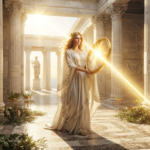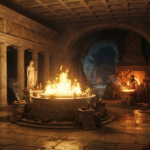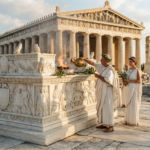
The Hekataeon was a small shrine, altar, or sacred niche dedicated to Hecate, the Greek goddess associated with crossroads, thresholds, the moon, ghosts, and protective magic. The term does not point to one single standardized temple in the ancient world, but to a devotional space built for her image or presence, often at the edge of a house, on a road, or near a gate. In Greek religion, such places mattered deeply because Hecate was not a distant cosmic deity alone; she was also a guardian of boundaries, and boundaries were where danger and divine power were thought to meet.
The word is tied to the cult of Hecate as it developed in both public and domestic settings. Ancient authors and later archaeological interpretation suggest that a Hekataeon could be a formal shrine with statues and offerings, or something much humbler: a niche with lamps, food, and keys placed for the goddess. Because Hecate’s worship was often local and practical rather than centralized, the Hekataeon reveals how Greek religion moved between myth and daily life, between great sanctuaries and the private spaces of households.
Hekataeon: Hecate’s Sacred Shrine and Niche
A Hekataeon was a sacred place dedicated to Hecate, usually understood as a shrine, niche, or altar rather than a grand temple. The term appears in later Greek usage for a cult space marked out for the goddess, often holding her image or symbols. Unlike the large sanctuary complexes built for Olympian gods, a Hekataeon could be modest in scale, fitted into a wall, positioned beside a doorway, or established at a crossing where human movement and divine protection were intertwined.
This smaller form suited Hecate’s character in Greek religion. She was invoked where people felt exposed: at entrances, at the edge of towns, and at liminal places where order gave way to uncertainty. The shrine therefore did not merely honor a goddess in the abstract. It created a protected threshold, a place where offerings could be made to keep harmful forces away and to invite Hecate’s watchful presence.
Hecate in Greek Religion and Household Ritual
Hecate appears in early Greek literature as a powerful and honored deity, especially in Hesiod’s Theogony, where Zeus grants her broad powers over earth, sea, and sky. In that older tradition she is not yet confined to witches, night rites, or the underworld. She is a beneficent force who can give success, nourishment, and victory, which helps explain why later household devotion to her could be both protective and practical.
In domestic cult, Hecate stood apart from the major gods of the hearth while still belonging to the rhythms of home life. Offerings were made to her at doorways and at the end of the lunar month in some traditions, especially during the Deipnon, a meal or set of offerings connected with cleansing and appeasement. The Hekataeon was thus not only a place of fear-based ritual; it was also part of ordinary piety, a way of acknowledging the goddess who watched the border between the secure interior and the dangerous outside.
Triple-formed Goddess at Crossroads and Gates
Hecate is famously associated with a triple form in later Greek and Roman art, often represented with three bodies or three faces. This imagery is most closely tied to her role at intersections and boundary points, where a person can look in more than one direction at once. The triple image is not the only ancient representation of her, but it became one of the most enduring because it expressed her reach over multiple paths and possibilities.
At crossroads and gates, Hecate was understood as a guardian and a presence of decision. A road junction was not just a meeting of routes; it was also a symbolic place of uncertainty, where travelers could be lost, met by spirits, or protected by divine attention. The Hekataeon, especially when placed at such liminal points, embodied that idea in built form. It made the goddess visible where passage itself was most vulnerable.
Offerings, Lamps, and Keys in Her Cult
Ancient devotion to Hecate often involved simple offerings rather than elaborate sacrifice. Food, honey, eggs, garlic, fish, and small cakes are frequently associated with her cult in later sources and commentary. These gifts were placed at shrines, crossroads, and household thresholds, especially in connection with the monthly appeasement known as the Deipnon. The offering signaled respect, but it also functioned as a protective measure, marking the boundary with sacred attention.
Lamps and keys were especially meaningful in Hecate’s cult. Lamps recall her connection with night, guidance, and visible presence in darkness, while keys symbolize control over gates, passage, and hidden spaces. In a Hekataeon, such objects could serve as devotional markers or votive gifts. Together they express a goddess who opens and closes, reveals and conceals, protects and permits movement through danger.
Ancient Sources for the Hekataeon’s Meaning
The exact term Hekataeon is not heavily attested in the earliest surviving Greek literature, so much of its meaning is reconstructed from cult practice, inscriptions, later lexicographic references, and the broader literary tradition around Hecate. Classical writers do, however, give strong evidence for her special relationship with thresholds, roads, purification, and household offerings. These themes provide the context in which a shrine to her would have been understood.
Later sources, including scholiasts and compilers, help clarify the cultic use of the goddess’s name for a shrine or sacred place. Pausanias, for example, preserves valuable testimony about local sanctuaries and images throughout Greece, showing how gods could have highly regional expressions of worship. The Hekataeon belongs to that wider pattern: a sacred installation whose meaning comes not from one single canonical description, but from the accumulated evidence of Greek religious life.
The Hekataeon in Athenian and Local Practice
Athens was especially important for Hecate’s cult, and local practice there shaped the goddess’s later reputation. At the end of the month, households could leave food for Hecate at crossroads or near doorways, a custom associated with the Hecate’s Deipnon. While the exact form varied, the principle was consistent: the goddess received offerings at the boundary between old and new, clean and unclean, safe and exposed.
Local shrines and small cult spaces could therefore function as Hekataeons even without being famous public monuments. In some communities, a niche or altar near a home, street corner, or sanctuary entrance would be enough to establish Hecate’s presence. Greek religion was deeply local in this way. What mattered was not only the deity’s mythic status, but the precise place where ritual could answer a concrete human need.
Rites of Protection Against Spirits and Illness
Hecate was often called upon for protection against spirits, pollution, and illness. Ancient Greek thought did not sharply separate physical health from spiritual safety, so a harmful presence, a curse, or a disease could all be approached through ritual cleansing and divine aid. The Hekataeon served as a point where these anxieties could be directed into recognized forms of worship.
Protection rites associated with Hecate often involved leaving offerings at night, using purifying substances, or observing careful ritual boundaries. She could be invoked to keep wandering dead, hostile powers, and unseen dangers away from the home. This is one reason her cult endured: the shrine answered a universal human concern, the need to safeguard life where the world felt porous and uncertain.
Hecate’s Role in Magic, Purification, and Limen
Hecate is strongly connected with magic in the Greek and Greco-Roman world, especially in later literary and magical texts. She appears in spells, curse tablets, and ritual formulas as a deity of night, crossroads, and hidden knowledge. This later magical prominence should not be read as replacing her earlier cultic role; rather, it extends her identity as a goddess of thresholds, where ordinary and extraordinary powers overlap.
She was also linked to purification and the Greek idea of the limen, the threshold or boundary. The threshold is a place of transition, and Hecate governs transitions of many kinds: from inside to outside, from impure to purified, from night to dawn, from one month to the next. The Hekataeon materializes that liminal power. It is the shrine of a goddess whose realm is not a stable center, but the moving edge where human order must be renewed.
Archaeology and Evidence for Domestic Altars
Archaeological evidence for Hecate’s cult includes figurines, inscriptions, small altars, and domestic installations that may have served as private shrines. Because household religion often used perishable materials and modest structures, much of what once existed has not survived. Even so, finds from Greek and later Hellenistic contexts show that small sacred spaces were common and that private devotion could be physically marked in stone, pottery, and wall niches.
These remains help explain the Hekataeon as a domestic or local altar rather than a standardized temple type. A household might maintain a tiny sacred corner; a neighborhood could install a boundary shrine; a sanctuary could include a niche for Hecate beside a broader cult area. Archaeology therefore supports a flexible picture of worship, one in which the shrine’s size mattered less than its placement and ritual use.
Why the Hekataeon Endured in Greek Devotion
The Hekataeon endured because it answered a lasting religious need: the desire to make fragile places safe. In Greek life, homes, roads, and crossings were all vulnerable points, and Hecate was the goddess most suited to them. Her shrine gathered together protection, purification, guidance, and reverence for the unseen powers that move along the margins of ordinary life.
Her cult also lasted because it could adapt. Hecate could be honored in a grander sacred landscape or in the smallest domestic niche, and the Hekataeon could reflect either setting. That flexibility gave the goddess a remarkable resilience in Greek devotion. She remained present wherever people understood that thresholds matter, and that the boundary between danger and safety is often where divine power is most needed.
The Hekataeon, then, is best understood as a shrine of presence rather than spectacle. It marks a place where Hecate stood watch over gates, roads, homes, and the uncertain spaces between them. Through lamps, offerings, keys, and small ritual acts, ancient worshippers gave shape to a goddess who belonged to the edge of things and made that edge safe enough to cross.

Orin Vale has spent the better part of two decades tracing the threads that connect the world’s oldest stories — from the halls of Asgard to the banks of the Nile, from Olympus to the jungles of the Maya. What began as a childhood fascination with flood myths and trickster gods grew into years of independent study across comparative mythology and ancient religion, always chasing the same question: what did these stories mean to the people who first told them? Orin writes for readers who want more than trivia — the ones looking for the beliefs, fears, and truths that myths were built to carry.