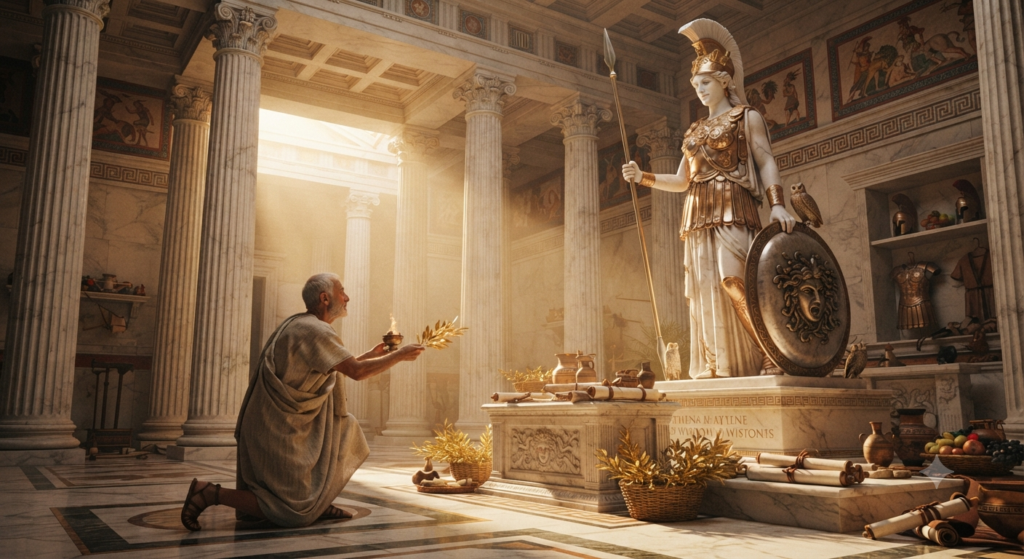
In Greek mythology, Athena is rarely a goddess of blind fortune. Her favor is earned through excellence of mind and hand, and it often appears where judgment, discipline, and craft matter more than impulse. When people ask what “trading favor with Athena” means in myth, the phrase is best understood as seeking or securing her approval in exchange for wisdom, piety, or demonstrated skill, rather than bargaining with her as one might with a merchant. The goddess of wisdom, strategy, and practical intelligence grants aid to those who respect order, ingenuity, and restraint, while remaining severe toward arrogance and folly.
Athena’s favor and the meaning of divine patronage
In Greek religion and myth, divine favor is not a sentimental blessing but a real form of patronage. A god may protect a city, support a hero, sharpen a craft, or frustrate a rival. Athena’s patronage is especially tied to civilization itself: walls, laws, weaving, military strategy, and the kinds of work that require thought before action. Her favor signals alignment with her values, and in epic and cult alike that alignment brings tangible success.
This is why the idea of “trading” favor with Athena can be misleading if taken too literally. The myths do not usually present her as someone who exchanges gifts on equal terms, but as a deity who responds to devotion, intelligence, and proper conduct. Mortals may offer sacrifice, build temples, or dedicate their finest work, yet the larger exchange is symbolic: humans honor Athena, and Athena grants guidance, protection, or victory in return.
How Greek myth defines a goddess’s favor
Greek myth often treats divine favor as a force that can raise a person, family, or city above ordinary limits. A god’s goodwill may appear as success in battle, survival in danger, beauty in craftsmanship, or wisdom in counsel. This favor is never fully separate from ritual, since the Greeks expected prayers, offerings, and reverence to accompany any request made of the immortals.
Athena’s goodwill is distinctive because it is linked to discernment. She does not simply reward strength; she rewards the disciplined use of strength. In Homer and later tradition, she aids those who can think clearly under pressure, whether on the battlefield, at the loom, or in civic debate. Her favor therefore means more than blessing in a general sense. It means being brought under the protection of a goddess who values intelligence joined to action.
Wisdom, skill, and victory under Athena’s care
Athena’s domain joins wisdom to practical success. She is not an abstract philosopher’s figure, though later writers emphasized that side of her; in the older poems she is the goddess who helps men and women do difficult things well. She can inspire tactical cunning, steady a warrior’s hand, and guide the planner who sees what others miss. Victory under her care is usually victory shaped by thought rather than rage.
This is why heroes associated with Athena often succeed by patience, disguise, or strategy. Odysseus is the clearest example, but he is not the only one. Craftspeople and cities also profit from her guidance because she represents skill ordered by intelligence. To be under Athena’s care is to be protected by a divine intelligence that favors precision, self-command, and usefulness over reckless display.
What mortals gain when Athena grants approval
When Athena approves of a mortal, the gain is not always material wealth, though success may follow. More often, the person receives clarity, confidence, or the means to perform an honored task. In mythic terms, her favor can turn a difficult undertaking into a successful one by bringing foresight to the moment of decision. She helps mortals act at the right time and in the right way.
At the civic level, her approval can mean the prosperity of a city, the stability of institutions, or the flourishing of arts that serve public life. At the personal level, it may mean excellence in weaving, horse training, warfare, or counsel. The mythic pattern suggests that Athena’s approval elevates competence into something almost sacred. What mortals gain from her is not mere luck, but the dignity of well-governed action.
Odysseus, heroes, and the pattern of her aid
Odysseus is the most familiar mortal favored by Athena in the Homeric poems. In the Iliad and the Odyssey, she repeatedly intervenes on his behalf, strengthening his judgment, concealing his appearance, or steering events toward his eventual return. His defining trait is not brute force but mētis, the cunning intelligence that Athena especially prizes. Their relationship shows how her favor works in heroic myth: she aids those who can match wit with endurance.
Other heroes also benefit from Athena’s support, though often in more limited or situational ways. Perseus receives divine assistance in the slaying of Medusa in later mythic tradition, and Heracles is sometimes linked to her counsel in difficult labors or in the creation of his equipment. These stories vary by source, but the pattern remains consistent. Athena’s aid is seldom random. It tends to appear when a hero’s success depends on careful judgment, protected movement, or a well-timed act.
Weaving, strategy, and the arts of practical wisdom
Athena’s sphere includes weaving because weaving is not merely domestic labor in Greek thought. It is a technical art that requires planning, sequence, and the capacity to hold an image in mind while working with the hands. The Odyssey makes this connection vivid through Penelope, whose weaving becomes an instrument of delay and intelligence. In that setting, weaving is a form of practical wisdom, not a passive household task.
The same logic extends to strategy in war and governance. Athena presides over arrangements, formations, and long-range thinking. Her arts are therefore both peaceful and martial, because both require order. Whether at the loom or on the battlefield, she favors those who can see patterns, impose structure, and resist haste. This is one reason her cult appealed so strongly to cities that valued discipline, craft, and civic self-control.
Sacred gifts and the signs of Athena’s goodwill
Greek worship often sought to make visible the bond between a deity and a city or individual. Athena’s favor could be honored through offerings of woven textiles, sacrifices, dedications of armor, or the construction of sanctuaries. The Panathenaia at Athens was the grandest expression of this relationship, especially through the offering of the peplos, the richly woven robe presented to the goddess. Such gifts were not bribes; they were acts of reverence that acknowledged her supremacy in her domains.
Signs of her goodwill in myth usually come through guidance rather than spectacle. She may appear in disguise, speak through a dream, strengthen resolve, or alter the outcome of a contest by favoring the better-prepared side. In narrative terms, her presence is often felt as a sudden opening of possibility. Where others see only danger, Athena reveals a path shaped by wisdom and discipline.
When Athena withholds favor in Greek tradition
Athena can be generous, but she is also exacting. Her myths repeatedly show that arrogance, disrespect, and reckless competition invite her displeasure. The story of Arachne is central here: the gifted weaver’s skill is real, but her pride and refusal to honor the goddess lead to ruin. Different ancient sources handle the transformation differently, especially in later Roman retellings, yet the moral pattern is stable. Talent without humility does not secure Athena’s goodwill.
Her withdrawal or opposition often marks the failure of a mortal to understand the limits of human excellence. A warrior who trusts only force, a craftsman who boasts beyond measure, or a city that neglects proper worship may lose her support. In myth, this is not cruelty for its own sake. It reflects a divine order in which skill must remain aligned with measure, reverence, and sound judgment. Athena’s favor is precious partly because it can be withheld.
Athens, patronage, and the goddess’s civic power
Athens itself took its identity from Athena’s patronage, and the city’s myths present her as the decisive divine protector of the polis. In the contest with Poseidon, she offers the olive tree and wins the city’s guardianship according to the familiar Attic tradition. The story captures her civic character: she gives what sustains life, trade, agriculture, and peace, not only spectacular power. Her relationship with the city became foundational to Athenian self-understanding.
This civic role makes Athena unusual among Greek deities. She is not only a guardian of individuals but also of institutions, laws, and collective identity. Temples, festivals, and public art all reinforced the sense that the city prospered by remaining under her oversight. Her favor, then, meant political stability as much as personal success. To live well in Athena’s city was to live in a culture shaped by ordered intelligence.
Interpreting trading favor with Athena in myth
In mythology, “trading favor with Athena” is best read as a shorthand for gaining her approval through worthy conduct, offerings, or devotion. Greek sources do not frame this as a literal marketplace exchange, but as a relationship of reciprocity between mortals and a goddess who governs wisdom, craft, and strategic victory. Humans bring honor, discipline, and excellence; Athena responds with protection, insight, and success.
The deeper meaning is that Athena’s favor cannot be separated from character. She helps those who think before they act, who master a skill, and who respect divine order. Her myths insist that wisdom is not ornamental. It is a power that shapes survival, cities, and heroic destiny. To seek Athena’s favor is to seek the blessing of clear sight, measured action, and intelligent strength.
Athena’s favor in Greek mythology is never simple indulgence. It is a form of divine recognition granted to those who embody the values she rules: wisdom, skill, restraint, and purposeful action. Whether in the home, the workshop, the council, or the battlefield, her presence marks the place where intelligence becomes power.

Orin Vale has spent the better part of two decades tracing the threads that connect the world’s oldest stories — from the halls of Asgard to the banks of the Nile, from Olympus to the jungles of the Maya. What began as a childhood fascination with flood myths and trickster gods grew into years of independent study across comparative mythology and ancient religion, always chasing the same question: what did these stories mean to the people who first told them? Orin writes for readers who want more than trivia — the ones looking for the beliefs, fears, and truths that myths were built to carry.