In ancient Greece, certain trees were not merely useful parts of the landscape but living presences tied to gods, heroes, and sacred places. Their holiness could arise from myth, from long ritual use, or from the way a grove marked off a divine space from the ordinary world. Among the most revered were the olive, laurel, oak, cypress, myrtle, poplar, fig, pine, and fir, each associated with particular deities and rites in the surviving literary and archaeological record.
Sacred trees in Greek religion and myth
Greek religion did not treat all trees equally. A tree might become sacred because a god had chosen it, because a shrine had grown around it, or because people believed divine power lived within a grove. Homer, Hesiod, Pausanias, and later authors preserve many such associations, though the evidence is uneven and sometimes local rather than pan-Hellenic. In practice, the sacredness of a tree often depended on place: one grove could be central to a city’s identity, while another belonged to a single sanctuary or cult.
This is why the question of which trees were sacred in ancient Greece does not have a single simple answer. Different gods favored different species, and the same tree could carry very different meanings in different regions. The olive belonged to Athena, the laurel to Apollo, the oak to Zeus, and so on, but these links were not always exclusive. Greek religion was deeply local, and sacred trees were part of a broader sacred landscape that included springs, stones, altars, and enclosed groves.
The olive tree of Athena at Athens
The olive tree was perhaps the most famous sacred tree in Greek tradition because of its connection with Athena and Athens. According to the well-known myth preserved by later writers, Athena and Poseidon contended for patronage of Attica, and Athena won by giving the olive tree, while Poseidon produced salt water or a sea horse depending on the version. The olive on the Acropolis, associated with this gift, became a symbol of the city’s identity, prosperity, and divine favor.
The olive also had practical and ritual importance. It was a tree of peace, nourishment, and oil, and in Athens its branches and oil were used in civic and athletic contexts, including the Panathenaic festival. Sacred olives, especially the cultivated olives believed to descend from Athena’s original gift, were treated with special care. Pausanias and other sources indicate that the Athenians regarded certain olive trees as ancient and inviolable, linking agricultural life directly to the goddess’s protection.
Laurel and Apollo’s prophetic evergreen
Laurel, or bay tree, was sacred to Apollo more strongly than perhaps any other tree was sacred to a single god. The central myth is the story of Daphne, who was transformed into a laurel tree to escape Apollo’s pursuit in Ovid’s Metamorphoses, though older Greek traditions already associated Apollo with the laurel. After this, the god adopted the laurel as his own plant, and laurel wreaths became a sign of his presence, victory, and inspiration.
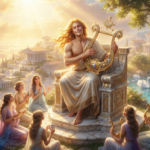
At Delphi, laurel had a particularly important ritual role. Apollo’s priestess and officials used it in ceremonies linked with prophecy, and the sacred tree appears repeatedly in the cult language of the sanctuary. Greek victors, poets, and seers could all be crowned with laurel, a visible mark of Apollo’s protection. The plant’s evergreen character suited its association with enduring divine power, and its crisp leaves and fragrant branches made it one of the most recognizable sacred plants in the Greek world.
Oak groves and Zeus’s thunder cult
The oak was sacred to Zeus, especially in his ancient oracular and weather-bearing aspects. In Greek thought, the oak stood high and commanding, its height and hard wood matching the power of the sky god. One of the oldest and most famous cult associations is the oracle of Zeus at Dodona, where the sacred oak was central to divination. Homer already refers to Dodona and its sacred oak, showing that this association was deeply rooted in early Greek tradition.
At Dodona, the rustling of the oak leaves was interpreted as a sign from Zeus, and the tree itself functioned as a divine medium. Elsewhere, oak groves could also mark Zeus’s presence, particularly in mountain or highland sanctuaries where thunder, rain, and judgment were emphasized. The oak was not simply a symbol; in some cult settings it was a living oracle, a tree through which the god’s voice could be heard.
The cypress in funerary Greek ritual
The cypress became closely associated with mourning and death in Greek culture. Its dark evergreen foliage and tall, slender form made it a natural emblem of graves, funerary processions, and the world of the dead. Although it was not tied to one major Olympian deity in the same way as the olive or laurel, it held a strong ritual place in the symbolic language of death.
Greek sources and later practice show the cypress being used in funerary contexts and planted near tombs or sanctuaries connected with the dead. Its association with mourning was durable enough to continue into later Mediterranean tradition. In Greek religious thought, evergreens often bridged the boundary between life and death, and the cypress, standing dark and resilient through the seasons, became one of the clearest such trees.
Myrtles of Aphrodite and bridal rites
Myrtle belonged especially to Aphrodite, the goddess of love, beauty, and sexual union. Ancient authors connect the plant with her cult and with the fragrance and softness that suited her sphere. In ritual and poetic tradition, myrtle could accompany images of the goddess, and wreaths of myrtle were worn in settings linked to marriage, beauty, and erotic celebration. Its dense leaves and aromatic quality made it fitting for a deity whose power was expressed through attraction and desire.
Myrtle also entered Greek bridal customs. Brides and wedding participants could be crowned or decorated with myrtle, reflecting the plant’s association with Aphrodite and with legitimate union. Unlike the more severe trees of prophecy or death, myrtle belonged to the social and bodily world of marriage, where divine favor was sought for fertility and harmony. It was sacred not because it was distant, but because it was intimate and protective in the rites of passage that shaped household life.
Poplar trees in Hades and mourning
The poplar carried strong chthonic associations in Greek myth, especially in relation to Hades and Persephone. One famous tradition explains that the white poplar acquired its two-toned leaves after Heracles brought the dog Cerberus up from the underworld; the sweat of the monster blackened the underside, according to one later explanation. Other traditions associate poplars with mourning and with the edges of the underworld because of their pale leaves and visible trembling in the wind.
The tree also appears in mythic and poetic settings connected with grief. In some Greek and later sources, poplars are linked to the daughters of Helios or to transformations prompted by sorrow, though the exact narratives vary. What remains consistent is the tree’s bond with lamentation and the underworld. In Greek sacred geography, the poplar helped mark the boundary between the living world and the realm of the dead.
The fig tree in Dionysian and local lore
The fig tree held a special place in Greek local religion and in the mythic orbit of Dionysus. Figs were important food plants, but they were also bound to fertility, abundance, and the rough vitality associated with Dionysian cult. In some traditions, fig wood and fig branches appear in ritual settings connected with rustic celebrations and local fertility customs. The tree’s fruitfulness made it a natural emblem of generative power.
Athens had its own strong fig traditions, and various Greek communities preserved local sacred figs or stories about their origin. Some myths tied the fig to culture-bringing or to the beneficence of heroes and gods. Although it does not enjoy the universal cult prominence of the olive or laurel, the fig tree was clearly meaningful in Greek sacred life, especially where Dionysian energy, agricultural fertility, and local identity overlapped.
Pine and fir in sacred mountain cults
Pine and fir were important in mountain and wilderness cults, especially those linked with Dionysus and with gods of untamed nature. Pine in particular was associated with Dionysian ritual implements and processions, including the thyrsus, which was often crowned with ivy but could also involve pine or pine-cone imagery in broader cult symbolism. The tree’s resin, height, and association with wild slopes made it suitable for the god of ecstatic transformation.
Fir, too, could be important in highland settings and in the material culture of sanctuaries built among mountains. While less famous than olive or laurel, it contributed to the sacred character of remote places where worship took place away from the polis. In Greek religion, mountain trees often signaled a threshold between cultivated life and the domain of gods who were powerful, unpredictable, and close to the wild.
Tree worship in sanctuaries and groves
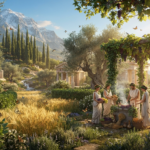
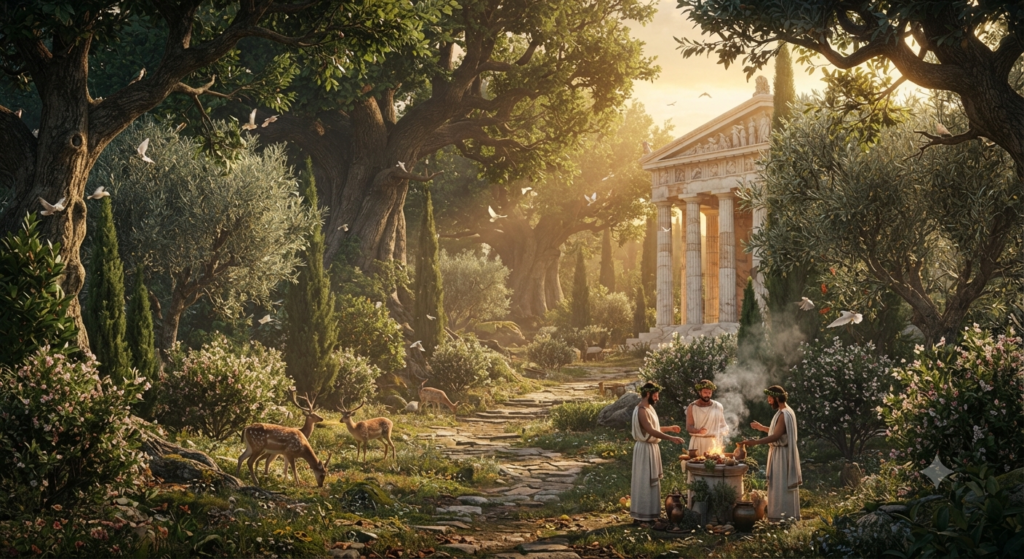
Greek sacred trees were often protected not as isolated specimens but as part of a grove or sanctuary precinct. Pausanias describes many such places, and the custom was widespread enough that groves could be under divine ownership in both myth and law. Cutting a sacred tree could be considered impious, and certain trees were linked to temple foundations, ancient cult images, or oracular practices. The sanctity lay not only in the species but in the relationship between tree, god, and place.
This is the broader context in which the olive, laurel, oak, cypress, myrtle, poplar, fig, pine, and fir should be understood. Ancient Greece did not have a single botanical canon of holiness. Instead, it recognized a sacred ecology in which trees participated in divine presence, memory, and ritual action. Some stood in cities, some on mountains, some beside tombs, and some in prophetic groves, but all could become more than trees when myth and worship met.
So, which trees were sacred in ancient Greece? The answer is a varied sacred forest rather than one fixed list: olive for Athena, laurel for Apollo, oak for Zeus, cypress for mourning, myrtle for Aphrodite, poplar for the underworld, fig for fertility and local cult, and pine and fir for mountain and Dionysian worship. In Greek religion, a tree was sacred because it carried memory, divine power, and ritual use, turning the natural world into a living part of myth.

Orin Vale has spent the better part of two decades tracing the threads that connect the world’s oldest stories — from the halls of Asgard to the banks of the Nile, from Olympus to the jungles of the Maya. What began as a childhood fascination with flood myths and trickster gods grew into years of independent study across comparative mythology and ancient religion, always chasing the same question: what did these stories mean to the people who first told them? Orin writes for readers who want more than trivia — the ones looking for the beliefs, fears, and truths that myths were built to carry.