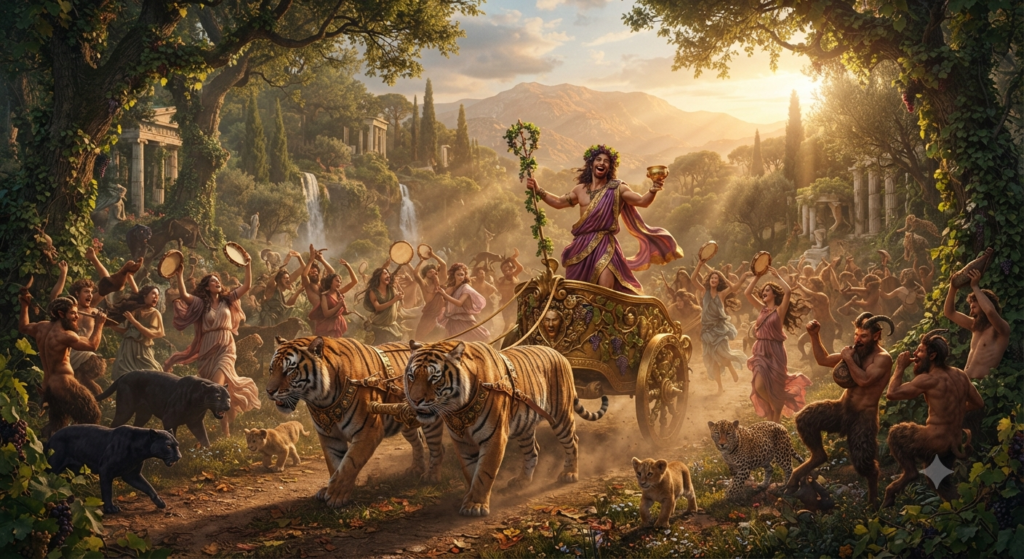
Tigers are not a major feature of Greek mythology in the way that lions, wolves, or snakes are. The Greek world imagined the tiger as a distant and exotic creature, associated more with the far reaches of Asia than with the landscapes of Hellas. Yet tigers do appear at the edges of Greek myth, especially in stories linked to Dionysus, eastern lands, and the wider encounter between Greece and the cultures beyond the Aegean. Their presence is rare, but meaningful, revealing how the Greeks pictured the foreign and the wondrous.
Tigers in Greek Myth: A Rare Animal
In the surviving myths of ancient Greece, tigers are far less prominent than lions, boars, or bulls. Greek poets and artists were far more familiar with animals native to the Mediterranean world, so the tiger usually appears as an imported idea rather than a central mythic creature. When it does appear, it often belongs to the imagined East, a region of wonder, danger, and abundance.
This rarity matters. Greek mythology is not a catalogue of every animal known to the ancient world, but a tradition shaped by local ecology, travel, trade, and literary inheritance. Tigers were not part of the ordinary symbolic vocabulary of early Greek myth, and they never gained the deep ritual or heroic associations that lions did. Their role is therefore marginal, but not insignificant.
Did Ancient Greece Know the Tiger?
The Greeks did know of tigers, though not in the same direct way they knew lions or dogs. Knowledge of tigers likely came through contact with Persia, India, and the eastern parts of the known world, especially as Greek horizons expanded through war, commerce, and later Alexander the Great’s campaigns. The animal entered Greek consciousness as something real, but remote.
Classical authors sometimes used the Greek word tigris, borrowed from eastern languages through Persian intermediaries. This tells us that the tiger was recognized as a distinct species, not merely as a kind of lion or leopard. Still, recognition did not equal familiarity. For most Greeks, the tiger remained a creature of report, travel writing, and symbolic distance rather than direct observation.
Tigers in Homer, Hesiod, and Early Epics
Homer and Hesiod do not give tigers a significant place in their mythic worlds. In the Iliad and Odyssey, the animal imagery centers on creatures known to Greek experience: lions, wolves, eagles, boars, and serpents. These animals provide the emotional and symbolic language of heroism, danger, and divine power, while tigers are absent from the core epic imagination.
That absence is revealing. Early Greek epic grew from a world before sustained contact with the far eastern regions where tigers were native. As a result, the tiger did not become part of the foundational mythic vocabulary preserved in Homeric poetry. When later Greek writers mention tigers, they are working in a different historical and cultural moment, one shaped by wider geography and imperial reach.
Dionysus, India, and Exotic Beasts
The strongest mythic association between Greek tradition and tigers belongs to Dionysus. In later Greek literature, especially in accounts of his eastern journey to India, Dionysus is imagined as traveling through lands populated by strange and splendid animals. Tigers appear in that eastern scenery as part of the god’s exotic retinue and the extraordinary world he brings under his influence.
This connection is not central in the earliest surviving Greek sources, but it grows in later mythic elaboration. Dionysus is a god of transformation, boundary-crossing, and the softening of civilization’s limits. Tigers suit that atmosphere well: fierce, untamed, and rooted in the far East, they become part of the god’s mythic geography. Their presence signals not a native Greek tradition, but a Greek imagination stretching outward.
Mythic Cats: Lions, Panthers, and Tigers
In Greek myth, the lion is the great feline emblem. Heracles’ Nemean lion, the lion-bodied sphinx, and countless heraldic and artistic lions dominate the symbolic landscape. Panthers and leopards also appear, especially in Dionysian contexts, where they are linked to the god’s ecstatic and untamed force. Tigers, by contrast, remain secondary and comparatively rare.
This hierarchy of animals reflects both geography and symbolism. Lions were known, feared, and deeply embedded in ancient art and legend, while panthers and leopards offered a more flexible image of wildness. Tigers, because they were so distant, often served as an intensified version of eastern ferocity rather than as independent mythic figures. In Greek thought, they belonged to the same family of dangerous magnificence, but not to the same level of prominence.
Greek Vase Art and the Image of Tigers
Greek vase painting and other visual arts sometimes include striped felines that modern viewers may identify as tigers, though interpretation can be uncertain. Some images likely portray exotic animals based on hearsay or artistic convention rather than strict zoological accuracy. Ancient artists were often interested in evoking foreignness more than in producing naturalistic species portraits.
Where a tiger-like figure does appear, it usually functions as a marker of the marvellous and the remote. Greek art was especially responsive to eastern influence during periods of trade and intercultural exchange, and exotic animals could symbolize wealth, distance, or divine mystery. Even when the artist did not distinguish carefully between tiger, leopard, and panther, the image still communicated something important about the Greek sense of the world beyond Greece.
Hellenistic Tales of Eastern Wildlife
The Hellenistic period brought Greeks into much closer contact with the eastern reaches of Asia, and that broader world expanded the literary presence of tigers. Writers interested in travel, ethnography, and marvels described strange animals from India and beyond, often blending observation with inherited myth. Tigers became more visible in these accounts because the world had become larger.
This was also the age when Greek culture increasingly absorbed and reorganized foreign material. Alexander’s campaigns and the kingdoms that followed opened pathways for stories, animals, and images to move westward. The tiger, once nearly absent from Greek myth, became part of a new geographical imagination, one in which the edges of the world were filled with powerful, unfamiliar life.
Trade Routes Bringing Tigers to Greece
Trade played a major role in introducing tigers to the Greek world, at least as ideas and occasional living curiosities. Persian imperial networks, later Hellenistic contacts, and long-distance exchange with India made it possible for Greek observers to hear of, and sometimes see, animals that had never belonged to their native environment. The tiger entered Greek consciousness through these routes of movement and exchange.
Even so, most Greeks would never encounter a tiger directly. The animal’s fame depended on reports, gifts, and the reputation of eastern courts. In this sense, the tiger was a creature of mediation. It was known through merchants, envoys, soldiers, and storytellers, and that indirect knowledge helped preserve its aura as something powerful and distant.
Tigers in Roman Adaptations of Greek Myth
Roman authors inherited Greek myth and often extended its geographical reach. Writers such as Ovid and others interested in the world of marvels, transformation, and imperial expansion could refer to tigers more freely than the earlier Greek poets did. In Roman literature, the tiger became more visible as a symbol of eastern splendor and fierce vitality.
This mattered for the afterlife of Greek mythology. Once Greek myths were retold in Roman contexts, the broader classical tradition became more open to exotic creatures that fit imperial horizons. Tigers did not become major mythic actors, but they entered the literary atmosphere more fully, especially in scenes connected to Dionysus, triumph, and the East. Roman adaptation helped make the tiger a recognizable classical animal, even if not a central Greek one.
Why Tigers Matter in Greek Mythology
Tigers matter in Greek mythology because they reveal what Greek myth was not. Their rarity shows the difference between the animals native to Greece’s symbolic world and the creatures imagined at its borders. Where lions embody heroic force and divine presence, tigers represent distance, foreign power, and the marvels of lands beyond the Aegean.
Their appearance also shows how Greek mythology evolved over time. As contact with Asia widened, so did the mythic imagination. Tigers slipped into Dionysian legend, travel narratives, and artistic representations, becoming part of the classical world’s image of the exotic East. They remain a minor presence, but one that helps explain how Greek myth absorbed new knowledge without losing its older shape.
Tigers are featured in Greek mythology only in a limited and indirect way. They do not belong to the earliest layers of Homeric or Hesiodic tradition, and they never rival the lion as a central mythic beast. Even so, they appear in later stories, especially those linked to Dionysus and eastern lands, where they serve as emblems of distance, power, and wonder. Their rarity is precisely what makes them significant: they mark the edge where Greek myth meets a larger world.

Orin Vale has spent the better part of two decades tracing the threads that connect the world’s oldest stories — from the halls of Asgard to the banks of the Nile, from Olympus to the jungles of the Maya. What began as a childhood fascination with flood myths and trickster gods grew into years of independent study across comparative mythology and ancient religion, always chasing the same question: what did these stories mean to the people who first told them? Orin writes for readers who want more than trivia — the ones looking for the beliefs, fears, and truths that myths were built to carry.