Soteria in Greek mythology means “deliverance,” “preservation,” or “safety.” In the ancient Greek world, the word could describe the act of rescue itself, the state of being saved from danger, and, in some contexts, a divine power associated with protection. It is important not to confuse this with modern religious ideas of salvation in a later doctrinal sense; in Greek usage, soteria belonged to a broader religious and civic vocabulary of being spared from harm, war, disease, or disaster. It was both an idea and, in some traditions, a goddess.
Soteria as the Greek idea of deliverance
In its most basic sense, soteria is a Greek noun meaning safety, preservation, or deliverance. Homeric and later Greek authors used related forms to describe rescue from mortal danger, especially in war or at sea. The word comes from the same root as soter, “savior” or “deliverer,” a title that could be applied to gods, rulers, and benefactors. In mythology and religion, therefore, soteria was not only a concept but also a way of naming divine help when human means failed.
Greek religious language often treated deliverance as something granted by the gods rather than achieved alone. A city saved from siege, a sailor brought through a storm, or a household preserved from plague might all be described in terms of soteria. This flexibility made the word especially powerful in public life, where communities looked to divine protection for survival in an uncertain world.
The goddess linked to safety and rescue
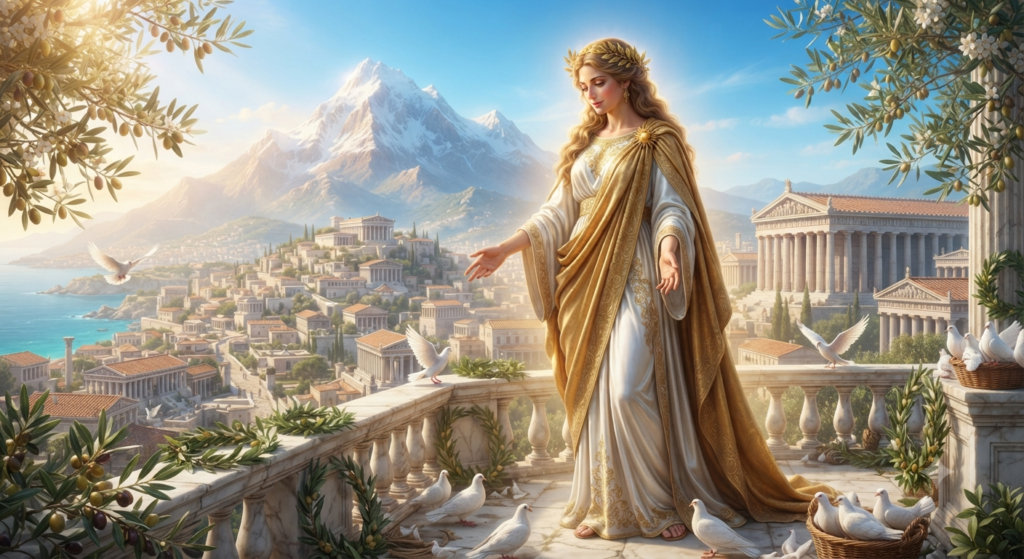
Alongside the abstract meaning, Soteria also appears as a goddess or divine personification of safety and deliverance. She is not among the great Olympians with a large mythic cycle of her own, but ancient worship and literary references show that she was recognized as a protective figure. In this form, Soteria embodied the relief that comes after danger has passed and the preservation that prevents ruin in the first place.
Her character is closely tied to related personifications such as Eirene (Peace) and Nike (Victory), yet Soteria is distinct. Where Nike marks triumph and Eirene marks the end of conflict, Soteria emphasizes rescue, survival, and safe outcome. This makes her especially meaningful in contexts of war, civic crisis, and gratitude after survival.
Soteria in cult practice and local worship
Soteria was worshiped in certain local cults, especially where communities sought divine protection from immediate danger. Greek religion was highly regional, and many divine figures existed in specific sanctuaries, city traditions, or festival calendars rather than as universal deities. Soteria belongs to this world of localized devotion, where a divine power could be honored because a city believed it had been saved.
Ancient evidence suggests that in some places Soteria received offerings and honors alongside other protective deities. Her cult does not seem to have been as widespread as that of Zeus, Apollo, Athena, or Artemis, but she was significant where deliverance mattered most. In these settings, worship was practical as well as religious: people thanked the goddess for safety already granted and asked for continued protection.
What ancient sources say about her origin
Ancient sources do not give Soteria a single, unified myth of birth or family. That is typical of personifications in Greek religion, which often emerged from cult and language rather than from a narrative genealogy. Some later authors and local traditions treated her as a divine presence in her own right, while others understood her more as an aspect of a greater god’s power.
Because of this, modern readers should be cautious about expecting a fixed “origin story” in the style of a major Olympian. Instead, Soteria appears through inscriptions, cult titles, and occasional literary references. Her origin lies less in epic storytelling than in the Greek habit of naming forces that affected human survival.
Soteria and the wider family of salvation
Soteria belongs to a wider Greek family of divine and semi-divine figures connected with rescue, well-being, and good fortune. The Greeks frequently personified abstract powers, especially those that touched public life. Alongside Soteria stand figures such as Asclepius, who heals, Tychē, who brings fortune, and Nike, who grants success. Each represents a different aspect of survival or favorable outcome.
This cluster of divine powers shows that Greek thought did not separate practical life from religious meaning. A person might seek healing from one god, victory from another, and deliverance from still another, depending on the nature of the threat. Soteria’s place in this family reveals how finely the Greeks distinguished between being spared, being healed, and being triumphant.
Sanctuaries, vows, and thank offerings to Soteria
In Greek religious practice, people often made vows before danger and thank offerings after it had passed. Soteria fits naturally into this pattern. A vow to a saving power was a promise made in hope of survival; a thank offering recognized that survival as a divine gift. Inscriptions and dedications from the Greek world show how closely religion, gratitude, and public memory were linked.
Sanctuaries associated with deliverance could contain dedications from individuals or communities who believed they had been preserved from harm. These offerings might include statues, altars, plaques, or other votive gifts. Even when Soteria was honored together with another deity, the ritual act carried a clear meaning: the danger had been real, and the rescue was remembered as sacred.
How cities invoked Soteria in crisis
Cities invoked Soteria most urgently during war, siege, political upheaval, or natural disaster. In the Greek world, the survival of a polis was never guaranteed, and public religion often responded to that insecurity. When a city escaped destruction, it was common to frame the event as a deliverance granted by the gods, and Soteria was a natural name for that blessing.
This civic dimension gave Soteria particular force. She was not only a private comfort but a public guarantee, a divine promise that the city itself could endure. In inscriptions and honors, the language of safety often appears after military victory or liberation from threat, showing that the Greeks understood deliverance as part of communal identity as much as personal relief.
Soteria’s ties to Zeus, Apollo, and other gods
Soteria could be connected with major gods who themselves had saving or protective functions. Zeus was invoked in many protective aspects, including as guardian of order and guest-friendship. Apollo could be a god of purification, healing, and defense against plague, while Athena protected cities and strategic wisdom. In some local traditions, Soteria appears in association with such gods rather than as an isolated figure.
These connections should not be taken to mean that Soteria was merely another name for Zeus or Apollo. Instead, she often worked as a focused expression of divine protection. Greek religion was comfortable with overlap: one god could save, yet the idea of saving itself could also be honored as its own sacred force. That layered approach allowed worshippers to address the exact form of help they needed.
Distinguishing the goddess from the abstract noun
It is essential to distinguish Soteria the goddess from soteria the noun. The noun simply means deliverance, safety, or salvation in a broad sense, and it appears frequently in Greek literature. The goddess is a personification or cult figure attached to that idea. Ancient writers were not always perfectly consistent in separating the two, because Greek religion often moved fluidly between concept and deity.
This fluidity is one reason Soteria can seem elusive to modern readers. She is not defined by a single mythic adventure, but by a semantic field of rescue and preservation. In Greek thought, that is not a weakness but a feature: divine reality was often experienced through effects before it was told as story.
The meaning of Soteria in Greek religious thought
Soteria reveals something central about Greek religious imagination. The Greeks did not only ask for power, victory, or wealth; they also asked to be spared. To be delivered from danger was a profound good, and one worthy of divine honor. Soteria names that moment when peril gives way to survival, and when survival itself becomes sacred.
Seen in this light, Soteria is less a minor goddess than a window into Greek values. She reflects the ancient recognition that life depends on forces beyond human control, and that gratitude is owed when disaster does not arrive or does not prevail. In mythology, cult, and language alike, Soteria stands for the deep human hope of being kept safe.

Orin Vale has spent the better part of two decades tracing the threads that connect the world’s oldest stories — from the halls of Asgard to the banks of the Nile, from Olympus to the jungles of the Maya. What began as a childhood fascination with flood myths and trickster gods grew into years of independent study across comparative mythology and ancient religion, always chasing the same question: what did these stories mean to the people who first told them? Orin writes for readers who want more than trivia — the ones looking for the beliefs, fears, and truths that myths were built to carry.