In Greek mythology, the words nymph and dryad are closely related, yet they do not mean the same thing. A nymph is a broad category of minor female nature spirits, associated with places such as springs, mountains, groves, and caves. A dryad is a more specific kind of nymph, one linked especially to trees and woodland life. Classical authors use these terms in ways that sometimes overlap, but the distinction is clear enough in the mythic tradition: all dryads are nymphs, but not all nymphs are dryads.
Defining a nymph in Greek mythology and cult
In Greek myth, nymphs are divine or semi-divine female beings tied to the natural world. They are not major Olympian gods, yet they appear often in epic, hymn, and local cult as living presences in streams, forests, mountains, and caves. Homer and Hesiod present them as long-lived spirits who inhabit the margins between mortality and divinity, shaping landscapes and receiving honor in certain places. Their identity is defined less by a single origin story than by their relationship to a locale.
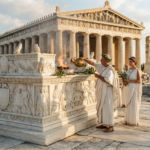
Cult practice also matters. Some nymphs were approached in sanctuaries, grottos, and water sources, where offerings could be made for fertility, health, or safe passage. Pausanias describes shrines and sacred places connected to nymphs across Greece, showing that they were not only literary figures but part of lived religious geography. In this sense, a nymph is both a mythological being and a sacred presence rooted in a particular landscape.
Dryads as tree nymphs of the woodland realm
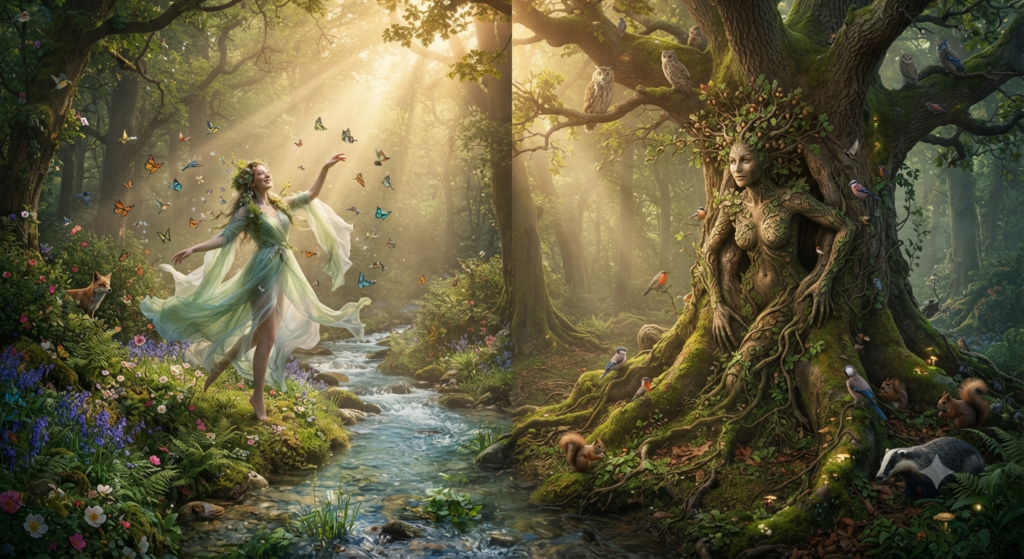
Dryads belong to the larger family of nymphs, but their defining feature is their connection to trees. In the broadest classical usage, a dryad is a tree spirit, especially one dwelling in woods and groves. The term is often associated with oak trees in later and literary tradition, though Greek sources do not always limit dryads strictly to oaks in the same neat way later writers sometimes do. Their world is the shaded interior of the forest, where bark, root, and leaf are imagined as alive with divine presence.
The dryad’s image is tied to the woodland as a living realm rather than to a single stream or hillside. She is a spirit of growth, shelter, and continuity, inseparable from the tree she inhabits. When a forest is sacred or ancient in myth, dryads help personify that sanctity. They belong to the deep logic of Greek nature religion, where a grove was never only wood and stone, but a place with intelligence and memory.
Nature spirits versus a specific class of dryad
The difference between a nymph and a dryad is therefore one of category and specialization. “Nymph” is the general term; “dryad” names one type within that larger class. Other nymphs might be linked to rivers, springs, mountains, caves, or meadows, while dryads are connected to trees. The relation is similar to a family name and a branch of that family: broad on one side, precise on the other.
This distinction helps explain why Greek texts can speak of nymphs in a wide variety of settings without meaning dryads specifically. A naiad is not the same as an oread, and neither is the same as a dryad, even though all are nymphs. The category allows Greek myth to populate every part of the natural world with distinct feminine presences, each fitted to its own environment. Dryads are simply the woodland branch of that larger spiritual order.
Sources on nymphs in Homer, Hesiod, and Ovid
Homer refers to nymphs frequently, especially in connection with caves, springs, and wild places. In the Iliad and Odyssey, they appear as divine inhabitants of the landscape, sometimes nursing heroes, sometimes gathering in sacred groves, sometimes associated with local waters or hills. Hesiod, too, gives them a place in the cosmological imagination, treating them as beings of the natural world with genealogies and a long duration of life. Their presence is scattered across the earliest layers of Greek literature.
Ovid, writing in Roman Latin but drawing deeply on Greek myth, offers many vivid scenes involving nymphs and transformation. In the Metamorphoses, nymphs are central to stories of pursuit, change, and the instability of form in the natural world. His work is especially important for later understandings of dryads, because he often dramatizes the bond between female spirit and tree, or between maiden and metamorphosed woodland life. Yet even in Ovid, the dryad remains a specific figure within the wider world of nymphs.
Tree-bound life: the dryad’s bond to an oak
A common later understanding of the dryad imagines her life as bound to a tree, especially an oak. This image is powerful because it expresses a shared fate: the spirit and the tree endure together. If the tree suffers, the dryad suffers; if the tree is felled, the dryad may perish or be diminished. Ancient sources and later mythographers vary in how literally they describe this bond, but the idea is deeply rooted in the tradition.
This tree-bound relationship distinguishes dryads from many other nymphs. A river nymph is tied to flowing water, but the river continues even as its banks change. The dryad, however, is imagined as inseparable from a living organism that can be wounded or cut down. The tree is not merely her home; it is her form of being. That makes the dryad one of the most intimate and vulnerable spirits in Greek mythology.
Naiads, oreads, and other nymph types in myth
Greek myth contains many kinds of nymphs, each linked to a natural setting. Naiads are water nymphs, associated with rivers, springs, fountains, and wells. Oreads belong to mountains and caves. There are also nymphs of meadows, groves, islands, and coastal places, reflecting the way ancient Greek religion mapped sacred presence onto the whole terrain of the world. These distinctions were flexible in poetry, but meaningful in cult and story.
Dryads fit into this system as the nymphs of trees and forests. Their place among the other nymph types shows how Greek mythology divided nature into living domains. Each spirit class expressed a different quality of the landscape: water’s motion, mountain solitude, woodland density, or cave secrecy. The dryad’s realm is the green and ancient one, where branches enclose light and the forest seems to breathe.
Immortality, aging, and the limits of each spirit
Nymphs are usually portrayed as long-lived, beautiful, and only partly mortal. They are not usually immortal in the full Olympian sense, yet they endure far longer than human beings. Their lifespans can be linked to the features they inhabit: a spring may last so long as the water flows, and a tree spirit may remain with the tree. Ancient authors do not always define their longevity in the same way, which leaves room for variation.
Dryads share this ambiguity. Some traditions suggest they can die when the tree they inhabit dies; others treat them as enduring spirits of the woodland more generally. This tension between permanence and fragility gives them their mythic force. They are ancient, but not beyond harm. Their existence reveals one of Greek myth’s recurring ideas: nature is divine, yet still vulnerable to change, violence, and decay.
Worship, local cults, and sacred landscape ties
Nymphs were often linked to local cult rather than formal pan-Hellenic worship. Small shrines, grottoes, springs, and groves could all become sacred because of their association with nymphs. Pausanias preserves many traces of these local traditions, where a particular site mattered more than a universal doctrine. The landscape itself was the sanctuary.
Dryads participate in this same sacred geography, especially in groves and wooded sanctuaries. A tree could be protected because it was believed to shelter a divine presence. Cutting such a tree was not merely practical damage but a violation of sacred order. This helps explain why nymphs and dryads are so important in understanding Greek religion: they show how holiness was distributed across the land, not confined to temples alone.
Metamorphosis stories linking maidens and trees
Greek and Roman myth often connects maidens, nymphs, and trees through transformation stories. Ovid is especially rich in such material, where pursuit, fear, desire, and divine intervention can end in changed form. In some tales, a woman becomes associated with a tree so closely that the boundary between person and plant dissolves. Daphne, for example, is transformed into a laurel tree, a story that later readers often place near dryad imagery even though she is not a dryad in the strict sense.
These metamorphoses are not the same as dryads, but they help explain the imaginative world around them. The ancient mind saw continuity between human life and vegetal life, between beauty and rootedness, between the body and the tree. Dryads belong to that same symbolic field. They are not women turned into trees, but spirits already native to trees, making the boundary between flesh and bark feel wonderfully thin.
So what is the difference between a nymph and a dryad?
The simplest answer is this: a nymph is the general term for a nature spirit in Greek mythology, while a dryad is a particular kind of nymph associated with trees, especially woodland trees. Nymphs may belong to water, mountains, caves, or meadows; dryads belong to forests and arboreal life. The relationship is one of inclusion, not opposition.
That distinction matters because it reflects how Greek myth organizes the living world. Nymphs are the wider sacred population of nature, and dryads are the tree-dwelling branch of that family. If a text mentions a nymph, it does not automatically mean a dryad. If it mentions a dryad, it is placing that spirit specifically among the trees. In Greek mythology, the forest has many voices, but the dryad is the one most closely joined to the tree itself.
Understanding the difference between a nymph and a dryad opens a deeper view of Greek mythology. The terms are related, but they do not stand at the same level: nymph is the broad category, dryad the woodland specialization. Together, they reveal how the Greeks imagined nature as inhabited, sacred, and alive with distinct forms of divine presence.

Orin Vale has spent the better part of two decades tracing the threads that connect the world’s oldest stories — from the halls of Asgard to the banks of the Nile, from Olympus to the jungles of the Maya. What began as a childhood fascination with flood myths and trickster gods grew into years of independent study across comparative mythology and ancient religion, always chasing the same question: what did these stories mean to the people who first told them? Orin writes for readers who want more than trivia — the ones looking for the beliefs, fears, and truths that myths were built to carry.