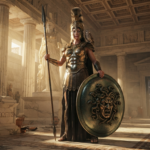
Aphrodite’s magical belt, usually called the cestus or kestos himas, is one of the most intriguing objects in Greek myth. It belongs to Aphrodite, the goddess of love, beauty, and desire, and in the surviving literary tradition it is not simply jewelry or clothing, but a woven instrument of enchantment. Ancient poets describe it as a girdle that can awaken longing, persuasion, and attraction in anyone who sees or is touched by its power.
The best-known account comes from Homer, where the belt becomes central to one of the most famous scenes in the Iliad. Later writers kept the image alive, and Roman poets especially turned it into a symbol of irresistible erotic force. The myth survives because it captures a very old idea: that beauty is not passive, but can act like power, shaping desire itself.
Aphrodite’s Cestus in Greek Myth and Lore
Aphrodite’s cestus is the goddess’s magical girdle, a woven band associated with seduction, charm, and persuasive allure. The word kestos in Greek suggests something embroidered or embroidered with decorative skill, which suits the mythic image of a beautifully crafted object carrying supernatural force. It is not a major standalone myth with a long cycle of adventures; rather, it appears as a potent attribute of Aphrodite, much like Zeus’s thunderbolt or Athena’s aegis.
In the mythic imagination, the belt belongs to Aphrodite because she governs the force that brings beings together through desire. Greek tradition often personified love as an overwhelming power, and the cestus became a perfect emblem for that idea. It is a visible sign of invisible influence: a goddess can fasten it on and, with it, stir longing in gods and mortals alike.
The Belt of Love in Homeric Tradition
The earliest and most authoritative account of the cestus appears in Homer’s Iliad. When Aphrodite seeks to aid Hera, the queen of the gods borrows the goddess’s enchanted belt, and Homer names it as the source of irresistible attraction. In this passage, the belt is not merely ornamental. It contains, or embodies, a cluster of powers connected with love, desire, seduction, and persuasive speech.
Homer’s language makes the object famous because it places erotic enchantment within a divine system of exchange and borrowing. Hera does not own the power; she receives it temporarily from Aphrodite. That detail matters. The myth shows that love and persuasion are forces that can be transferred, manipulated, and deployed, not just felt. The cestus becomes a literary device for explaining how desire can alter perception and behavior.
How the Cestus Sharpened Desire and Persuasion
Ancient readers understood the cestus as more than a charm for physical attraction. It sharpened persuasion itself, and in Greek thought persuasion often belonged close to desire. A person influenced by Aphrodite’s belt would be more likely to attract, convince, and overcome resistance. The belt thus stands at the border between beauty and rhetoric, between erotic pull and social influence.
This overlap is one reason the cestus has remained memorable. Greek myth often treated persuasion as a force with moral ambiguity: it can soften hostility, but it can also deceive. Aphrodite’s belt sits in that tension. It beautifies, enchants, and inclines the heart, yet it also implies that love may operate by subtle compulsion rather than free choice. The myth does not condemn this power; it simply recognizes it as real.
Hephaestus, Hera, and the Making of the Girdle
Classical sources do not give a single, fully detailed story of the cestus’s making. In some traditions, it seems simply to be one of Aphrodite’s divine possessions, as natural to her as her beauty. Later imagination sometimes connected such objects with craftsmanship, which would have made the belt feel even more wondrous: woven, adorned, and charged with power.
Hephaestus is relevant because he is Aphrodite’s husband in the divine genealogy of the Olympians, while Hera is the goddess who borrows the belt in Homer. Yet no canonical source says Hephaestus forged the cestus itself. That distinction is important. The belt’s mythic authority lies not in a known workshop origin, but in its association with Aphrodite’s own nature and with the dramatic episode in the Iliad where Hera uses it to win Zeus’s attention.
Aphrodite’s Magical Belt in the Iliad
The central scene occurs in Book 14 of the Iliad, when Hera prepares to seduce Zeus so that he will be distracted from the battlefield. She asks Aphrodite for the powers of desire, and Aphrodite lends her the embroidered belt. Homer describes it as containing affection, desire, intimate speech, and seductive charm, making it a concentrated emblem of erotic persuasion.
Hera then seeks the help of Sleep, who will aid her plan by easing Zeus into rest after the encounter. The belt is therefore part of a larger strategy, not an isolated talisman. In Homer’s hands, the cestus becomes a tool within the divine politics of war. Love here is not merely romantic; it is strategic, capable of redirecting the ruler of Olympus and changing the course of mortal battle.
What Ancient Sources Say About the Cestus
Homer is the main source, but later writers preserve and adapt the image. Apollodorus, in his Bibliotheca, recounts many divine and heroic traditions, though he does not develop the cestus into a separate mythic episode the way Homer does. The belt remained familiar enough that later poets and mythographers could refer to it without elaborate explanation. That familiarity suggests how firmly the image had entered the mythic vocabulary of antiquity.
Roman authors, especially Ovid, were drawn to Aphrodite’s belt as a symbol of erotic power and cosmetic enchantment. In Latin contexts, the Greek kestos often becomes associated with the irresistible arts of Venus, Aphrodite’s Roman counterpart. While details vary, the core meaning stays stable: this is a divine object that intensifies attraction and gives the goddess control over desire’s direction.
Love, Beauty, and Power in the Golden Girdle
The cestus is not just a romantic accessory. It expresses a deep Greek intuition that beauty can be powerful, even dangerous. Aphrodite is not portrayed as passive ornamentation; she is a goddess whose beauty has effects. The belt concentrates that principle into one object, as though love itself had been tied into a woven band and fastened around the body.
At the same time, the myth also hints at power relations. Hera borrows the belt because Aphrodite possesses a kind of influence even the queen of the gods needs. This is a striking idea in Greek myth. Aphrodite’s domain may appear softer than Zeus’s thunder or Ares’s violence, but the cestus shows that desire can be more effective than force. The belt’s power is subtle, yet it reaches even the highest god.
The Cestus and Later Roman Retellings
Roman poets inherited the Greek image and often expanded its sensual resonance. For them, Venus’s girdle could become a shorthand for the whole apparatus of love’s seduction, including beauty, speech, gaze, and bodily presence. Ovid in particular is comfortable with the language of erotic enchantment, and the belt fits neatly into his interest in transformation and desire.
In Roman retellings, the cestus sometimes loses the precise Homeric context and becomes more generalized as a symbol of Venus’s irresistible charm. This broader use helped preserve the object in literary memory. Even when the exact scene from the Iliad was not retold, readers could still recognize the belt as the goddess’s token of mastery over attraction.
Symbolism of Aphrodite’s Woven Enchantment
The cestus is symbolic because it unites weaving and enchantment. Weaving in Greek culture was closely linked to skill, order, and creation, so a woven belt carrying supernatural influence suggests that desire itself has form and pattern. Aphrodite’s power is not random; it is crafted, bound, and wearable. That image gives the myth a quiet elegance.
The belt also suggests that love is both external and internal. It is placed on the body, but its effects reach the mind and the emotions. In that sense, the cestus reflects a wider mythological truth: divine gifts in Greek myth often alter perception before they alter events. The belt does not force the world physically; it changes the atmosphere around the wearer, and that change is enough.
Why the Myth of the Belt Endured Through Time
Aphrodite’s magical belt endured because it captures a universal experience in mythic form. People across cultures recognize that beauty, charm, and persuasion can be transformative, and the cestus gives that recognition a divine image. It is memorable because it is concrete: a belt, a woven object, a simple thing with extraordinary effects.
The myth also survives because Homer made it vivid in a major epic, giving later ages a scene they could not forget. From Greek poetry to Roman retelling, the cestus remained a perfect emblem of Aphrodite’s realm. It reminds readers that in myth, love is never only emotion. It is force, artistry, and power, gathered into a golden girdle that can alter gods and mortals alike.
Aphrodite’s cestus endures as one of mythology’s most elegant symbols of enchantment. It is a small object in form, yet vast in meaning: a belt that gathers beauty, persuasion, and desire into a single divine emblem. Through Homer and the later classical tradition, it became a lasting image of love as an active, shaping power.
What makes the myth compelling is its restraint. The sources do not turn the cestus into a sprawling tale of origins and quests; they let it remain what it is in the epic imagination, a token of Aphrodite’s authority. That very simplicity helped it survive, because the belt speaks with clarity across centuries: desire, once woven, can change the course of the world.

Orin Vale has spent the better part of two decades tracing the threads that connect the world’s oldest stories — from the halls of Asgard to the banks of the Nile, from Olympus to the jungles of the Maya. What began as a childhood fascination with flood myths and trickster gods grew into years of independent study across comparative mythology and ancient religion, always chasing the same question: what did these stories mean to the people who first told them? Orin writes for readers who want more than trivia — the ones looking for the beliefs, fears, and truths that myths were built to carry.