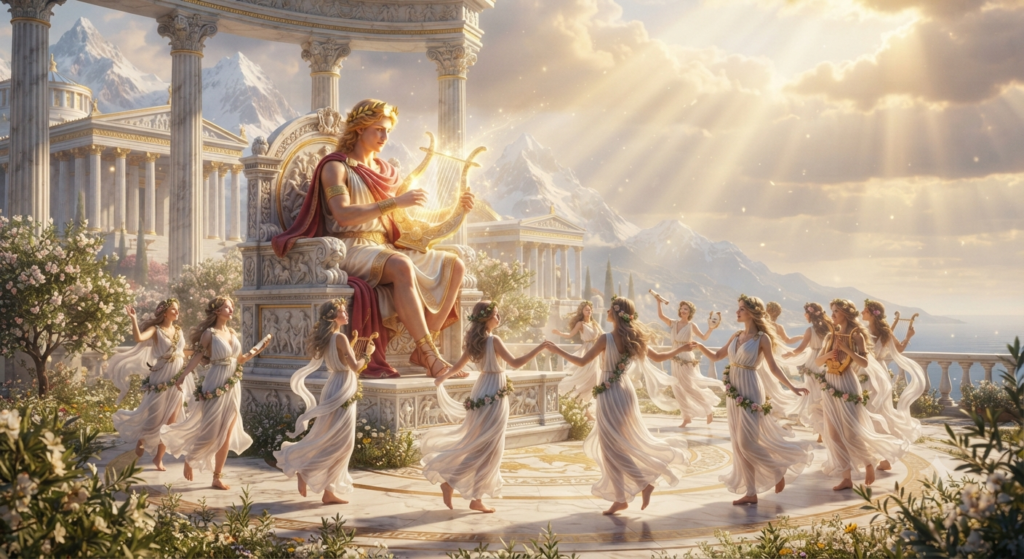
In Greek mythology, music and the Muses are most closely associated with Apollo, the radiant god of the lyre, song, poetic order, and inspired speech. The Muses themselves are the nine daughters of Zeus and Mnemosyne, but from early Greek poetry onward they are repeatedly shown in the company of Apollo, who guides their chorus and embodies the disciplined beauty of music. He is not the only divine figure linked to song in the Greek world, yet when readers ask which god stands behind the Muses and music, Apollo is the central answer in classical tradition.
Muses and Apollo in Greek myth and song
In the oldest surviving Greek literature, the Muses are summoned at the opening of epic poetry, and their presence signals that song comes from a divine source. In Hesiod’s Theogony, they are born of Zeus and Mnemosyne and sing of the gods under the leadership of Apollo. That pairing is not incidental: the Muses inspire, while Apollo gives form, measure, and musical excellence to their sound. Together they represent the sacred authority of poetry and performance in Greek culture.
Later poets and artists continued this association. Apollo appears as the god who can hear, direct, and accompany the Muses, especially in scenes of orderly choral song. In Greek mythic imagination, their relationship expresses a balance between inspiration and structure. The Muses supply memory and creative vision; Apollo turns that inspiration into harmony, rhythm, and proportion.
The god of music in Homeric and later tradition
Homer does not always present a fully developed theology of the Muses, but Apollo already stands as a god of music, archery, and prophetic power. In the Iliad and Odyssey, he is invoked as a formidable divine presence whose gifts include the kind of ordered excellence later associated with music. The lyre in particular becomes one of his defining symbols. By the classical period, Apollo is widely understood as the god most directly linked with musical skill.
Later Greek authors made that role even clearer. Apollo is shown presiding over contests, processions, and sacred performances, especially where song and measured movement belong together. While other gods or mortals may sing, play instruments, or inspire frenzy, Apollo represents music in its refined and civilized form. That is why he is often treated as the divine patron of musicians and poets alike.
Why Apollo leads the chorus of the Muses
Apollo is frequently called the leader of the Muses, a role that reflects both myth and cult. The Muses are not a chaotic band of divinities; they are a chorus, and in Greek thought a chorus requires a leader to coordinate movement, voice, and timing. Apollo, with his lyre and his association with order, naturally fills that role. He is often depicted standing at the center of divine song, shaping the harmony that the Muses express.
This leadership also reflects Greek ideas about beauty and proportion. Apollo is a god of clarity, balance, and form, qualities that suit the arts of music and poetry. The Muses preserve memory and inspire invention, but Apollo ensures that inspiration becomes something intelligible and elevated. In mythic terms, he is the figure who gives song its architecture.
Calliope, lyre song, and poetic inspiration
Among the nine Muses, Calliope is especially linked with epic poetry and eloquence. Ancient sources sometimes place her close to kingship, heroic speech, and the gravest forms of poetic composition. Because the lyre was central to Greek song, Calliope’s domain often overlaps with Apollo’s, particularly where poetry is recited or sung with musical accompaniment. Her presence highlights that “music” in Greek tradition is not only instrumental sound, but also sung poetry.
Apollo and the Muses together represent the two sides of inspired art. Calliope may inspire the singer, but Apollo governs the instrument, the cadence, and the order in which words are delivered. In this sense, lyric and epic poetry become part of the same sacred field. The god and the Muse together ensure that human speech can rise into art.
Helicon, Delphi, and sacred places of song
Greek myth places the Muses on Mount Helicon and sometimes on Mount Parnassus, landscapes strongly tied to poetic inspiration. Delphi, however, is Apollo’s great sanctuary, and the proximity between Delphi and the poetic mountains reflects their shared sacred atmosphere. At both places, song is not merely entertainment; it is a ritual act bound to divine presence. The geography itself reinforces the link between Apollo and the Muses.
Helicon is especially associated with the fountain of the Muses and the poetic life of Hesiod, while Delphi belongs to Apollo’s prophetic authority. Together they map the religious imagination of Greek song: one mountain of inspiration, one sanctuary of divine utterance. The Muses and Apollo meet in these landscapes because Greek culture did not separate poetry, music, and revelation as sharply as later traditions often do.
The nine Muses in Greek religious tradition
The nine Muses were worshipped in various local cults, and their religious role extended beyond literature. They were honored as patrons of memory, education, dance, lyric, history, astronomy, and the full range of civilized arts. In this broader cultic context, Apollo remained their most important divine companion, especially where ritual music and chorus were concerned. Their relationship was part of lived religion as well as poetic myth.
Ancient writers and travelers such as Pausanias preserve traces of sanctuaries and dedications connected to the Muses and Apollo alike. These were not abstract symbols but powers invoked in real places by real communities. The association between Apollo and the Muses therefore belongs to Greek religious practice as much as to literary tradition. It shows how deeply music was understood as a sacred gift.
Apollo Mousagetes and the art of harmony
One of Apollo’s important epithets is Mousagetes, meaning “leader of the Muses.” This title captures his central position in Greek musical imagination. He is not only a performer with the lyre but also the one who brings the Muses into ordered movement and song. The title appears in contexts where divine harmony, procession, and ritual performance converge.
Apollo Mousagetes represents more than artistic taste. He embodies harmony as a cosmic principle, linking music to balance in the wider universe. In Greek thought, musical order could mirror moral and cosmic order, and Apollo stood at the center of that idea. The Muses inspire the voice of culture; Apollo gives that voice coherence and proportion.
Music, poetry, and prophecy under Apollo
Apollo is unusual among Greek gods because his domain joins music and prophecy. At Delphi, the same god who inspires measured song also speaks through the oracle. This combination is not accidental. For the Greeks, both music and prophecy require a special kind of divine ordering, where human language becomes more than ordinary speech. Apollo governs both the beautiful and the true.
The Muses share this sphere because poetic inspiration is akin to a controlled form of revelation. A bard who sings under their influence is not simply entertaining an audience; he is voicing memory and truth in elevated form. Apollo’s presence reinforces that sacred seriousness. Music under Apollo is never random sound, but a structured path toward insight.
Variations in ancient sources on divine patronage
Ancient sources do not always describe the same hierarchy between Apollo and the Muses. In some traditions, the Muses are simply the source of poetic inspiration, while Apollo’s role is less explicit. In others, especially later and more systematic accounts, Apollo clearly leads them. These differences reflect the richness of Greek myth rather than contradiction alone. Myths often preserve multiple layers of belief and practice.
What remains consistent is the close association between Apollo and the arts of song. Even when a source emphasizes the Muses, Apollo is rarely far away in the broader tradition of Greek music. He appears as their companion, conductor, and patron. That enduring connection is why he became the god most identified with music in the classical world.
How Greek myth links music to Apollo’s power
Greek mythology links music to Apollo because his powers encompass measure, beauty, prophecy, and divine order. The lyre is his emblem, the chorus of the Muses his company, and sacred song one of his clearest domains. In this mythic landscape, music is not separate from power; it is one of the forms through which divine order is made audible.
For that reason, when Greek tradition asks who stands behind the Muses and music, Apollo is the figure most often encountered. The Muses embody inspiration and remembrance, but Apollo gives their art direction and radiance. Together they define the classical Greek vision of song as something at once human and divine.
Apollo is the main figure from Greek mythology associated with the Muses and music, especially in his role as Mousagetes, leader of the Muses. The nine Muses inspire the arts, but Apollo presides over musical harmony, lyric performance, and the sacred order that turns inspiration into enduring song.

Orin Vale has spent the better part of two decades tracing the threads that connect the world’s oldest stories — from the halls of Asgard to the banks of the Nile, from Olympus to the jungles of the Maya. What began as a childhood fascination with flood myths and trickster gods grew into years of independent study across comparative mythology and ancient religion, always chasing the same question: what did these stories mean to the people who first told them? Orin writes for readers who want more than trivia — the ones looking for the beliefs, fears, and truths that myths were built to carry.