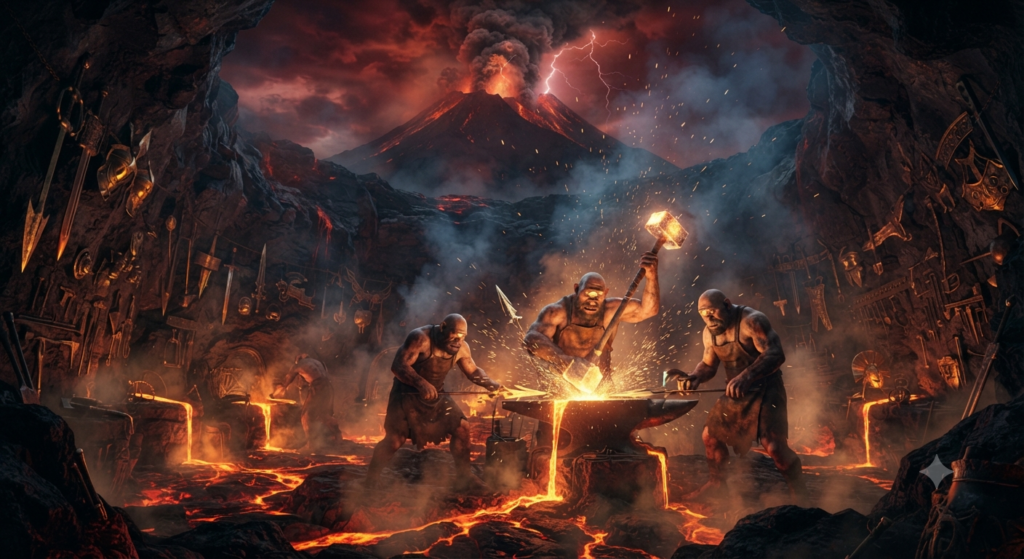
In Greek mythology, Mount Etna is more than a mountain on the coast of Sicily. It is a place where divine craft, monstrous imprisonment, and volcanic terror meet. Ancient poets treated its fires as signs of the gods’ hidden activity, and its slopes as a boundary between the human world and forces older than kings or cities. Because Etna is an actual volcano, myth found in it a vivid landscape for explaining flame, smoke, earthquakes, and the uneasy power of the earth itself.
Mount Etna as the forge of Hephaestus
In Greek tradition, Mount Etna is often linked with Hephaestus, the god of fire, metalworking, and craft. Several ancient authors place his forge beneath or within the volcano, imagining the mountain’s eruptions as the breath of divine industry. This is not presented uniformly in every source, but the association became strong in literary tradition, especially in poems and later mythography that sought to explain Etna’s visible fires through divine labor.
The image suits Hephaestus perfectly. He is a god whose work is hidden, intense, and transformative, turning raw metal into weapons, armor, and marvels. Etna offered an ideal mythic workshop: a place where the earth itself seemed to smelt and hammer. In this way, the volcano became a symbol of creativity joined to danger, where artistry and destruction shared the same flame.
The volcano’s place in Greek cosmogony
Mount Etna also appears in Greek thinking about the deep structure of the world, where mountains, underworld regions, and divine punishments were often connected. In cosmogonic imagination, volcanic places were not random features of the landscape but thresholds between the ordered surface of human life and the chaotic powers below. Etna’s smoke and fire made it a natural candidate for stories about primordial beings and cosmic struggle.
Although Greek cosmogony is not a single fixed narrative, Etna came to represent the earth’s hidden violence. The mountain suggested that the world was not entirely stable, but alive with forces beneath the crust. That idea fits with broader Greek myth, in which giants, monsters, and divine enemies are often buried under mountains, their movements causing trembling ground and eruptive fire.
Typhon trapped beneath Etna’s fires
One of the most famous myths connected to Mount Etna is the imprisonment of Typhon beneath it. Typhon, a monstrous offspring of Gaia in Hesiod’s Theogony, challenged Zeus in a violent cosmic battle. In some traditions, Zeus defeated him and confined him under Mount Etna, where the monster’s struggles were said to produce eruptions and flames. Other ancient texts place Typhon under different volcanic or subterranean regions, so Etna is one version within a wider mythic pattern.
The Typhon story gave the volcano a dramatic explanation for its destructive force. When Etna smoked or rumbled, it was easy to imagine a titan-like being thrashing below. This myth linked natural disaster to divine victory: the gods had subdued chaos, but chaos remained active beneath the mountain, never fully silent. The result is one of Greek mythology’s most powerful images of restrained catastrophe.
Enceladus and the earth-shaking myth
A related tradition places the giant Enceladus beneath Mount Etna. In this version, the giant was thrown down after the battle between the gods and the Giants, and his buried body caused the mountain to quake and burn. Different sources identify different giants with different volcanic or seismic sites, but Enceladus became especially associated with Etna in later classical imagination. The myth reflects the Greek tendency to explain earthquakes as the motions of defeated earthborn beings.
This story deepened Etna’s role as a place of divine punishment. The mountain was not only a forge or a prison, but also a monument to the gods’ triumph over rebellion. Its tremors became the signs of a defeated giant’s eternal struggle. In that sense, Etna belongs to the same mythic logic as other bound monsters in Greek tradition: the landscape remembers the violence that shaped it, and the earth itself keeps the wound open.
Ancient poets on Etna’s smoking peak
Greek poets repeatedly returned to Mount Etna because it joined spectacle with symbolic force. Pindar, Aeschylus, and other writers could evoke its fire and height as images of overwhelming natural power. Later poets, too, used Etna as a grand setting for mythic events, especially those involving gods, giants, and hidden subterranean workings. The mountain’s real eruptions made it one of the most vivid places in the Greek poetic imagination.
These poets did not merely describe a volcano; they used Etna to think about the relationship between visible nature and invisible causation. A smoking peak could suggest divine craftsmanship, punishment, or cosmic disorder depending on the context. Greek literature often treats such landscapes as morally and cosmically charged, and Etna is among the clearest examples of that habit of mind.
Sicilian landscapes in myth and memory
Because Mount Etna stands in Sicily, Greek myth also folded the island into its sacred geography. Sicilian places became linked with gods, monsters, and heroic journeys, especially through colonies and later literary tradition. Etna dominated this mythic map, standing as a landmark that could not be ignored by travelers, settlers, or storytellers. Its presence helped turn Sicily into a land of extraordinary encounters rather than ordinary terrain.
At the same time, the mountain anchored myth in memory. Greek and later Roman authors could point to a real volcano and attach to it tales of the gods, making the island feel inhabited by ancient history. This blending of landscape and story is central to Greek mythic thought: place is never just setting, but evidence. Etna, visible from afar and active in lived experience, became one of the strongest examples of a mythic site that seemed to confirm the old narratives.
Hephaestus, the Cyclopes, and divine craft
In some traditions, Etna is associated not only with Hephaestus but also with the Cyclopes, the one-eyed smiths and builders linked to divine craftsmanship. The Cyclopes are sometimes imagined as laboring in subterranean workshops, forging Zeus’s thunderbolts and other divine weapons. Later literary tradition often places such work near Etna, where the mountain’s fire offered a natural image for metalworking beneath the earth.
This association reinforces the idea that Etna is a place of creation as much as danger. The same mountain that can destroy also produces, in mythic imagination, the tools that preserve cosmic order. Hephaestus and the Cyclopes embody that paradox: fire is not merely ruinous, but useful, precise, and sacred. Etna therefore becomes a symbol of controlled power, even when that control is only imagined and always threatened by eruption.
Earthquakes, eruptions, and sacred terror
Greek mythology often interprets earthquakes and eruptions through divine agency, and Mount Etna is one of the clearest places where such interpretations converge. The mountain’s violence was not experienced as random geology but as a sign that the boundary between worlds had become unstable. In the language of myth, this could mean a monster shifting beneath the ground, a god at work, or the lingering force of an ancient punishment.
That uncertainty created a form of sacred terror. Etna was dangerous, but also holy in a severe way, because it made visible powers that ordinary life could not contain. Such places inspired awe precisely because they were uncontrollable. Greek myth did not try to domesticate that force completely; instead, it gave it a story, allowing people to name what they feared without pretending it had been made harmless.
Etna in Homeric and Hellenistic sources
Mount Etna appears in the wider classical tradition in different ways, depending on the author. Homer does not make Etna central in the surviving epics, but later Greek writers and commentators place it firmly within the mythic geography surrounding the heroic age. Hellenistic poets, especially those interested in learned allusion and local detail, helped sharpen Etna’s association with monsters, craftsmen, and subterranean fire.
This later tradition matters because it shows how mythology evolves around a place. Etna was not fixed by one authoritative tale; rather, it accumulated meanings across centuries. Some sources stressed volcanic fire, others divine labor, and others the burial of defeated beings. The result is a layered mythic profile, one that reflects both early Greek ideas and the later literary delight in weaving geography into grand narrative.
Mount Etna in later Roman retellings
Roman authors inherited Greek traditions about Etna and often expanded them. In Virgil, Ovid, and other Latin writers, the mountain appears as a powerful emblem of buried rage, divine craft, and the physical grandeur of Sicily. Roman literature tends to preserve the Greek myths while giving them new literary shape, and Etna becomes a familiar site for dramatic description and epic resonance. Its fires are especially effective in Roman verse, where they can stand for both natural splendor and elemental threat.
These retellings helped keep Etna alive in the classical imagination long after the original Greek myths had taken shape. Roman poets and mythographers treated it as one of the most memorable volcanic landscapes in the Mediterranean world. Through them, the mountain remained what it had already become for the Greeks: a place where the earth speaks in fire, where defeated monsters still stir, and where divine power leaves visible traces in stone and smoke.
Mount Etna’s role in Greek mythology is that of a threshold place, where the visible world opens onto the hidden realm beneath it. It is the forge of gods, the prison of monsters, the site of earthquakes, and a landscape that preserves the memory of divine conflict. Because it is both real and mythic, Etna allowed Greek writers to give shape to phenomena that were otherwise difficult to explain. In that union of earth and story, the mountain became one of the most enduring symbols of sacred fire and unsettled power in the classical world.

Orin Vale has spent the better part of two decades tracing the threads that connect the world’s oldest stories — from the halls of Asgard to the banks of the Nile, from Olympus to the jungles of the Maya. What began as a childhood fascination with flood myths and trickster gods grew into years of independent study across comparative mythology and ancient religion, always chasing the same question: what did these stories mean to the people who first told them? Orin writes for readers who want more than trivia — the ones looking for the beliefs, fears, and truths that myths were built to carry.