When people picture Athena in ancient art, they often imagine a single marble goddess standing calmly in a museum case. The reality was far richer. In Greek sanctuaries, Athena could appear as a towering cult image of wood, ivory, and gold, as a bronze warrior goddess, or as a finely carved marble figure set within a temple precinct. The materials chosen for her statues were never accidental: they reflected local resources, devotional practice, artistic fashion, and the status of the shrine that housed her.
Athena statues in wood, ivory, and gold
Athena’s earliest sacred images were often made from humble materials rather than monumental stone. In Greek tradition, especially around old cult centers, a goddess could be represented by a wooden xoanon, a venerable carved figure whose power lay in antiquity and ritual presence more than in lifelike realism. Pausanias often notes such archaic images at sanctuaries, and although not every one of them survived into his day, their memory shows how deeply wooden cult statues belonged to Greek religion. For Athena, this older sacred idiom could persist even when later art preferred marble or bronze.
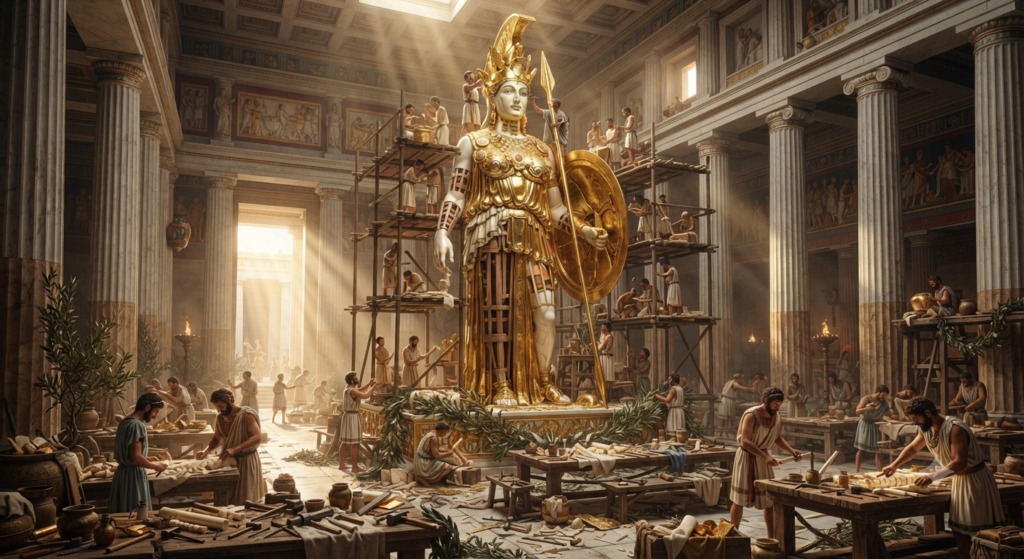
At the other end of the scale stood the lavish chryselephantine image, made from gold and ivory. The most famous Athena statue of this type was the monumental Athena Parthenos by Phidias in the Parthenon, known from ancient descriptions rather than survival. Such works projected divine majesty through precious materials: ivory for flesh, gold for garment and armor. In cult settings, these materials signaled both the goddess’s splendor and the civic wealth of the community that honored her.
The chryselephantine tradition in Greek cult
The chryselephantine tradition was not unique to Athena, but she was among the gods most closely associated with it. Greek sanctuaries that could support such an image treated it as a statement of power, piety, and political identity. Gold and ivory were expensive, difficult to work, and carefully assembled over a supporting framework, which made the statue both a sacred object and an engineering achievement. In Athens, the great Phidian statue of Athena embodied the city’s confidence at the height of its imperial influence.
These images were also part of a broader ritual world. Ancient authors describe them not as passive sculptures but as cult presences maintained with care, decoration, and offerings. Because gold could be removed, repaired, or even used in times of need, such statues occupied a complex place between devotion and civic treasury. The material brilliance of Athena’s chryselephantine forms helped translate her identity as a virgin warrior and guardian of the polis into visible, gleaming matter.
Pentelic marble in later Athenian sculpting
As Greek sculpture developed, Pentelic marble became one of the defining materials of Athenian art. Quarried in Attica, it was prized for its fine grain and warm, luminous surface, making it ideal for both architecture and statuary. Although Pentelic marble is most famously associated with the Parthenon itself, it also shaped later representations of Athena, especially in the classical and Hellenistic periods when sculptors favored durable, elegant stone over earlier cult materials.
Marble statues of Athena were often made for public display, sanctuaries, and dedications rather than as the oldest sacred images of a temple. Their smooth surfaces allowed for crisp rendering of the aegis, helmet, and drapery folds, while traces of paint and metal attachments could heighten the effect. In this way, marble became a medium through which Athena could appear both idealized and immediate, combining permanence with visual refinement.
Bronze cores and metal fittings for support
Even when a statue looked entirely golden or ivory from the outside, it usually depended on a hidden structural system. Chryselephantine works required a bronze or wooden armature to support the delicate slabs of ivory and sheets of gold. Metal pins, nails, and clamps held individual parts in place, while internal supports prevented the image from warping or collapsing. Ancient craftsmanship here was as much about engineering as about artistry.
Bronze also played a direct role in other representations of Athena. Many statues were cast wholly in bronze, a material associated with strength, resilience, and the martial character of the goddess. The reflective surface of polished bronze suited Athena’s warrior identity, especially when combined with separately attached weapons or decorative elements. Even where bronze served only as a hidden skeleton, it remained essential to the statue’s meaning, allowing the divine form to stand securely in space.
Painted surfaces and details on sacred images
Ancient statues of Athena were rarely left in bare material alone. Greek sculpture was commonly painted, and the goddess’s images likely carried strong color contrasts that are now mostly lost. Hair, eyes, lips, armor details, and patterned garments could be accented with pigments, making the statue more vivid and more legible from a distance. What appears today as plain marble would once have seemed alive with color.
Painting also worked together with applied materials. A marble Athena might have had a painted aegis, gilded ornaments, or metal accessories that sharpened the visual effect. In cult statues, color was not decorative in a modern sense but part of the image’s sacred clarity. The goddess was made present through a carefully layered surface, where stone, paint, gold, and bronze all contributed to the final impression.
Wooden xoana and early temple dedications
The xoanon was one of the oldest forms of divine image in Greece, and Athena was sometimes represented this way in early sanctuaries. These wooden figures were often abstract or stiff by later standards, yet they carried immense sanctity because of their age, ritual use, and association with tradition. Pausanias records several ancient cult images whose wooden character marked them as relics of a more archaic religious world. Such statues were not valued for anatomical realism but for continuity with ancestral worship.
Athena’s wooden dedications likely appeared in early temples and shrine spaces before more ambitious sculptural programs took over. In some places, a wooden image could remain central even when later temples were rebuilt in stone around it. This persistence reflects a common Greek pattern: the material may have been simple, but the meaning was profound. A wooden Athena could embody the goddess’s protective presence just as surely as a more elaborate later statue.
Ivory inlays for skin and facial features
Ivory was especially important in the chryselephantine rendering of Athena because it suggested the smooth brightness of divine flesh. Ancient descriptions of major cult statues imply that ivory was used for exposed skin areas such as the face, hands, and feet. The material’s pale surface carried both natural beauty and symbolic weight, distinguishing the goddess from the mortal world around her. In combination with gold, it created a dazzling contrast that defined some of the most famous statues in Greek cult.
Because ivory was expensive and fragile, it was reserved for the most prestigious commissions. Its use also connected the statue to long-distance trade and elite patronage, since ivory had to be imported and carefully worked into thin pieces. On Athena’s image, the material helped articulate her otherworldly composure: the goddess appeared not as a crude idol, but as an ordered, radiant presence shaped by the finest substances available to the ancient world.
Gold drapery, armor, and ritual ornament
Gold gave Athena’s statues their unmistakable authority. In chryselephantine works, sheets of gold could represent her peplos, aegis, helmet decorations, ornaments, or other elements of armor and regalia. Ancient accounts of the Athena Parthenos emphasize precisely this fusion of divine beauty and martial splendor. Gold made the goddess visible as a figure of protection, wisdom, and civic power, all at once.
The metal also allowed practical and ritual flexibility. In some statues, gold fittings could be removed, repaired, or weighed as part of the image’s value. This meant that the goddess’s ornament was not merely symbolic; it was a real store of wealth and a testament to civic dedication. The brilliance of gold on Athena’s figure mirrored the radiance expected of a temple cult image, especially in sanctuaries that wished to present the goddess as the shining defender of the city.
Stone bases, pedestals, and temple settings
The materials of Athena statues were only part of their impact. Many were set on stone bases or pedestals that anchored them physically and visually within the temple. These supports could bear inscriptions, dedications, or sculpted reliefs, linking the image to patrons and to the sanctuary’s ritual life. Even a small statue gained authority when placed on a properly finished base in a sacred precinct.
Temple settings further shaped how the statue was understood. A chryselephantine Athena inside a grand temple, a marble Athena standing in the open air, and a wooden xoanon housed in a venerable chamber all created different devotional experiences. The material of the statue and the material of its environment worked together: stone walls, painted ceilings, bronze doors, and altar space all framed the goddess’s presence. In Greek religion, the image was never isolated from the place that sheltered it.
Regional materials in Athena images across Greece
Not every Athena statue followed the Athenian pattern of gold, ivory, or costly marble. Across Greece, local resources shaped the goddess’s image. In regions rich in bronze-working, bronze Athene may have been favored; elsewhere, wood or local stone provided the practical basis for cult. The material record therefore reflects regional devotion as much as artistic convention. Athena could appear in many guises, but the local sanctuary often determined what substance best conveyed her presence.
This diversity is important because it reminds us that ancient Greek religion was not uniform. A sanctuary on a rocky island, a city shrine, or an old rural cult site might each preserve different materials and older traditions. Athena’s images ranged from austere wooden forms to spectacular gold-and-ivory masterpieces, with marble and bronze filling the space between. Together they show how the goddess of wisdom and war could be expressed through whatever material a community had at hand, whether humble or magnificent.
Ancient statues of Athena were made from more than one substance because the goddess herself belonged to more than one sphere. She was guardian of cities, patron of craft, and a figure of ritual power, so her images could be wooden, ivory-faced, gold-clad, bronze-cast, or carved from Pentelic marble. Each material carried a different register of meaning, from archaic sanctity to civic grandeur.
What endures across all these forms is the Greek insistence that divine presence could be embodied through craft. Whether in a weathered xoanon or a glittering chryselephantine masterpiece, Athena’s statue was meant to be seen as more than ornament. It was a sacred meeting point between material skill, local tradition, and the enduring image of the goddess herself.

Orin Vale has spent the better part of two decades tracing the threads that connect the world’s oldest stories — from the halls of Asgard to the banks of the Nile, from Olympus to the jungles of the Maya. What began as a childhood fascination with flood myths and trickster gods grew into years of independent study across comparative mythology and ancient religion, always chasing the same question: what did these stories mean to the people who first told them? Orin writes for readers who want more than trivia — the ones looking for the beliefs, fears, and truths that myths were built to carry.