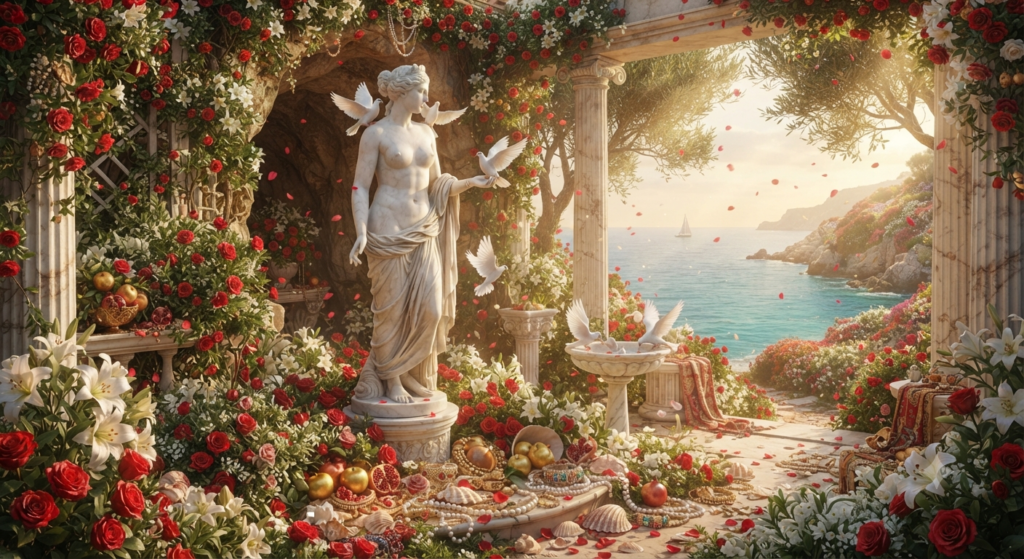
Aphrodite, the Greek goddess of love, beauty, desire, and generative attraction, is surrounded in the ancient sources by a rich web of plants, animals, and treasured objects. These symbols were not random decorations. In Homer, Hesiod, Sappho, and later writers such as Apollodorus and Pausanias, they help define the goddess’s sphere: fragrant blossoms, fertile trees, radiant metals, sea-born wonders, and birds associated with grace and union. Some emblems appear in the earliest poetry, while others became more prominent in sanctuaries, vase painting, and Roman adaptation under Venus. Taken together, they reveal how the Greeks imagined Aphrodite as a power who made beauty visible in both nature and crafted splendor.
Roses and myrtle in Aphrodite’s sacred imagery
Among the plants most closely associated with Aphrodite, the rose and myrtle stand foremost. The rose, with its beauty and thorns, became a natural emblem of love’s delight and vulnerability, and later Greek and Roman poetry often treats it as one of the goddess’s flowers. Myrtle appears even more securely in cult and myth: it was linked to her worship, especially in contexts of marriage, adornment, and ritual greenery. Ancient authors and later commentators connect myrtle with Aphrodite because of its fragrance, evergreen leaves, and association with festive garlands.
These plants also reflect the goddess’s double aspect. Roses point to beauty at its most fleeting, while myrtle suggests enduring life and ritual order. In Greek sanctuaries and domestic rites, garlands of myrtle could mark a bride’s transition into marriage, a sphere over which Aphrodite presided. The plants therefore do more than decorate her image; they speak to love as both desire and social bond, a force that joins bodies, households, and communities.
Apples and pomegranates in love’s symbolism
Apples are one of the most famous fruits connected with Aphrodite, especially through the myth of the golden apple of Eris, which led to the judgment of Paris. In that story, preserved in later tradition and summarized by mythographers such as Apollodorus, the apple becomes a token of beauty contested among goddesses. It is a fitting symbol for Aphrodite because it combines allure, ripeness, and a hidden core, qualities often used in ancient literature to evoke erotic desire.
The pomegranate also belongs to Aphrodite’s symbolic world, though it is shared with other deities, most notably Persephone and Hera in different contexts. Its many seeds made it a natural sign of fertility, abundance, and marital continuity. In Aphrodite’s sphere, it could suggest the generative power that follows attraction, especially within marriage. The fruit’s rich color and association with life inside a hard shell made it a powerful image for love that is both sensual and fertile.
The dove, swan, and sparrow as holy birds
Aphrodite is frequently accompanied by birds whose elegance and movement match her character. The dove is perhaps the best known. Ancient art and later literary tradition alike connect doves with the goddess, and they appear as gentle, pure, and fecund creatures suited to her presence. Their soft cooing and pair-bonding made them apt symbols of love and companionship in the Greek imagination.
The swan and sparrow also belong to Aphrodite’s bird-world. The swan, with its whiteness and grace, could represent beauty refined into almost otherworldly form; the sparrow, by contrast, appears more playful and lively, and is associated with erotic vigor in Sappho’s famous language of Aphrodite’s carriage drawn by sparrows. These birds do not carry the same cultic weight in every source, but together they show how the goddess was imagined through creatures of air, motion, and attraction.
Shells and pearls linked to Aphrodite’s birth
Few images are more enduring than Aphrodite rising from the sea, often standing in or upon a shell. This scene is especially familiar from later art, but it draws on the ancient idea of the goddess emerging from the waters near Cyprus after the castration of Uranus in Hesiod’s Theogony. The shell became a visual shorthand for that birth, even when the earliest poems do not specify it in detail. It captures the idea of life appearing from the sea’s hidden depths.
Pearls belong to the same symbolic field. As treasures of the sea, they suit a goddess who is both ocean-born and radiant. Ancient authors do not always single out pearls as a primary cult object of Aphrodite, but in later artistic and literary tradition they become part of her luxury and splendor. Their luminous surface evokes the goddess’s own brilliance, while their formation inside a shell ties them to the marine origin that so often defines her imagery.
Gold, mirrors, and girdles in the goddess’s cult
Gold is one of the most persistent treasures associated with Aphrodite, not because it belongs to her alone, but because it suits her nature as the radiant goddess of attraction. In Homer and later literature, divine beauty is often described in gleaming terms, and Aphrodite is regularly adorned with ornaments that shimmer like sunlight or sea light. Gold crowns, necklaces, and bands emphasize the costly, alluring dimension of her presence.
Mirrors and girdles are equally important. The mirror belongs to the goddess because it reflects beauty, self-awareness, and adornment, all central to her domain. The girdle, especially the famous embroidered belt described in Homer’s Iliad, is among her most potent treasures. When Hera borrows Aphrodite’s girdle to seduce Zeus, the object is described as containing charm, desire, and persuasion. It is not merely ornament, but a repository of the goddess’s power over union and desire.
The sea foam myth and Aphrodite’s origin signs
Aphrodite’s origin is inseparable from the sea foam, or aphros, from which her name is often explained in ancient mythographic tradition. In Hesiod’s account, after Uranus is wounded, the sea receives his severed remains, and from the foam generated there Aphrodite arises. This is not just a dramatic birth scene; it is the foundational sign of her being. The sea foam makes her a goddess of emergence, beauty arriving suddenly and impossibly from elemental motion.
The signs of that origin remain with her in later representation. Shells, waves, wet hair, marine creatures, and shoreline settings all echo the same mythic beginning. Even when specific objects are not present, the sea itself functions as one of Aphrodite’s great emblems. It suggests both instability and fertility: foam disperses quickly, yet from it the goddess is born. In Greek thought, that paradox fits love itself, which can seem ephemeral and yet shape human life profoundly.
Gardens of roses, myrtle, and spring blossoms
Aphrodite’s association with gardens is rooted in the broader Greek sense that flowering growth mirrors erotic and seasonal renewal. Sacred groves and ornamental gardens were appropriate spaces for her worship, especially when filled with roses, myrtle, violets, and spring blossoms. Such settings evoke the moment when nature appears in full color after winter, much as love makes human life newly vivid. The goddess is therefore not limited to a single plant, but presides over flowering abundance itself.
Spring blossoms matter because they embody the timing of Aphrodite’s power. Ancient poetry often links love with the quickening of the season, when buds open and fragrance returns to the air. This makes floral imagery central to her cult and mythic presence. A garden under Aphrodite’s influence is never merely decorative; it is a living figure for growth, attraction, and the temporary beauty that flourishes before fading.
Sacred incense and fragrant offerings to Aphrodite
Fragrance is one of Aphrodite’s most important but easily overlooked associations. Incense, perfumed oils, and scented flowers belong naturally to her sphere because scent operates like love itself: invisible, pervasive, and able to alter perception. In Greek ritual, offerings of incense were common to many gods, but for Aphrodite they carried a special fit, since beauty in her realm is never purely visual. It is also olfactory, surrounding the worshipper like a subtle enchantment.
Classical sources and later cult practice show that offerings to Aphrodite could include perfumes, garlands, and richly scented materials. These gifts suited temples and private devotion alike. The emphasis on fragrance also reflects literary portrayals of the goddess in Homeric hymn and epic tradition, where divine arrival is often accompanied by an atmosphere of sweet-smelling radiance. In this sense, incense is not just a cult object but a sensory extension of her power.
Cyprus, Paphos, and treasured cult objects
Cyprus is the island most strongly associated with Aphrodite, especially in connection with her epithets Cypria and Kypris. Paphos, in particular, was one of her most famous cult centers, and ancient writers repeatedly identify it as a place of deep devotion to the goddess. The island’s prominence in her mythology ties geography to divine identity, making Cyprus itself part of her symbolic treasure. Sea, shore, and sanctuary come together there with unusual force.
The cult objects linked to Aphrodite in such centers likely varied by local tradition, but ancient testimony emphasizes sacred precincts, altars, and images rather than a single universal relic. Pausanias and other writers note notable sanctuaries and local customs, while artistic tradition adds the emblems of shells, birds, flowers, and precious ornaments. What makes Cyprus and Paphos important is not one item alone, but the concentration of treasures and rites that made Aphrodite’s presence feel anchored in place.
Hellenic art and the goddess’s enduring emblems
Greek art preserved Aphrodite’s symbols with remarkable consistency. On vases, reliefs, statues, and coins, she appears with doves, apples, flowers, mirrors, veils, and richly adorned garments. These images helped standardize her visual identity across the Greek world and later into Roman culture as Venus. Artistic convention did not replace myth; it translated myth into durable signs that could be recognized at a glance.
The endurance of these emblems shows how deeply Aphrodite’s associations entered Hellenic culture. A rose, a shell, a girdle, or a dove could all point toward her, but together they form a larger language of beauty, fertility, and desire. Some symbols come directly from literature, others from cult practice, and still others from artistic imagination. Their shared effect is to present Aphrodite as a goddess whose treasures are not merely possessions, but living forms of attraction and generative power.
The plants and treasures associated with Aphrodite reveal how the Greeks understood beauty as something both natural and sacred. Roses, myrtle, apples, doves, shells, gold, and fragrant offerings all gather around her because they express different aspects of the same divine force: attraction, fertility, adornment, and the sudden radiance of becoming. In myth and cult alike, these symbols gave Aphrodite a visible language.
Her emblems endure because they still feel immediate. A flower, a jewel, a bird, a shell, or a scent can suggest presence before words do, and that is precisely the kind of power Aphrodite embodies in the classical tradition. Through these signs, the goddess remains one of the most recognizable figures in Greek mythology, her beauty carried forward by the very things the ancient world found most precious.

Orin Vale has spent the better part of two decades tracing the threads that connect the world’s oldest stories — from the halls of Asgard to the banks of the Nile, from Olympus to the jungles of the Maya. What began as a childhood fascination with flood myths and trickster gods grew into years of independent study across comparative mythology and ancient religion, always chasing the same question: what did these stories mean to the people who first told them? Orin writes for readers who want more than trivia — the ones looking for the beliefs, fears, and truths that myths were built to carry.