In ancient Greece, trees were not merely part of the landscape. They stood at the edge of divinity, memory, and ritual, often understood as living presences through which gods revealed themselves, protected their sanctuaries, or marked moments of mythic significance. Some species became closely bound to particular deities; others were honored because they framed sacred places, funerary customs, or heroic legends. The question of which trees were sacred in ancient Greece does not have a single answer, because Greek religion was local as well as shared, and different cities and cults cherished different groves and species. Still, a clear pattern emerges from the sources: oak, olive, laurel, cypress, myrtle, fig, poplar, fir, and pine all carried special religious weight in myth and cult.
Sacred trees in ancient Greece and their cults
Greek sacred trees belonged to a world in which nature and cult were intertwined. A tree might be sacred because a god was believed to dwell in it, because its leaves or wood were used in ritual, or because a famous myth attached divine memory to a particular species. Homer, Hesiod, Pausanias, and later writers preserve many such associations, though they do not offer a single formal list. Instead, they show a landscape where sanctuaries often included groves, where prophecies could come from rustling leaves, and where branches, wreaths, and cuttings of specific trees served as tokens of divine favor.
The sacredness of a tree was often practical as well as symbolic. Olive oil fed lamps, anointed athletes, and marked honor; laurel crowned prophets and victors; oak served oracles and altars; cypress and myrtle accompanied the dead and the newly married. In this sense, the trees of Greek religion were not isolated emblems but active participants in rites that shaped civic identity and private life. Their holiness lay as much in repeated use as in mythic origin.
The oak of Zeus at Dodona and prophecy
Among the most famous sacred trees in Greece was the oak of Zeus at Dodona in Epirus. In Homer’s Iliad, Achilles refers to Zeus of Dodona “who dwells afar” and whose sanctuary is associated with prophetic power, while later tradition more explicitly places the god’s oracle among the rustling oaks. The priestly attendants, the Selloi, were said to interpret the divine voice through the tree’s leaves, the sounds of bronze objects, or other signs associated with the sanctuary. Here the oak was not a decorative symbol but the very medium of revelation.
Zeus was naturally linked to the oak across the Greek world, perhaps because of the tree’s strength, age, and tendency to draw lightning. At Dodona, however, the association became especially concrete. Pausanias and other authors describe the site as one of the oldest oracles in Greece, and the sacred oak gave the sanctuary its distinctive atmosphere: prophecy rooted not in a statue alone, but in a living tree that trembled with divine speech. The oak of Dodona stands as one of the clearest answers to the question of which trees were sacred in ancient Greece.
The olive tree and Athena’s gift to Athens
No tree is more closely tied to Greek civic religion than the olive, especially through Athena and Athens. According to the contest myth preserved by later authors and alluded to in various forms, Poseidon and Athena competed for patronage of the city. Poseidon produced a salt spring or a horse, depending on the version, while Athena offered the olive tree, a gift judged more useful and therefore victorious. From that act came the city’s name and its deep association with the olive as a sign of wisdom, prosperity, and civilized order.
The sacred olive on the Acropolis had a special place in Athenian identity. Herodotus and Pausanias preserve traditions about this tree and the “moriai,” the sacred olives of Attica protected by law. Olive branches also played a major role in ritual life: they were carried by suppliants, used in processions, and associated with victors and sacred festivals. The olive was sacred not because it was rare, but because it embodied a divine gift that sustained both household and polis.
Laurel, Apollo, and the memory of Daphne
The laurel was sacred above all to Apollo. Its mythic center is the story of Daphne, preserved most fully by Ovid, though with earlier Greek precedents in the Apollo-Daphne tradition. Pursued by Apollo, Daphne was transformed into a laurel tree, and the god declared the plant his own. Because of that myth, Apollo’s cult made strong use of laurel branches, wreaths, and purification rituals. The tree became a permanent reminder of desire transformed into divine association.
Laurel wreaths crowned victors in poetic, musical, and athletic contexts, especially at Delphi, where Apollo’s oracle and festivals emphasized the god’s link to purity and inspiration. In Greek thought, laurel also had protective and cleansing power. Branches could be carried in ritual procession, and the tree’s evergreen quality made it especially suited to a god of lasting light and prophetic authority. The memory of Daphne gave the laurel its emotional force, but the cult of Apollo gave it enduring sacred status.
Cypress groves and funerary sacred symbolism
The cypress became one of the most recognizable trees of funerary symbolism in the Greek world. Its dark, upright form and association with graveyards made it a natural emblem of mourning and the underworld. While the sources do not always present the cypress as sacred to a single god in the same way as the oak or laurel, it was deeply bound to rites of death and remembrance. Greek and later Roman writers alike preserve its role in funerary landscapes and memorial practice.
Myth gave this association a poignant foundation through the story of Cyparissus, the youth beloved by Apollo in some versions, who killed a treasured stag and was transformed into a cypress in grief. Ovid tells the story in the Metamorphoses, making the tree an image of sorrow that cannot be lifted. In practice, cypress wood, branches, and groves became part of the language of burial and mourning. Its sacredness was solemn rather than celebratory, tied to the boundary between the living and the dead.
The myrtle of Aphrodite and bridal rites
The myrtle was sacred to Aphrodite, the goddess of love, beauty, and desire. Ancient writers associate the plant with the goddess’s emergence and with her cultic landscape, and later Greek ritual often used myrtle in ceremonies connected to marriage and feminine transition. Its glossy leaves and aromatic character suited a deity whose power was linked to attraction and fertility. In Greek religion, the myrtle signaled not only erotic love but also the social order of marriage.
Bridal rites frequently included myrtle wreaths or branches, and the plant appears in contexts where Aphrodite’s presence is felt in a controlled, civic form. Unlike the dangerous or disruptive aspects of passion found in myth, the myrtle in ritual helped frame union, beauty, and legitimate household formation. Its sacredness lay in that balance: a plant of desire, but also of ritual decorum. Through Aphrodite, the myrtle entered the symbolic language of weddings and festive processions.
Fig trees in myth, ritual, and the polis
Fig trees were important in Greek life both materially and symbolically, and they appear in mythic and ritual contexts with particular prominence around Athens and Attica. The fig was a food of substance and a marker of cultivated land, which already gave it civic value. In some traditions, the fig is linked to Demeter and to the broader cycle of agricultural abundance, though its sacred status was more localized and less singular than that of the olive or laurel. Still, the tree was often treated with respect because it stood at the intersection of nourishment and fertility.
Athenian tradition also associated fig trees with early city history and sacred boundaries. The “sacred fig” or hierophytos figures in local memory and in the agricultural identity of the region, and fig branches appear in certain ritual contexts. Literary and scholastic sources preserve the sense that figs were not casual trees in the Greek imagination: they belonged to ordered cultivation, to seasonal plenty, and to the moral economy of the polis. Their sanctity was rooted in use and remembrance more than in a single pan-Hellenic myth.
Poplar and black poplar in Greek heroic lore
The poplar, especially in its dark or black form, appears in several Greek myths connected to transformation and heroic memory. One important tradition links the poplar to the Heliades, the sisters of Phaethon, who were transformed after mourning their brother and whose tears became amber. In some versions, they were changed into poplars along the banks of the Eridanus. Ovid’s telling made this association especially vivid for later readers, but the broader mythic pattern is Greek in origin: trees can become the lasting form of grief.
Poplars also appear in heroic and underworld settings. Their leaves and pale undersides gave them a distinctive presence, often associated with rivers, mourning, and the edges of life. In Greek religion and poetry, the poplar could therefore signal liminal space, just as the cypress did in funerary settings. When sacredness attached to the poplar, it often did so through memory, metamorphosis, and the persistence of emotion in the natural world. It was a tree of transition rather than of one fixed cult.
Pine, fir, and mountain sanctuaries of the gods
Pine and fir belonged especially to mountainous and rustic sacred landscapes. These trees were not always tied to a single deity in the way the olive was tied to Athena or the laurel to Apollo, but they were strongly present in the cultic world of Dionysus, the mountain gods, and certain sanctuary settings. Pine torches and pine cones appear in Dionysiac iconography and ritual, and the tree’s evergreen resilience gave it a natural link to vitality, wildness, and enduring force. In myth, the mountain setting often mattered as much as the species itself.
Fir and pine also framed sanctuaries in high places where Greeks imagined divine nearness more vividly than in the city. Mountaintop cults, rural shrines, and processional routes could be marked by these trees, whose height and scent suited sacred terrain. Their use in ritual objects, such as wreaths, staffs, and torches, reinforced their religious role. If the olive was the tree of the polis, pine and fir were the trees of the uplands, where gods were approached through height, wind, and evergreen shade.
Sacred trees in Greek temples and groves
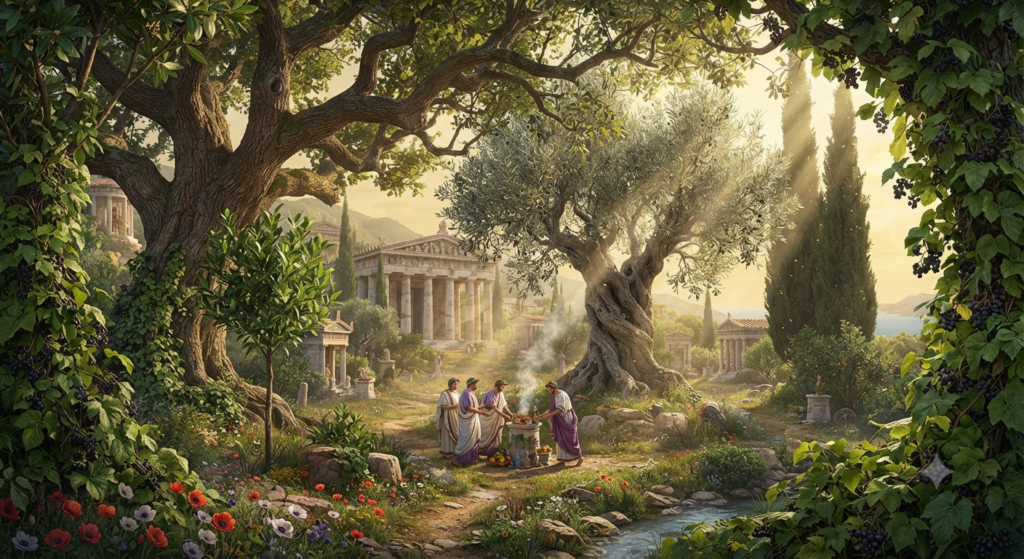
Greek temples were often accompanied by groves, and in some places the sacred tree was as important as the building itself. Pausanias repeatedly describes sanctuaries where a tree, spring, or grove formed part of the holy precinct, reminding us that Greek worship was not confined to architecture. In a landscape of altars, statues, and precinct walls, the living tree could serve as a marker of divine presence, a boundary of sacred space, or a focus of ritual action. Many sanctuaries were, in effect, designed around preserved nature.
This helps explain why the sacred trees of ancient Greece are so varied. The oak of Zeus spoke through prophecy; the olive of Athena embodied civic wisdom; laurel, myrtle, and cypress carried the rhythms of cult, marriage, and death; the fig, poplar, pine, and fir linked myth to daily life and wild terrain. Greek religion did not treat sacredness as abstract. It grew from contact between god, place, and living matter, and trees made that contact visible in every season.
Which trees were sacred in ancient Greece depends on the god, the city, and the rite, but several species recur again and again in the sources. Oak, olive, laurel, cypress, myrtle, fig, poplar, pine, and fir all carried religious meaning, whether through prophecy, civic identity, love, mourning, or mountain worship. Their sacredness was not a matter of botanical rarity; it came from myth, memory, and the repeated habits of ritual life. In Greek religion, a tree could be a gift, a sign, a boundary, or a lingering form of divine presence, and that is why these species still stand at the center of ancient sacred landscape.

Orin Vale has spent the better part of two decades tracing the threads that connect the world’s oldest stories — from the halls of Asgard to the banks of the Nile, from Olympus to the jungles of the Maya. What began as a childhood fascination with flood myths and trickster gods grew into years of independent study across comparative mythology and ancient religion, always chasing the same question: what did these stories mean to the people who first told them? Orin writes for readers who want more than trivia — the ones looking for the beliefs, fears, and truths that myths were built to carry.