Dionysus is the Greek god most closely associated with wine, but the bond runs deeper than simple patronage over a drink. In myth and ritual, he is the power in the vine’s growth, the force that turns juice into intoxicating wine, and the divine presence believed to move through celebration, frenzy, fertility, and release. Ancient Greeks did not treat wine as merely a pleasure of the table; it was a sacred substance that could sharpen the mind, loosen restraint, and draw human beings into contact with the god who ruled over its mysteries.
Dionysus and Wine in Greek Mythology
Dionysus stands apart among the Olympian gods because his sphere is not one of distant order alone, but of living transformation. Classical sources present him as the god who brings the vine to humankind, and with it the cultivated use of wine. In Homer and later authors, he appears as a powerful, often unsettling figure whose arrival can alter communities, inspire ecstasy, or provoke resistance. Wine belongs to him because it shares his nature: both can delight, both can overwhelm, and both can reveal what lies beneath restraint.
The connection is also mythic and agricultural. The vine is not static; it grows, twists, dies back, and returns with the seasons. That cycle suited the Greeks’ understanding of Dionysus as a god of life that seems to vanish and reappear. His presence in wine made the drink more than a product of farming. It became a bearer of divine vitality, one that could be mixed with water, shared at the symposium, or poured in ritual as a sign that human life remained under the shadow of divine gifts.
The God of Vine, Grapes, and Ecstasy
Dionysus is often called the god of vines and grapes because ancient tradition links him directly to cultivation, ripening, and the vintage itself. While not every source gives the same account of how humans first learned to make wine, the god is consistently tied to the vine as his plant. Grapes are his fruit, and the wine made from them carries his name and power. Hesiod and later mythographers place him among the divinities who govern fertility and the bounty of the earth, though Dionysus is unusual in that his gift is intoxicating abundance rather than orderly harvest alone.
Ecstasy is equally central. The Greek term ekstasis suggests standing outside oneself, and Dionysian worship often aimed at precisely that boundary between self-control and divine possession. Wine was the most familiar medium of this experience. It could lift a person into joy, song, and inspired speech, but also into disorder if abused. That duality made Dionysus a god of both blessing and danger. He was not simply the inventor of wine in a practical sense; he was the god whose presence made wine a threshold between the human and the divine.
Ancient Cults of Wine and Fertility
Archaeology and literary testimony alike show that Dionysian worship was deeply entwined with fertility cults. Vine growth depended on earth, sun, rain, and careful cultivation, so the god of wine naturally became associated with the flourishing of fields, orchards, and human reproduction. In many regions of Greece, especially in rural communities, Dionysus was honored in ways that connected him to the cycle of the seasons and the renewal of life. These rites could be exuberant, processional, or secretive, depending on local tradition.
The fertility connection should not be reduced to crude symbolism. Ancient worshippers understood fertility as a broad cosmic force governing plants, animals, and people alike. Dionysus embodied that force in a particularly dramatic form. The ripening grape cluster was a visible sign of stored sweetness and future intoxication, much like the hidden promise of fertility itself. Through cult, song, and sacrifice, communities sought the god’s favor so that both vines and households might prosper.
Wine Pressing, Harvest, and Sacred Rites
The grape harvest was one of the clearest moments when Dionysus entered ordinary life. Pressing grapes into wine transformed raw fruit into something socially and ritually potent, and this act carried religious meaning in the ancient world. The process itself could be observed as a kind of sacred metamorphosis. What looked simple in the vineyard became, through human labor and time, a beverage associated with the god’s presence.
Sacred rites often accompanied agricultural stages such as pruning, gathering, and pressing. In several Greek communities, Dionysian festivals marked the beginning or completion of the vintage, though the exact customs varied widely. The Anthesteria in Athens, for instance, honored new wine and included ritual drinking and the opening of jars. Such festivals show that wine was not merely consumed after harvest; it was ceremonially acknowledged as something that crossed from nature into culture under Dionysus’s protection.
Ritual Libations in Dionysian Worship
Libations were among the oldest and most widespread Greek offerings, and wine was often central to them. A libation involved pouring liquid, usually wine, to honor the gods, the dead, or the divine powers present at an occasion. In Dionysian contexts, this act was especially fitting because wine itself belonged to the god. Pouring it outward affirmed that human enjoyment depended on divine gift and divine favor.
The sacramental character of wine in these rituals did not mean the Greeks viewed it in later theological terms, but they certainly saw it as charged with presence. A libation could begin a feast, seal a prayer, or accompany a sacred meal. With Dionysus, the poured wine retained its link to abundance and transformation even as it left the cup. This is one reason the god’s worship could be at once communal and intimate: the same wine that was drunk could also be offered back to the power from which it was believed to come.
Bacchus in Rome and the Wine Tradition
When Dionysus entered Roman religion as Bacchus, his association with wine remained intact and became even more widely recognized in the Latin world. Roman authors such as Ovid and Livy describe Bacchus as a god of wine, revelry, and inspired abandon, though Roman attitudes toward his cult were often tense. The Bacchanalian affair of 186 BCE, recorded by Livy, shows official concern that Dionysian-style rites could escape civic control. This was not a rejection of wine itself, but fear of the social force attached to Bacchic worship.
In Roman culture, Bacchus also took on a broader artistic and celebratory role. He appeared in poetry, painting, and public festivity as the bringer of the vine’s gifts and the patron of joyful excess. The Roman tradition preserved the Greek core of the god’s identity: wine was his defining medium, and intoxication could symbolize divine release. Yet Rome also framed that power within questions of order, authority, and public discipline, revealing how strongly the god’s wine cult could challenge norms.
Maenads, Satyrs, and the Vine God’s Retinue
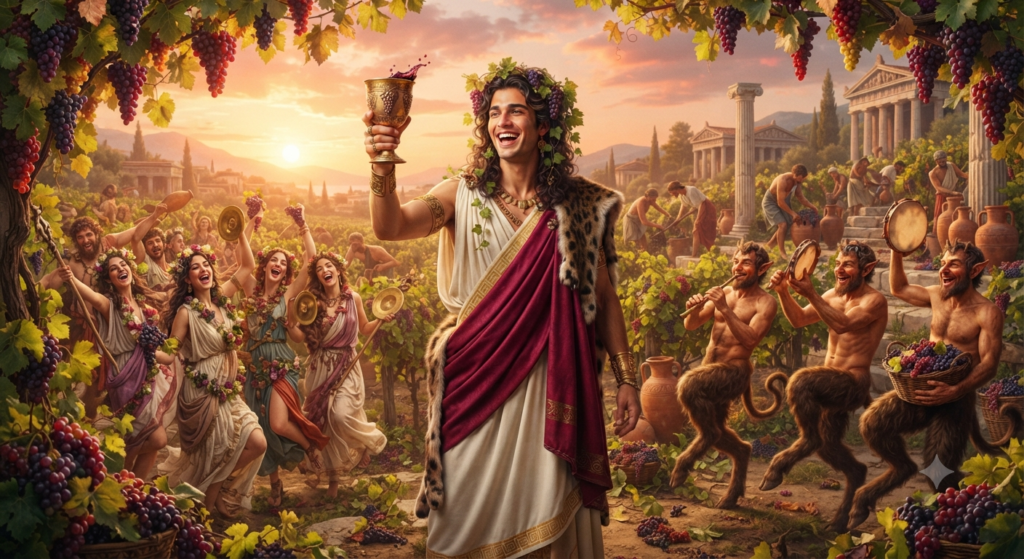
The followers of Dionysus make the connection between the god and wine unmistakable. Maenads, also called Bacchae in Romanized contexts, are women associated with ecstatic devotion, dance, and possession by the god. In myth and tragedy, they sometimes appear in a state of wild enthusiasm that mirrors the disinhibiting force of wine. Satyrs, too, are closely bound to the vine god, often depicted as rustic companions who embody appetite, music, and misrule.
Their presence is symbolic, but not arbitrary. The Dionysian retinue represents the social and psychological effects that wine can produce when no longer restrained by convention. Ancient art often shows satyrs carrying wine skins, cups, and vine branches, while maenads brandish thyrsoi wrapped in ivy or vine leaves. These figures do not simply decorate the god’s image; they dramatize the world that wine opens around him, a world where ordinary boundaries blur and the human voice can become song, cry, or prophecy.
Tragedy, Theater, and Dionysian Festivities
Dionysus was also deeply linked to Greek theater, especially tragedy. The dramatic festivals of Athens, such as the City Dionysia, were held in his honor, and performances took place within a religious context. This connection matters because wine and theater share a strange kinship: both can reveal hidden truth through altered states of feeling. The chorus, masks, and ritual atmosphere of tragedy reflect a Dionysian world in which identity is not fixed and emotion can swell beyond ordinary limits.
Festival drinking would have accompanied or followed these celebrations, though the theater itself was not simply a drinking event. Rather, the whole civic occasion belonged to Dionysus as god of transformation. Scholars often note that tragedy’s roots in choral song and ritual performance fit the god’s domain of ecstasy and metamorphosis. Wine was not the only force at work, but it stood near the center of the atmosphere in which citizens encountered story, suffering, and divine ambiguity.
Mythic Tales Linking Dionysus to Vines
Several myths explain Dionysus’s intimate relation to vines, though the details differ across sources. One famous tradition tells of his travels bringing viticulture to human communities, teaching them the arts of cultivation and wine-making. In other stories, he punishes those who reject his gifts or deny his divinity, as in the Homeric Hymn to Dionysus, where pirates who seize him are transformed when his divine nature is revealed. These tales reinforce the sense that wine is inseparable from recognition of the god.
Another strand of myth emphasizes loss, return, and miraculous growth. Dionysus himself has complex origins, being born from Zeus and Semele in one tradition and connected in some later accounts to earlier forms of divinity or foreign lands. This layered identity suits the vine, which is both local and ancient, seasonal and enduring. The myths do not present wine as a mere invention, but as a revelation of a divine process already latent in the world. Through Dionysus, the vine becomes a sign of power that humans can use, but never fully control.
How Greeks Understood Wine’s Divine Power
For the Greeks, wine was never simply alcoholic drink. It could heal, intoxicate, strengthen fellowship, or break the self apart. That ambiguity is the key to Dionysus’s connection with it. In moderation, wine belonged to civilized life, the symposium, and the proper ordering of communal pleasure. In excess, it could lead to madness, violence, or loss of judgment. Dionysus presided over both possibilities because he embodied the hidden force within the vine itself.
This is why the god remained so enduring in Greek thought. Wine was one of the clearest experiences through which humans could encounter transformation, and Dionysus gave that transformation a face, a mythic history, and a ritual framework. To drink wine was not automatically to worship him, but to understand wine deeply was to understand something Dionysian: that joy and danger, harvest and ecstasy, are often born from the same root.
Dionysus and wine are linked by more than tradition; they are joined by a whole ancient vision of life’s generative and unruly powers. The grape, the press, the cup, and the sacred offering all belonged to a world in which wine was seen as a gift from a god who governed growth, delight, frenzy, and release. In Greek and Roman myth alike, Dionysus remained the figure through whom wine became symbol, sacrament, and story.

Orin Vale has spent the better part of two decades tracing the threads that connect the world’s oldest stories — from the halls of Asgard to the banks of the Nile, from Olympus to the jungles of the Maya. What began as a childhood fascination with flood myths and trickster gods grew into years of independent study across comparative mythology and ancient religion, always chasing the same question: what did these stories mean to the people who first told them? Orin writes for readers who want more than trivia — the ones looking for the beliefs, fears, and truths that myths were built to carry.