Capricorn is tied in Greek myth most often to the tale of Pan and Typhon, though the constellation’s origin is layered with later astronomical and Roman interpretations. The zodiac sign Capricornus, usually imagined as a sea-goat, preserves an old celestial story in which a rustic god changes shape to escape a monstrous enemy, and Zeus later places that form among the stars. Because ancient writers did not all tell the story in exactly the same way, Capricorn belongs less to a single fixed legend than to a family of related traditions that join Greek myth, astronomy, and ancient zodiac lore.
Capricorn and the Greek myth of Pan and Typhon
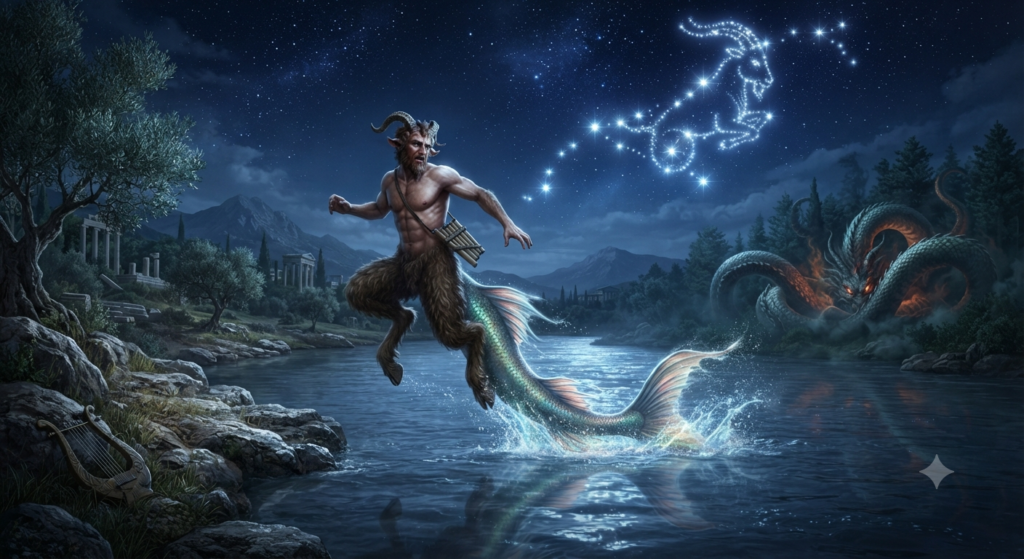
The Greek myth most commonly linked to Capricorn is the episode in which Pan fled from Typhon, the earth-born monster who challenged the gods. In the version associated with catasterism, Pan leapt into water and changed shape in order to escape, becoming part goat and part fish. That image became attached to Capricorn, a sign whose hybrid form already suggested adaptation, boundary-crossing, and survival under threat.
Pan himself was an old pastoral god, deeply associated with wild places, flocks, and sudden panic, while Typhon represented a force of chaos so immense that even the Olympians recoiled from him. Ancient tradition connects the sea-goat not to a heroic conquest, but to a swift transformation made in danger. This is one reason Capricorn’s myth feels different from many other zodiac stories: it is less about victory than about endurance and metamorphosis.
The sea-goat symbol in ancient zodiac lore
The sea-goat was not simply a decorative image. In Mesopotamian and Hellenistic astral tradition, hybrid beings often carried cosmological meaning, and Capricorn inherited that broader symbolic language when Greek and Roman astrologers systematized the zodiac. The constellation’s half-goat, half-fish form signaled a creature of two elements, able to move between land and water, earth and sea.
In Greek usage, the sign was often called Capricornus in Latin and Aigokerōs in Greek, both meaning “goat-horned” or goat-related, though the fish-tail became part of its standard visual identity. Ancient sky watchers linked the figure to the winter portion of the ecliptic, where the sun appears to reach a low point before beginning its return. The symbol therefore came to suggest not only the myth of escape, but also seasonal descent and renewal.
How Pan escaped Typhon in the Egyptian tale
Some later tellings connect Pan’s transformation with Egypt, where gods and monsters were sometimes folded into broader Hellenistic stories. In these versions, Pan is said to have leapt into the Nile or another body of water and changed his form while Typhon pursued the gods. The details vary, and classical authors do not preserve one uniform account, but the central image remains consistent: a god of the wild survives by becoming amphibious.
It is important to separate these retellings from the original Greek mythic core. The Egyptian setting reflects the way Greek and Egyptian religious traditions were compared and fused in the Hellenistic world, especially through astral lore. Rather than belonging to an independent Egyptian myth in the strict sense, the story shows how Capricorn’s symbolism expanded as Greek myth traveled into new cultural settings.
Zeus, the stars, and the sign of Capricorn
In catasterism myths, transformation into a constellation often follows divine recognition or reward, and Capricorn is no exception in later astronomical tradition. Zeus, as the ordering power of the sky, becomes the figure who fixes the transformed being among the stars. This act does not always appear in the same form in every source, but it reflects a familiar Greek pattern: after a mythic event on earth, the heavens preserve the story in visible shape.
Capricorn’s placement in the zodiac gave it a special role within celestial order. As one of the twelve signs, it marked a section of the sun’s annual path and thus became more than a mythic image. The constellation was read as a sign of cosmic timing, joining divine narrative with observational astronomy. In that sense, Zeus’s sky is not only the home of the gods, but also the framework through which myth becomes calendrical knowledge.
From goat to fish: the constellation’s form
The hybrid shape of Capricorn has invited explanation since antiquity. One common account describes a goat that, in trying to escape danger, plunged into the water and emerged transformed below the surface, creating the goat-fish form. Another tradition emphasizes only the goat aspect, while the fish tail became a later visual addition as astronomical iconography developed. The standard constellation image ultimately combined these strands into one figure.
This form mattered because it condensed a mythic idea into a single celestial emblem. Goats belong to rough hills and winter pastures; fish belong to the hidden, shifting world of water. Together they made a sign that could stand for mobility across extremes. The constellation thus became memorable not just for its story, but for the visual logic that made the story legible in the night sky.
Classical sources for Capricorn’s mythic origin
Classical references to Capricorn are scattered rather than centralized. Aratus, in the Phaenomena, describes constellations in poetic astronomical language, while later commentators and mythographers preserve more explicit stories about the sea-goat. Hyginus, in the Astronomica, is among the important sources for catasterism traditions, including the notion that Capricorn was linked to Pan or to a figure transformed in flight from Typhon.
Other authors, such as the compilers of mythographic handbooks and astrologers of the Roman period, helped stabilize the tradition that readers now recognize. Because the evidence is fragmentary, scholars usually treat the Pan-Typhon explanation as the best-known Greek mythic association rather than a single universally attested origin tale. The constellation’s meaning comes from the convergence of texts, not from one authoritative version.
Roman astrology and the Capricorni emblem
Roman astrology inherited Greek zodiac lore and gave Capricorn a durable emblematic life. In Roman texts and on coins, gems, and mosaics, Capricorn could appear as a sign of fortune, discipline, and imperial destiny. The sea-goat was not merely a mythological creature; it was also a practical astrological marker used in horoscopes, calendars, and state symbolism.
This Roman layer is part of why Capricorn remains so familiar today. The sign became embedded in the larger system of planetary and zodiacal interpretation that spread across the Mediterranean world. Roman readers may not have focused on Pan’s flight every time they saw the emblem, but the old myth gave the image depth. Beneath the astrological shorthand stood a story of transformation under pressure.
Why Capricorn links earth, sea, and survival
Capricorn’s power lies in its dual nature. The goat points to rocky ground, endurance, and the ability to climb where others cannot; the fish tail points to hidden movement and life below the surface. Together they form a symbol of survival through adaptability, which fits the myth of Pan’s escape and also the practical ancient sense of the sign as one associated with the turning of the year.
That link between earth and sea is not random. Ancient myth often used hybrid beings to express thresholds, and Capricorn is one of the clearest examples in the zodiac. It stands at the edge of categories, suggesting that life persists by crossing boundaries rather than remaining fixed. The sea-goat is therefore both a creature and a lesson in mythic form.
Greek myth and the winter solstice sky
Capricorn’s place in the winter sky helped deepen its symbolic associations. Ancient astronomy connected the sign with the turning point of the sun’s cycle, when daylight begins its slow return after the darkest season. For cultures attentive to the heavens, this made Capricorn a marker of transition, renewal, and the hidden promise of light.
The winter solstice connection also explains why the sign gathered themes of endurance and patience. The sky itself seemed to dramatize recession followed by recovery, just as the myth of Pan dramatized escape through transformation. In Greek myth and zodiacal thought alike, Capricorn became a figure of survival at the edge of darkness.
Capricorn in later astrology and legend
Later astrology preserved Capricorn as one of the most recognizable zodiac signs, even as its mythic background grew more diffuse. Medieval and Renaissance writers often repeated the sea-goat image without always retelling Pan’s encounter with Typhon in detail. The symbol remained powerful because it could carry many meanings at once: discipline, ascent, resilience, and passage through adversity.
Today, when people ask which Greek myth is linked to the zodiac sign Capricorn, the most established answer is the story of Pan escaping Typhon and becoming the sea-goat among the stars. Yet the sign also reflects centuries of added interpretation from Greek, Roman, and astral traditions. Its enduring form comes from that layered history, where a single constellation holds both a myth and a map of the sky.
Capricorn is linked most strongly to the Greek myth of Pan’s escape from Typhon, followed by his transformation into the sea-goat constellation. Around that core story, ancient astronomy and astrology built a richer symbolic life for the sign, blending mythic transformation with celestial order. The result is one of the zodiac’s most enduring images: a creature that survives by crossing from land to water, and from mortal danger into the stars.

Orin Vale has spent the better part of two decades tracing the threads that connect the world’s oldest stories — from the halls of Asgard to the banks of the Nile, from Olympus to the jungles of the Maya. What began as a childhood fascination with flood myths and trickster gods grew into years of independent study across comparative mythology and ancient religion, always chasing the same question: what did these stories mean to the people who first told them? Orin writes for readers who want more than trivia — the ones looking for the beliefs, fears, and truths that myths were built to carry.