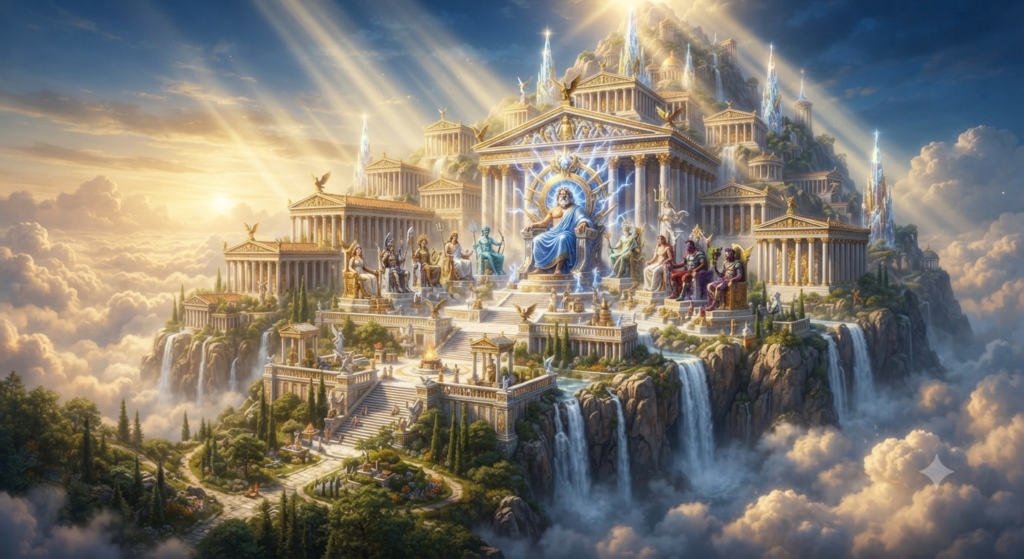
Mount Olympus in Greek mythology is not simply a mountain in the modern geographic sense, but the highest and most majestic seat of the Greek gods, above the world of humans and beneath the vast order of the heavens. In ancient imagination, it was at once a real peak in northern Greece and a divine realm where Zeus ruled, the Olympian gods gathered, and the powers that shaped fate and weather seemed to reside.
Mount Olympus as the Greek gods’ dwelling place
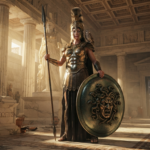
In Greek myth, Mount Olympus is the principal home of the Olympian gods, especially Zeus, Hera, Athena, Apollo, Artemis, Ares, Aphrodite, Poseidon, Hermes, Hephaestus, Demeter, and either Hestia or Dionysus depending on the tradition. It is presented not as a mortal settlement, but as a perfected divine court, where the gods live in splendor, receive worship, and deliberate over the affairs of gods and men. Homer often imagines it as a lofty, shining place beyond ordinary reach, while later writers make it the settled center of divine kingship.
The mountain’s role as a dwelling place gave Greek mythology a clear vertical order: mortals lived below, the gods above, and between them stood a fragile boundary of prayer, sacrifice, and fate. Olympus was therefore not merely a backdrop. It was the symbolic address of divine authority, where storms might be sent, councils held, and justice measured from a height that human beings could never physically attain.
Where Mount Olympus stands in northern Greece
The real Mount Olympus rises in northern Greece near the Aegean coast, on the borderlands between ancient Macedonia and Thessaly. Its highest summit, Mytikas, dominates the surrounding landscape and can be seen from great distances when the weather is clear. The mountain’s scale, cloud cover, and often hidden upper slopes made it an ideal natural site for divine imagination long before later maps and surveys fixed its shape.
Ancient Greeks did not treat this physical mountain and the divine Olympus as separate ideas. Rather, the visible peak helped anchor the mythic one. Because the mountain stood high above the plains and often disappeared into mist, it seemed plausible as the threshold of a supernatural realm. Geography and myth reinforced one another, and the mountain’s real grandeur likely helped preserve its sacred status across centuries.
Olympus in Homer, Hesiod, and early myth
The earliest major literary sources already treat Olympus as the gods’ elevated residence. In Homer’s Iliad and Odyssey, Olympus is the place where the gods gather, from which Zeus watches human battles, and where the divine world remains remote from the blood and dust of war. Homer’s Olympus is not always described with one fixed physical precision; sometimes it feels like the mountain itself, and at other times like an exalted divine region associated with the sky.
Hesiod gives Olympus a more ordered theological role. In the Theogony, after the defeat of the Titans, the rule of Zeus and his allies is established with Olympus as the center of the new divine order. Early myth therefore links the mountain with legitimacy, succession, and cosmic hierarchy. Later authors continued this pattern, making Olympus the natural seat of the gods who had replaced older powers.
The Twelve Olympians and divine royal power
The phrase “Twelve Olympians” refers to the major gods associated with Olympus, though the exact list varies by author, place, and period. Some traditions include Hestia, while others replace her with Dionysus. Poseidon is often counted among the Olympians even though his domain is the sea rather than the mountain, because his rank places him within the ruling circle of the divine family. The term names a political and religious order as much as a physical location.
Olympus thus became the image of divine monarchy. Zeus presides as king, Hera as queen, and the other gods occupy their respective spheres of influence under his authority, even when they resist him. In myth, their disputes are frequent, but they occur within a structured court. Olympus represents not perfect harmony, but a stable hierarchy in which power is concentrated and legitimacy is acknowledged.
Zeus’s throne, halls, and cloud-capped peak
Zeus is the central figure of Mount Olympus, and many ancient texts present him as enthroned there, watching over gods and mortals alike. His throne symbolizes not only rule but judgment, since Zeus is the god who grants kingship, enforces oaths, and sends thunder. The halls of Olympus are imagined as magnificent spaces suited to immortal life, with abundance, music, and feasting beyond human measure.
The peak itself is often associated with clouds, brightness, and inaccessible height. This cloud-capped image is important because it expresses the mountain’s dual nature: it is visible and yet hidden, earthly and yet transcendent. In mythic language, Olympus is high enough to touch the sky, but no mortal road leads comfortably to its summit. That inaccessibility strengthens Zeus’s authority, since his seat is literally above ordinary reach.
Why Olympus became a sacred mountain in lore
Mount Olympus became sacred partly because ancient religion often located divine presence in elevated, striking places. Mountains were natural sites for contact with the gods: they stood apart from settled life, were difficult to ascend, and seemed closer to the heavens. Olympus, towering over the landscape, embodied those qualities in an especially powerful form. Its isolation made it suitable for a realm where divine beings could dwell beyond disturbance.
Myth also made Olympus sacred by attaching decisive events to it. Once the gods were imagined as ruling from there, the mountain gained a sanctity that was both poetic and theological. It became the imagined center from which rainfall, victory, fertility, and cosmic order flowed. Sacredness in Greek tradition often grew through story, ritual, and local reverence, and Olympus gathered all three.
Olympus in the Titanomachy and divine order
In Hesiod’s account of the Titanomachy, the war between the Olympian gods and the older Titans ends with Zeus’s victory and the establishment of a new order. Olympus belongs to that new order as its visible emblem. The gods who fought against Cronus and the Titans now rule from the mountain, while the defeated powers are cast into deeper confinement, often associated with Tartarus rather than any lofty height.
This contrast is crucial to Greek mythic cosmology. Olympus stands for lawful sovereignty, while the Titans represent an earlier and more chaotic phase of divine history. The mountain is not just where the victors live; it is the place that marks victory itself. From Olympus, Zeus does not merely reside. He governs the universe in the aftermath of cosmic struggle, turning force into structure.
Mortals, heroes, and the mountain’s unreachable height
For mortals in Greek myth, Olympus is fundamentally inaccessible. Heroes may approach divine spaces in dreams, visions, or extraordinary encounters, but they do not casually climb into the gods’ home. The mountain’s height expresses the difference between human limitation and divine power. Even the boldest hero remains bound to a lifespan, while the gods dwell in a realm untouched by age and death.
That distance shapes many myths. When mortals are favored, the favor comes down from Olympus; when they are punished, the decision is made there. The mountain is therefore a symbolic barrier and a channel at once. It marks the place where human longing meets divine indifference, generosity, or wrath, depending on the will of the gods.
Ancient worship around Olympus and nearby shrines
Although Olympus itself was not the center of a single universal cult in the way some temples were, the broader region around it was deeply religious. Sanctuaries, local shrines, and mountain associations in northern Greece reflected the mountain’s prestige. Nearby communities honored Zeus and other deities connected with sky, sovereignty, and the mountain landscape, reinforcing Olympus as a sacred presence in regional devotion.
Pausanias and other ancient writers show how Greek religion often linked mythic geography with living ritual. Even when the peak was not climbed for everyday worship, its surrounding areas carried religious meaning. Temples and altars in the region helped translate the mythic mountain into practical piety, making Olympus part of the religious life of northern Greece as well as the world of epic poetry.
Mount Olympus in later Greek and Roman tradition
In later Greek and Roman literature, Mount Olympus remained the standard poetic home of the gods. Roman authors adopted the Greek mountain into Latin mythic language, often using Olympus as shorthand for the divine realm itself. Ovid, for example, frequently invokes Olympus as the seat of the gods in Metamorphoses, where the mountain functions as both setting and symbol.
Over time, Olympus became less a specific mountain and more a literary term for divine authority, celestial life, and elevated power. Yet the real peak in Greece never disappeared from memory, and its continued presence helped preserve the myth. That blend of physical place and sacred imagination is one reason Mount Olympus remains so enduring: it stands where landscape and legend meet, and in Greek mythology that meeting place is the home of the gods.
Mount Olympus is the mountain of the Olympian gods, the visible peak that Greek imagination transformed into a divine throne above the human world. In myth, it embodies kingship, distance, order, and the enduring presence of Zeus and his court, while in geography it remains the impressive northern Greek mountain that inspired those stories.

Orin Vale has spent the better part of two decades tracing the threads that connect the world’s oldest stories — from the halls of Asgard to the banks of the Nile, from Olympus to the jungles of the Maya. What began as a childhood fascination with flood myths and trickster gods grew into years of independent study across comparative mythology and ancient religion, always chasing the same question: what did these stories mean to the people who first told them? Orin writes for readers who want more than trivia — the ones looking for the beliefs, fears, and truths that myths were built to carry.