In Greek mythology, the question of which god was the patron of horses leads most directly to Poseidon, especially in his aspect as Poseidon Hippios, “Poseidon of Horses.” Although he is remembered first as the sea god, the ancient Greeks also honored him as the divine power behind horses, horse breeding, and sometimes even the first creation of the horse itself. Other deities were connected to horses in specific ways, but Poseidon stands at the center of the tradition.
Which Greek god is the patron of horses?
Among the Greek gods, Poseidon is the chief patron of horses. His link to equines appears in cult, poetry, and myth, where he is invoked not only as ruler of the sea but also as the god who gives horses their strength and swiftness. The name Hippios identifies this older and more specialized role, showing that horse worship was not a minor curiosity but an established part of his divine identity.
This connection was broad enough to survive alongside Poseidon’s maritime fame. In some places he was honored as the source of horses in general; in others, he was imagined as the protector of riders, breeders, and chariot teams. Because Greek religion was local and flexible, the same deity could hold different functions from city to city, but the strongest and most widely attested horse patron is still Poseidon.
Poseidon Hippios and the horse’s divine patron
The epithet Hippios comes from hippos, the Greek word for horse, and it marks Poseidon as a god with an ancient equine dimension. Pausanias records altars and cult titles that preserve this identity, while later authors also remember him in horse-related contexts. This is not a late decorative title; it reflects a deep and old association that existed alongside his better-known relationship with the sea.
Poseidon’s horse patronage fits the god’s broader character as a force of power, motion, and untamed energy. Horses were among the most powerful animals in the Greek world, and the Greeks often imagined divine mastery over such force as belonging to Poseidon. In myth and worship, he stands as the god who can create, command, or unsettle the horse, depending on the story being told.
The sea god’s role in equine creation
Several ancient traditions link Poseidon directly to the creation of the horse. The most famous version appears in later mythographic and scholarly traditions, where Poseidon is said to have brought forth the first horse. The details vary, but the central idea remains stable: the horse belongs to Poseidon’s sphere because he either made it or was the first divine power to reveal it to humankind.
This creative role also explains why horses can appear in his mythology as sudden, vigorous beings associated with the sea’s force. Poseidon is not a gentle pastoral god; he is a primordial and often unpredictable deity. In that context, the horse becomes a fitting expression of his power: beautiful, swift, difficult to master, and capable of carrying both nobility and danger.
Athena, Hermes, and other horse-linked deities
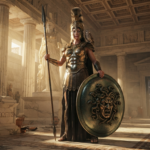
Although Poseidon is the principal horse god, other deities are linked to horses in narrower ways. Athena is associated with practical intelligence, skill in harnessing power, and the arts of warfare, which includes the use of horses in chariots and cavalry. She is not a horse creator or patron in the same direct sense as Poseidon, but she belongs to the larger divine world in which horses were tools of status and strategy.
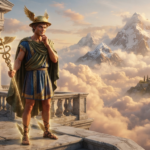
Hermes also has horse connections, especially through movement, travel, and invention. In some traditions he is associated with the introduction of the alphabet or with clever devices, and later mythic imagination sometimes places horses in his orbit because he governs journeys and swift passage. Still, neither Athena nor Hermes displaces Poseidon as the primary divine patron of horses; their links are secondary, functional, and context-dependent.
Horse cults and shrines in ancient Greece
Greek worship of horses often centered on local cults rather than a single pan-Hellenic horse god. Shrines to Poseidon Hippios or related forms of Poseidon appear in different regions, showing that communities felt a need to honor the god in connection with breeding, riding, or the dangerous power of the animal. These cults reflect practical life as much as myth, since horses were expensive, prestigious, and vital in warfare.
Pausanias is especially useful here, because he describes sanctuaries and local traditions that preserve older religious memory. In some places, horse imagery belonged to Poseidon’s worship directly; in others, it was tied to heroes or local founders who had a special relationship with horses. The diversity of these cults shows that Greek religion did not treat the horse as a single abstract symbol, but as a living part of civic, military, and aristocratic identity.
Homer, Hesiod, and early references to horses
The early epics already place horses near the center of heroic culture. In Homer, horses are marks of rank, speed, and martial prestige, especially in the Iliad and Odyssey. Poseidon appears in a world where horses matter deeply, and Homer’s language often links divine action to the sea, travel, and the movement of powerful animals.
Hesiod also contributes to the older divine framework in which Poseidon is one of the great Olympians with broad dominion. While Hesiod is not chiefly interested in horse cult, his cosmic ordering helps establish the god’s ancient authority. Later readers and worshippers could easily fold horse patronage into that authority, especially because Poseidon’s domain already included the primal energies of earth, water, and violent force.
Poseidon in myth as tamer and giver of horses
Myths often present Poseidon as both giver and tamer of horses. He can bestow the animal on mortals, but he can also unleash terror through flooding, storms, or unruly movement. That double nature suits a god whose power is never entirely controlled. The horse, in this sense, becomes one of his most perfect symbols: a noble creature that must be bridled, trained, and honored.
A well-known mythic pattern places Poseidon in contests or acts of foundation where his gift of the horse is significant. At times he is opposed to Athena, whose own gifts are more explicitly civic and technical. The rivalry is not simply about which god is “better,” but about two different kinds of divine power: Poseidon’s elemental force against Athena’s ordered skill. The horse belongs to that tension, because it is both a creature of beauty and a machine of war.
Chariot racing, cavalry, and sacred stallions
In Greek life, horses were most visible in chariot racing and military cavalry, where they signaled wealth, discipline, and aristocratic standing. Olympic and other Panhellenic games celebrated horse teams as elite displays, and the prestige of victory often reflected the resources needed to own and train such animals. Divine favor mattered here, and Poseidon was naturally suited to such contests.
Sacred horses and stallions also appear in ritual and heroic settings, where particular animals could be dedicated, sacrificed, or associated with a god. The horse was never just livestock; it was a creature that stood at the edge of the sacred. Because it was expensive and difficult to master, it became a fitting offering to a god like Poseidon, whose power over motion and force made him an ideal divine patron for riders and breeders alike.
Local epithets of horse gods in Greek worship
Greek gods were often worshipped under local epithets, and Poseidon’s horse aspect is a clear example. Poseidon Hippios is the best-known form, but regional worship could emphasize different divine functions, including the protection of horses, the fertility of herds, or the safe training of animals. These epithets reveal how Greek religion adapted the same god to different needs.
This local flexibility is one reason the horse god question does not have a single simplistic answer. In one city, Poseidon might be the obvious divine name attached to horses; in another, the cult emphasis might be more civic or more martial. Yet across these variations, the same pattern emerges: when Greeks thought of horses in sacred terms, Poseidon was the deity most often at the center.
Why Poseidon remained the chief horse patron
Poseidon remained the chief patron of horses because he united power, antiquity, and mythic legitimacy. He was old enough to belong to the deepest layers of Greek religious imagination, and strong enough to govern a creature that embodied speed and danger. His horse title was not an accessory to his identity; it was one of the clearest signs of how wide his authority really was.
Other gods touched the horse world, but none replaced Poseidon’s central place. He was the sea god, yet also the horse god; the shaker of earth, yet also the giver of noble animals. That paradox is exactly what makes him so enduring. In Greek myth, the horse belongs to the god whose power is vast enough to cover both the depths of the ocean and the thunder of hooves on dry land.
For ancient Greeks, the patron of horses was chiefly Poseidon Hippios, the form of Poseidon honored as lord of horses. His cult, myths, and epithets show that horses were never far from his divine sphere, even when he was invoked as a sea god. The horse remained one of the clearest reminders that Poseidon’s authority reached beyond the waves into the living force of the earth itself.

Orin Vale has spent the better part of two decades tracing the threads that connect the world’s oldest stories — from the halls of Asgard to the banks of the Nile, from Olympus to the jungles of the Maya. What began as a childhood fascination with flood myths and trickster gods grew into years of independent study across comparative mythology and ancient religion, always chasing the same question: what did these stories mean to the people who first told them? Orin writes for readers who want more than trivia — the ones looking for the beliefs, fears, and truths that myths were built to carry.