In Homer’s Odyssey, hubris is never a simple matter of arrogance. It is the habit of overstepping one’s proper limits—toward gods, toward fate, and toward other human beings—and it repeatedly shapes the poem’s suffering and resolution. Odysseus is admired for intelligence and self-command, yet he is also vulnerable to pride, especially when victory tempts him into boasting. Around him, kings, sailors, and suitors all reveal how excess invites ruin in a world ruled by divine order and strict measures.
The epic is not a moral tract in the modern sense, but it does present a clear pattern: those who respect limits survive longer, while those who presume too much bring disaster on themselves and others. Hubris in the Odyssey appears in public boasts, reckless disobedience, wasteful consumption, and the refusal to recognize what is due to gods and guests alike. It is one of the poem’s central forces, shaping both the long delay in Odysseus’s homecoming and the justice that finally restores Ithaca.
Hubris in Odysseus and the Trojan War aftermath
Odysseus is not introduced in the Odyssey as a simple hero of restraint. He is the man whose mind is “of many turns,” but the memory of Troy also marks him as someone who can trust his own brilliance too much. The war itself has already created a world in which Greeks and Trojans alike were driven by honor, vengeance, and the desire for lasting fame, and Homer shows that such ambitions often shade into excess. Odysseus is wiser than many around him, yet he is not immune to the same heroic impulse to be known and remembered.
That tension matters because the Odyssey is set in the aftermath of a conflict where pride has not been fully disciplined by suffering. The returning warriors are tested not by battlefield glory but by patience, self-restraint, and reverence for divine order. Odysseus repeatedly succeeds when he controls his speech and fails when he lets the old heroic urge to proclaim himself take over. Homer makes that pattern plain: survival at sea and restoration at home demand more than martial courage, because hubris survives even after the war ends.
The Cyclops cave: pride and a fatal boast
The encounter with Polyphemus is the poem’s clearest case study in hubris. Odysseus enters the Cyclops’s cave expecting hospitality or at least some exchange governed by human custom, but Polyphemus stands outside that order entirely. He devours the strangers instead of receiving them, and in that sense he is already a figure of savage excess. Yet Odysseus’s own response is not pure prudence. Once he has escaped the cave, he cannot resist revealing his name.
That boast is not necessary for survival. The victory is already won when the ships pull away, and the men are safe enough to leave the island. Instead, Odysseus turns rescue into self-display, claiming the deed for his own glory. In Homeric terms, that is the moment hubris enters most visibly: the hero reaches beyond the practical need of the hour and seeks lasting renown at the cost of safety. The result is immediate and disastrous, because the boast gives the wounded Cyclops the means to call down divine punishment.
Polyphemus, Poseidon, and the cost of excess
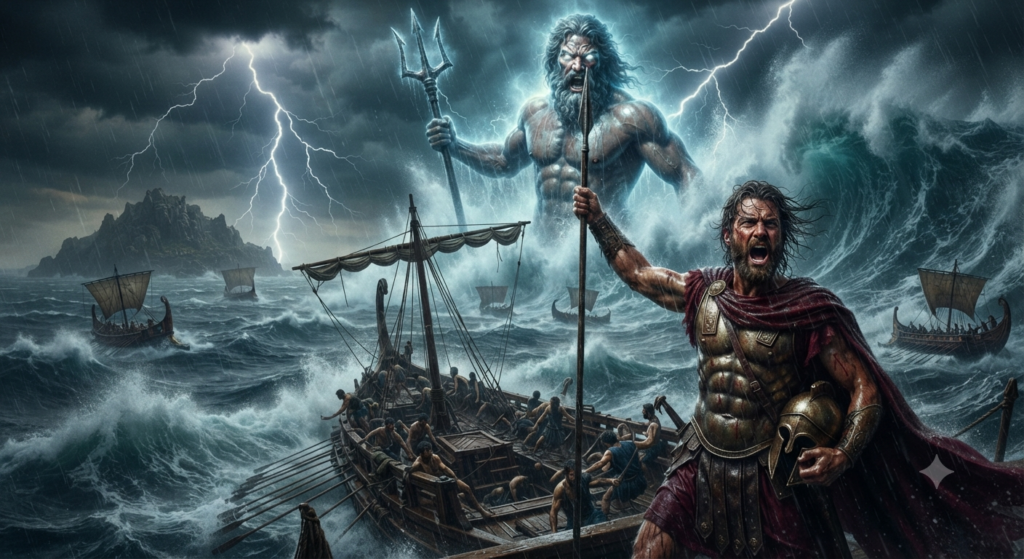
Polyphemus’s curse matters because he is Poseidon’s son, and in Homer the gods do not treat insults lightly. Odysseus’s pride in the cave does not merely anger a monster; it insults a divine family and transforms a local escape into a cosmic grievance. Poseidon’s wrath then becomes one of the major forces delaying the hero’s return. The sea god’s hostility is not random suffering but the consequence of a mortal overreaching his place and then advertising the deed.
This is one reason the Odyssey links hubris with long wandering rather than instant punishment alone. The result of excess is not always a single catastrophe; sometimes it is a prolonged unmaking of one’s life. Odysseus survives shipwrecks, isolation, and loss, but each delay reminds the reader that mastery claimed too loudly can rebound across years. Homer thereby connects the boast in the cave to the larger structure of the poem: one proud act can reverberate through an entire homecoming.
Divine warnings ignored in Homeric seafaring
The Odyssey repeatedly shows that the gods provide warnings, signs, and instructions, but mortals often respond as though these measures were optional. Calypso, Circe, Tiresias, and even Athena all guide Odysseus at different points, and his best moments come when he listens carefully and acts within the boundaries they set. Yet the sea in Homer is a place where confidence can quickly become presumption. Sailors who think skill alone can defeat divine will are usually the ones who perish.
This theme is especially visible in the contrast between warning and response. Odysseus is often more successful than his men because he can pause, interpret, and adapt. Still, the poem does not flatter him as perfectly obedient. The pattern is consistent: divine counsel requires humility, while hubris treats warning as inconvenience. Homer’s seafaring world is therefore not governed by human boldness but by the ability to recognize when boldness must stop.
Crew disobedience and the theft of Helios cattle
The most tragic example of hubris in the crew’s actions is the slaughter of Helios’s cattle. Odysseus has already been warned not to touch them, and even in his absence the men know that the herd is forbidden. Their decision to kill and eat the cattle is not born from necessity alone but from hunger joined to defiance. In Homeric terms, this is more than disobedience; it is the refusal to respect divine property, a direct act of excess against sacred order.
The punishment is total because the offense is total. The crew’s conduct shows a kind of collective hubris: once discipline erodes, appetite becomes law. They reason as men who think present need overrides cosmic boundaries, but the poem rejects that logic. Helios appeals to Zeus, and the ship is destroyed. Odysseus alone survives, which is itself a severe judgment on the men who could not govern desire. Their fate underlines the epic’s larger lesson that self-restraint is not an ornament of piety but a condition of survival.
Athena’s aid set against mortal self-importance
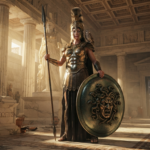
Athena’s role in the poem sharply exposes the difference between divine wisdom and mortal self-importance. She favors Odysseus because he is clever, adaptable, and capable of bearing disguise, but even her help does not erase the limits of human power. Athena directs, protects, and clears obstacles, yet she never allows her chosen hero to become autonomous in a godlike sense. Her support is a reminder that success in the Odyssey always exceeds human control.
That is why hubris becomes especially foolish in the presence of Athena’s aid. Odysseus is at his strongest when he works with divine guidance rather than trying to shine alone. The suitors, by contrast, imagine wealth and social dominance are enough to secure their position. They miss the deeper order of the poem, in which favor, timing, and measure matter more than display. Athena’s presence throws mortal self-importance into relief: what looks like strength without wisdom is only a prelude to collapse.
Penelope’s suitors and the arrogance of wealth
The suitors embody hubris in one of its most social forms. They consume Odysseus’s household without shame, court Penelope while refusing to respect her answer, and treat the palace as if inheritance were already theirs. Their behavior is not only greedy but presumptuous, as though status entitles them to ignore both the household order and the gods’ unseen scrutiny. Homer lingers on their feasting because it is an image of excess made visible through appetite.
Their arrogance is also a failure to understand hospitality. In Greek heroic culture, the guest-host bond is sacred, but the suitors reverse it: they are guests who behave like occupiers. They spend freely, mock restraint, and assume no reckoning will come. The poem presents this not as youthful impatience but as moral blindness. Their destruction is therefore more than revenge for one man’s house; it is the restoration of violated measure.
The bow contest as a test of rightful mastery
The bow contest is often remembered as a triumph of disguise and recognition, but it is also a correction of hubris. The suitors attempt to prove themselves through a feat that belongs to Odysseus alone, yet they cannot even string the bow. Their failure reveals that power without legitimate right is empty show. Odysseus, by contrast, takes up the bow calmly, without boasting, and accomplishes what the others cannot. The contrast is central: mastery in the Odyssey is not loud self-assertion but disciplined possession of what one has earned.
The scene also strips away the illusion that social confidence equals competence. The suitors have numbers, status, and appetites, but none of these can substitute for the proper relation between person and instrument, king and house, human and divine order. Odysseus’s silent use of the bow makes his authority visible without verbal excess. Homer lets the action speak where the suitors only performed arrogance. In that sense, the contest is not merely a martial test but a judgment on whose claim to mastery is true.
Recognition scenes shaped by restraint and measure
The recognition scenes in the Odyssey are remarkable for their restraint. Odysseus does not rush into every reunion at once; he tests, conceals, and waits. Penelope’s recognition of him is especially measured, because she refuses to surrender judgment too quickly. This restraint is the opposite of hubris. It shows that knowing the truth requires patience and care, not the desire to seize certainty before it is secure.
Homer repeatedly suggests that recognition becomes possible only when pride is set aside. Telemachus grows into maturity by learning to speak and act with greater discipline, while Odysseus survives by accepting disguise rather than insisting on open display. Even the reunion with Laertes unfolds through signs and confirmation, not grand self-proclamation. These scenes make a quiet but important claim: measure is a form of wisdom, and the absence of hubris allows memory, trust, and justice to take shape.
Hubris, justice, and homecoming in Ithaca
By the end of the poem, hubris has been answered not by abstract punishment alone but by the restoration of order in Ithaca. The suitors’ deaths are severe, yet Homer frames them as the consequence of long abuse rather than sudden cruelty. Odysseus returns not as a conqueror seeking new glory, but as the rightful king reclaiming a household distorted by excess. Justice in the Odyssey is inseparable from proportion: each figure receives what matches the path they have chosen.
Homecoming, then, is not just a personal return but a rebalancing of the world. Odysseus himself has been chastened by experience, though not perfectly purified of pride; he remains a man whose intelligence can edge toward self-assertion. Still, the poem closes by privileging order over display, measure over boast, and lawful recognition over reckless appetite. In that final movement, hubris is shown to be a force that delays homecoming, while restraint makes homecoming possible.
The Odyssey presents hubris as one of the deepest causes of human suffering because it breaks the boundaries that hold both households and kingdoms together. Through Odysseus’s boast to Polyphemus, the crew’s defiance of Helios, and the suitors’ arrogant misuse of wealth, Homer shows that excess is never merely a private fault. It draws divine response, distorts justice, and extends hardship across years.
At the same time, the epic does not deny greatness. It suggests that true greatness depends on measure: the ability to speak, act, and desire within limits. That is why Odysseus can be both admirable and flawed, and why his homecoming matters so much. In Ithaca, order returns only when hubris is checked and rightful place is restored.

Orin Vale has spent the better part of two decades tracing the threads that connect the world’s oldest stories — from the halls of Asgard to the banks of the Nile, from Olympus to the jungles of the Maya. What began as a childhood fascination with flood myths and trickster gods grew into years of independent study across comparative mythology and ancient religion, always chasing the same question: what did these stories mean to the people who first told them? Orin writes for readers who want more than trivia — the ones looking for the beliefs, fears, and truths that myths were built to carry.