In Homer’s Odyssey, the Greeks did not leave Troy as a single unified host moving in perfect order. The war had ended, but the return voyage was already broken by quarrels, warnings, sacrifices, and divine displeasure. What follows in the epic is less a triumphant fleet departing together than a scattering of ships and leaders across the Aegean, each shaped by the favor or hostility of the gods. Odysseus’ own journey is only one strand of that larger homecoming, known in Greek as the nostoi, the returns of the Achaean heroes.
The Greek fleet after Troy’s fall
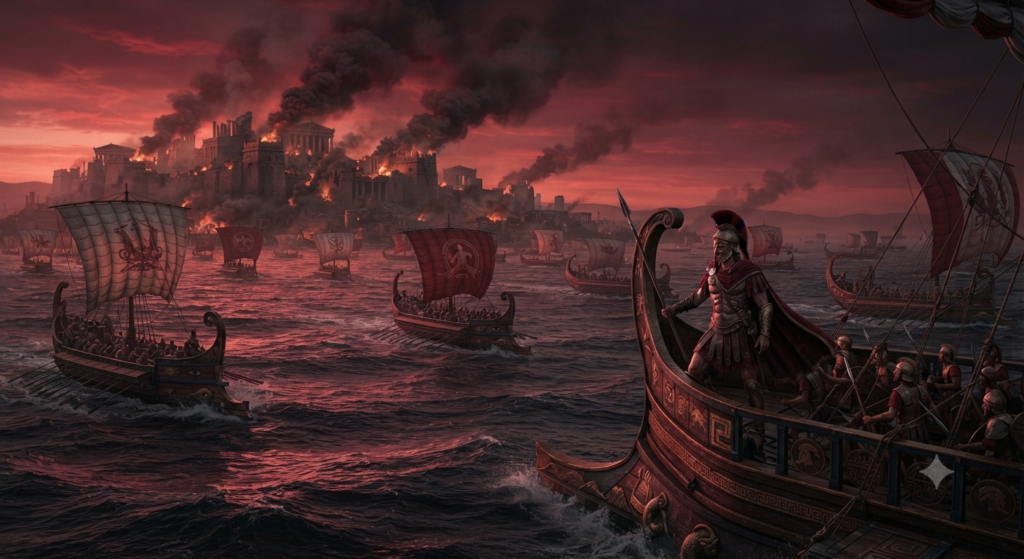
When Troy fell, the Greek army did not remain long on the Trojan shore. Homer and later tradition present the victors as eager to leave, though not everyone departed at the same moment or by the same route. Some heroes were already marked by offense against the gods or by bad omens during the sack, and the gathering fleet carried with it the burden of sacrilege, division, and loss. The war had been won, but the homeward voyage was not secure.
The Odyssey assumes a broad background of Greek return, even though it centers on Odysseus. Other surviving epics from the Trojan cycle, now lost except in fragments and summaries, treated the departures of the different leaders in more detail. This wider mythic memory explains why the Greeks after Troy appear not as a single convoy sailing neatly west, but as a dispersed set of homecomings, some swift and some disastrous.
Odysseus and the homeward voyage
Odysseus is the most famous Greek traveler leaving Troy, yet his departure is delayed and complicated from the start. In Homer, he does not simply sail out of the harbor and head for Ithaca. His route is broken by storms, encounters, and divine anger, especially the hostility of Poseidon, whose wrath follows him because of the blinding of Polyphemus. Odysseus’ homecoming becomes the model of the impossible return: the war is over, but the sea still tests him.
At the same time, Odysseus’ story preserves the memory that Greek return was never just geographical. To sail from Troy was to move from warfare into the uncertain realm of divine justice, where a man’s conduct during the sack could determine his fate. The Odyssey repeatedly contrasts the desire to go home with the reality that the gods, omens, and prior offenses can alter the path completely.
How the ships cleared the Trojan shore
The ships cleared the Trojan shore in stages rather than all at once. After the sack, the Greeks carried off spoils, divided the captives, and prepared the vessels for departure. Homeric poetry often compresses this process, but the underlying picture is clear: the army had to regroup, launch its ships, and leave a devastated coast that still held the memory of violence. Once the wind was favorable, the oarsmen drove the vessels away from the mainland and into open water.
Some traditions imply that certain leaders delayed their sailing because of sacrifices or because the gods withheld favorable signs. Others left immediately but met misfortune shortly afterward. This uneven departure is important to the mythology of the post-Troy world. The sea does not receive the Greek victors as honored guests; it becomes the threshold where the consequences of the war begin to unfold.
Sacrifices, omens, and the first departure
Greek departure from Troy was closely tied to sacrifice and divination. In Homeric culture, a ship did not simply launch by human will alone; the gods had to be acknowledged, and favorable signs mattered. Before or during departure, leaders offered prayers and sacrifices, seeking safe passage. Yet the signs were not always reassuring, and after the fall of a city stained by slaughter, the ritual relationship between mortals and gods was especially fragile.
The most important omen in the wider tradition is the grim warning that followed the Greeks because of their treatment of sacred places and suppliants. Later mythographers, especially those preserving versions of the Nostoi, connect many of the disasters at sea to sacrilege committed during or after the sack of Troy. Even when the poems do not spell out every rite in full, they make clear that the first departure was shadowed by divine judgment rather than protected by it.
The divided returns of the Achaean heroes
The Greek heroes did not all arrive home together, and some never truly completed the journey. Menelaus wandered through Egypt and elsewhere before reaching Sparta; Agamemnon came home only to be murdered; Ajax the Lesser perished at sea after offending Poseidon; Neoptolemus reached home by a different route in some traditions; Diomedes experienced exile or displacement in later legend. The return of the Achaean heroes is therefore a mosaic of separate stories rather than one orderly exodus.
Homer’s Odyssey is especially interested in this fractured pattern because it mirrors Odysseus’ own uncertainty. The Greek world after Troy is not unified by victory. Instead, each leader’s return reveals a different kind of vulnerability: betrayal at home, shipwreck, divine punishment, wandering, or death. The sea after Troy is not merely a highway back to Greece; it is the medium through which the costs of war are revealed.
Athena, Poseidon, and a troubled sea
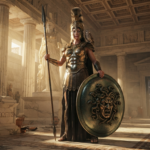
Among the gods, Athena and Poseidon stand at opposite poles in the Odyssey. Athena supports Odysseus, guiding his eventual restoration, while Poseidon opposes him because of the insult done to his son Polyphemus. This divine conflict shapes the atmosphere of the return voyage. Even where Athena helps, she does not simply remove danger; she works within a world already made unstable by Poseidon’s hostility and by the general disorder left after Troy’s fall.
The sea is troubled not only in a physical sense but as a theological space. In Greek thought, navigation depended on divine goodwill, seasonal weather, and practical seamanship all at once. When Poseidon turns against a hero, the water itself becomes a sign of his anger. Odysseus’ long suffering thus reflects a larger mythic principle: after Troy, the Greeks sail under the memory of a war that offended the sea gods, the sky gods, and the moral order alike.
Missing men and ships lost after Troy
Many ships and men were lost on the way home from Troy. Some losses are recorded in the epic tradition; others belong to later retellings. Ajax the Lesser is the clearest example of a post-Troy disaster caused by impiety, since Athena and Poseidon combine in his destruction after his offense against divine protection and sacred refuge. Other heroes lose companions in storms or in foreign lands, so that the return from Troy becomes a sequence of dwindling crews.
This attrition matters because it explains why the homecoming narratives are so often solitary or intimate. Odysseus does not arrive with a great fleet; he loses ship after ship until only his own suffering remains. That reduced scale is not an invention of later imagination but a faithful expression of the tradition: Troy sends many ships out, yet the sea and the gods allow very few to return intact.
Wind, storms, and divine hindrance at sea
Wind is one of the most important forces in the post-Troy voyages. In Homer, favorable winds can carry a fleet swiftly, while contrary winds trap it far from home. Aeolus, the keeper of the winds, appears in Odysseus’ journey as a figure who can both aid and complicate travel. Elsewhere in myth, storms are signs that the gods have closed the path, at least for the moment. A Greek ship after Troy was never simply mastering the sea; it was negotiating with powers that could change direction in an instant.
Divine hindrance often overlaps with natural danger. A storm may be ordinary weather in one sense and punishment in another. Greek myth does not sharply separate those categories. When the winds drive Odysseus off course, or when Zeus sends a storm against a returner, the event is both meteorological and moral. That fusion is essential to understanding how the Greeks sailed from Troy in the Odyssey: they sailed by human skill, but they moved under a sky that could refuse them passage.
The route from Ilion to the Aegean
From Ilion, the Greek ships had to leave the Troad, pass into the broader waters of the Aegean, and then aim for the various homelands scattered across the Greek world. The exact route varied by hero and by tradition. Some sailed directly toward the islands and mainland coasts of Greece, while others were blown east, south, or north by storms. Odysseus’ own route is the most elaborate, carrying him through lands of the Cicones, Lotophagi, Cyclopes, and beyond before he can even re-enter the familiar sea lanes of the Aegean.
Geographically, the journey reflects the real hazards of Bronze Age and early Greek seafaring, but Homer turns those hazards into mythic landscape. The departure from Troy is therefore not just a matter of leaving one shore for another. It marks entry into a world where known routes can dissolve, where islands become tests, and where the sea itself seems to remember the violence of the war.
Why the Greeks did not sail straight home
The Greeks did not sail straight home because, in myth, Troy had left them burdened by divine, moral, and practical obstacles. Some had offended the gods during the sack; some were condemned by omens; some were simply blown off course; and some were destined to suffer as examples of the limits of human victory. Homer’s world assumes that a successful war does not guarantee a successful return. To come home requires more than ships and sails.
The Odyssey turns this truth into epic form. The Greeks’ passage from Troy becomes a lesson in the fragility of human plans once the gods, the winds, and the sea have their say. Victory at Ilion was only the beginning of another struggle, and the scattered returns of the Achaean heroes show that the road from Troy to home was never straight, brief, or safe. In the end, the Greeks sailed from Troy as victors who were no longer fully masters of their own fate. Their ships carried spoils, prisoners, and the memory of a ruined city, but they also carried the consequences of the war itself. The Odyssey preserves this afterlife of Troy in the form of wandering, loss, and delayed return, making the voyage home as significant as the siege that preceded it.

Orin Vale has spent the better part of two decades tracing the threads that connect the world’s oldest stories — from the halls of Asgard to the banks of the Nile, from Olympus to the jungles of the Maya. What began as a childhood fascination with flood myths and trickster gods grew into years of independent study across comparative mythology and ancient religion, always chasing the same question: what did these stories mean to the people who first told them? Orin writes for readers who want more than trivia — the ones looking for the beliefs, fears, and truths that myths were built to carry.