The myth of the winged golden ram belongs to the world of Greek legend, where divine animals often appear at the turning points of human suffering and heroic quests. The creature at its center is usually called Chrysomallos, the golden-fleeced ram sent to rescue Phrixus and Helle, children of King Athamas. In later tradition, its fleece became the object sought by Jason and the Argonauts, making the ram a figure that links rescue, sacrifice, and kingship with one of the most famous adventures in Greek myth.
The winged golden ram in Greek myth
The winged golden ram is not a separate beast from Greek tradition, but the marvelous ram associated with the Golden Fleece. In the standard mythic account, it is a divine animal with golden wool and the power of flight, sent to carry away two imperiled children. Its appearance belongs to the sacred and symbolic world of Greek myth, where the boundary between beast and divine instrument is often fluid. The ram is not described in Homeric epic in detail, but later mythographers and poets preserve its story as part of the larger cycle leading to the Argonauts.
Greek sources treat the ram as a miraculous gift rather than an ordinary creature. The ram’s wings and golden fleece mark it as an object of divine intervention, and its role is inseparable from the fate of Phrixus. In that sense, the winged golden ram is both a rescuer and a sign: it carries the saved child away, and it leaves behind a fleece that becomes a royal treasure and a future quest.
Phrixus, Helle, and the divine rescue
The story begins with Phrixus and Helle, children of Athamas, king of Boeotia, and in many versions his first wife, Nephele. Their stepmother, usually named Ino, plots against them in order to secure the succession for her own children. Ancient sources vary in the details of the crisis, but the basic pattern is consistent: famine, false ritual, and political intrigue place the siblings in mortal danger. In the hour of need, a divine rescue arrives in the form of the winged ram.
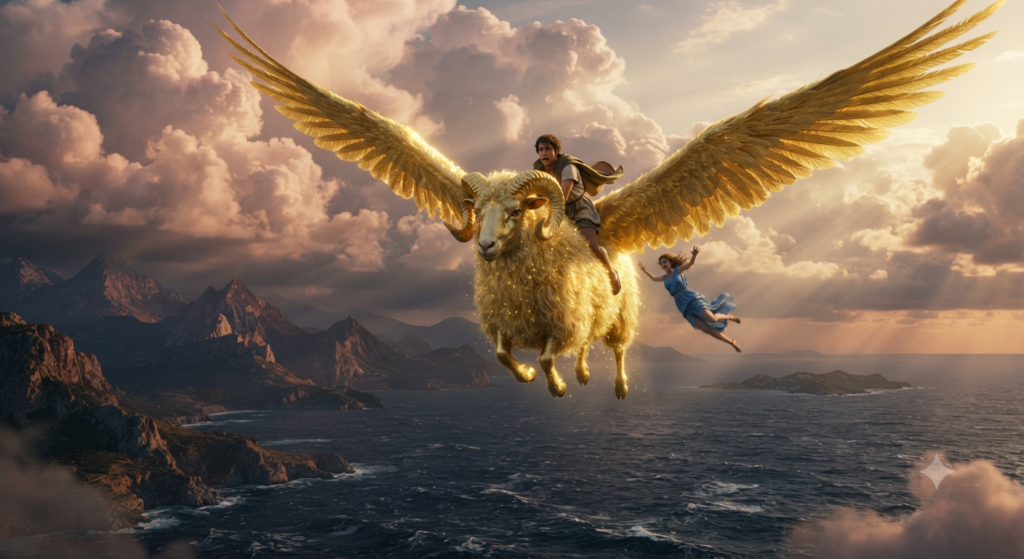
Phrixus and Helle mount the ram and are borne away from Greece. The image is one of dramatic deliverance, but it also carries the tragic tension typical of Greek myth. The escape saves one child and condemns the other to loss. The ram functions as a mediator between the human household and the gods, turning private dynastic violence into a myth that explains places, rites, and later heroic ambition.
Golden fleece and the ram’s sacred role
The ram’s Golden Fleece is the feature that gave the myth its lasting power. In later Greek tradition, the fleece is not merely decorative; it is a token of divine favor, wealth, and legitimate authority. When Phrixus reaches safety, the ram is honored by sacrifice in some accounts, and the fleece is dedicated to Zeus or given to King Aeëtes in Colchis. The exact destination differs across ancient tellings, but the sacred quality of the fleece remains central.
This is why the fleece becomes such an important symbol in Greek myth. It represents the visible trace of a god-sent deliverance, yet it is also a material object that can be guarded, claimed, and contested. The ram itself, having completed its task, disappears from the human sphere, but its fleece continues to shape mythic history. That transformation from living animal to ritual prize is a familiar pattern in Greek religion and legend.
Hermes, Nephele, and a cloud-born gift
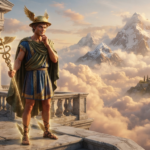
The ram’s origin is given in different ways by ancient authors. In many later sources, Nephele—whose name means “cloud”—is credited with the gift, and some traditions connect the ram to the divine world through Hermes. This makes sense within Greek mythic logic: a cloud-born mother and a messenger god together explain a creature that can move between earth and sky. The ram is therefore not random magic but a deliberate divine intervention.
Not all sources agree on the precise genealogy of the beast, and careful retellings should preserve that uncertainty. Some accounts emphasize Nephele’s role, others Hermes’ agency, and still others simply present the ram as a miraculous creation without elaborating on its origins. What remains stable is its status as a god-sent rescuer. The myth does not require a single rigid explanation to work; its power comes from the image of supernatural aid arriving at the edge of disaster.
The flight over sea and mountain passes
The journey of Phrixus and Helle is one of the most memorable flights in Greek myth. Carried high above the world, they pass over sea and land in a passage that dramatizes both speed and peril. The ram’s wings allow escape from domestic tyranny, but the route itself becomes dangerous. The sea below is not neutral landscape; it is an active threshold between survival and death.
Ancient storytellers often focus on the geography of the flight because the myth was used to explain real places. The route over the straits and promontories of the Aegean gave the tale a lasting topographical life. The winged ram is thus not only a creature of wonder but also a mythic navigator, one whose path maps ancient memory onto the Mediterranean world. Its flight links household tragedy in Boeotia to distant lands beyond the Black Sea.
Helle’s fall into the Hellespont legend
The most tragic moment in the myth is Helle’s fall. As the ram flies onward, Helle loses her grip and plunges into the waters below. The strait where she falls is thereafter associated with her name, becoming the Hellespont in Greek explanation. This is one of the classic examples of an etiological myth, one that explains a place-name through a story of divine or heroic events.
The fall gives the winged ram myth its double character: rescue and loss, ascent and descent. Phrixus survives, but the myth refuses simple triumph. Helle’s death or drowning is treated with solemnity in ancient tradition, and her name remains attached to geography rather than to a continuing role in the story. The ram, still bearing Phrixus onward, becomes inseparable from this sorrowful etymology.
Colchis and the origin of the fleece quest
Phrixus is carried to Colchis, the far eastern land on the edge of the Greek imagination, where King Aeëtes receives him. There, in the most common versions, Phrixus sacrifices the ram or otherwise dedicates its fleece, which is then guarded in a sacred place. This deposit is the starting point for the later quest of Jason. The myth of the winged golden ram therefore reaches beyond rescue into heroic destiny.
Colchis matters because it transforms the ram’s fleece into an object of political and mythic desire. The Golden Fleece is no longer a relic of deliverance alone; it becomes a treasure to be won through ordeal. Greek myth often turns a sacred object into the goal of a dangerous journey, and this one is among the most famous. Without the ram’s flight, there would be no Argonautic expedition in the form later literature celebrates.
Chrysomallos in later Greek tradition
Later Greek tradition gives the ram the name Chrysomallos, often rendered as “golden wool.” Under this name, the creature appears more clearly as a distinct mythic figure, though the core story remains the same. Chrysomallos is remembered not simply as a means of transport but as a divine animal whose fleece becomes famous across the Greek world.
The later tradition also sharpens the ram’s symbolic value. Chrysomallos stands for rescue, sacrifice, and the transfer of sacred power from one land to another. In artistic and literary retellings, the ram’s wings and golden coat emphasize its otherworldly status. The name itself helps fix the beast in memory, even though earlier sources are less interested in naming it than in narrating what it did.
Apollodorus and other ancient accounts
Among the clearest ancient prose summaries is Apollodorus in the Bibliotheca, which gives a concise version of the story of Phrixus, Helle, and the Golden Fleece. Other sources, including later mythographers, scholia, and poets, preserve variations in emphasis and detail. Some accounts differ on who sent the ram, how the sacrifice occurred, and where exactly the fleece was kept, but the essential arc remains recognizable.
Because Greek myth survives through multiple authors rather than a single canonical text, the winged ram’s story should be read as a tradition with layers. Hesiodic material, lost epic cycles, Apollodoran summaries, and later literary elaborations all contribute something. The result is not confusion so much as richness: a myth shaped by retelling across centuries, with the ram at its center as a stable emblem of divine rescue.
Why the winged ram still matters today
The myth of the winged golden ram endures because it combines vivid imagery with enduring themes. It speaks of children in danger, divine intervention, tragic separation, and the long afterlife of a sacred object. The ram is at once a deliverer and the source of a future quest, a figure that turns personal survival into collective legend. That balance between wonder and loss gives the story its lasting force.
In modern reception, the Golden Fleece often overshadows the ram itself, yet the creature is the heart of the tale. Without the winged ram, there is no flight over the sea, no Hellespont explanation, and no path to Colchis. The myth remains compelling because it shows how Greek tradition often works: a single divine act can generate geography, ritual memory, and heroic history all at once.
The winged golden ram is, at its core, the story of a miraculous rescue that becomes a world-shaping legend. Through Phrixus and Helle, Greeks explained a tragic place-name, a sacred fleece, and the origins of one of their greatest heroic quests. Chrysomallos survives in memory not as a simple beast, but as a golden, winged sign of how myth turns suffering into meaning.

Orin Vale has spent the better part of two decades tracing the threads that connect the world’s oldest stories — from the halls of Asgard to the banks of the Nile, from Olympus to the jungles of the Maya. What began as a childhood fascination with flood myths and trickster gods grew into years of independent study across comparative mythology and ancient religion, always chasing the same question: what did these stories mean to the people who first told them? Orin writes for readers who want more than trivia — the ones looking for the beliefs, fears, and truths that myths were built to carry.