Apollo was one of the most widely honored gods in the Greek world, worshiped as a deity of prophecy, music, healing, plague, and order. The ancient Greeks did not approach him with a single fixed prayer formula. They honored Apollo in sanctuaries, spoke to him through hymns and vows, brought offerings, and sought his guidance through oracles, especially at Delphi. His worship could be public and magnificent or intimate and practical, depending on whether a city, a household, or an individual was seeking his favor.
Apollo’s shrines and sacred spaces in Greece
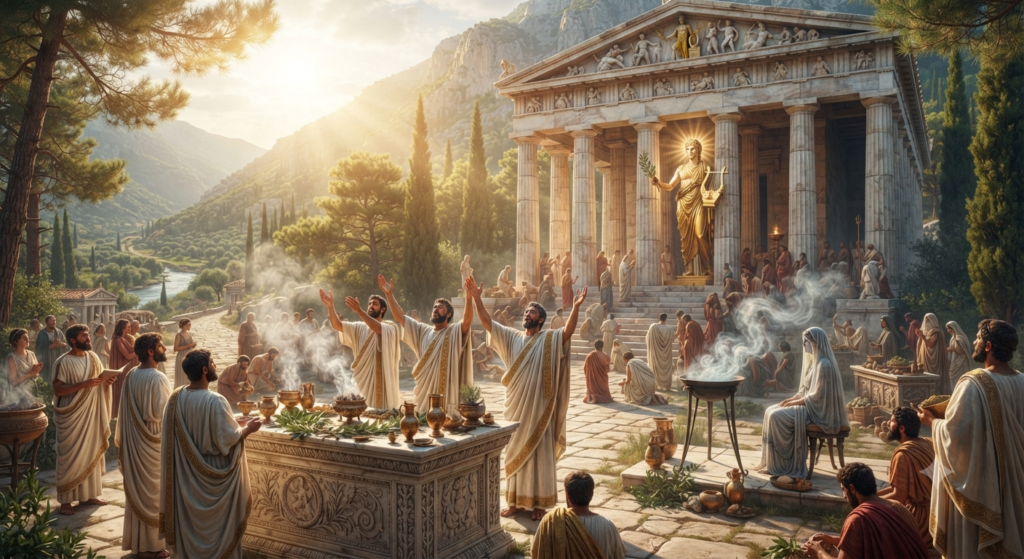
Apollo was not confined to one sacred place. His worship spread across the Greek world in sanctuaries that could stand on mountain slopes, island shores, city centers, and prophetic springs. Delphi was the most famous of these places, but other important shrines included Delos, Didyma, Claros, and many local temples dedicated to Apollo in particular cities. Each space gave a different shape to devotion, yet all reflected the same idea: Apollo was a god to be approached with reverence, order, and ritual cleanliness.
These sanctuaries were more than buildings. They were environments marked off from ordinary life, where the divine could be met through sacrifice, prayer, and consultation. In Homer and later sources, Apollo is closely linked with holy precincts and well-built temples, and by the classical period his sanctuaries had become major centers of ritual life. A Greek who prayed to Apollo usually did so in a place already made sacred by tradition, myth, and repeated worship.
How Greeks approached the god of prophecy
Apollo’s prophetic aspect was central to his identity. In myth and cult, he was the god who revealed hidden things, whether through an inspired priestess, a sacred sign, or the interpretation of omens. Greeks who came to him for guidance did not treat prophecy as casual fortune-telling. They approached it as a formal encounter with divine knowledge, one that required respect, patience, and often sacrifice.
Requests to Apollo often concerned war, colonization, illness, household troubles, or political decisions. The question was usually phrased carefully, sometimes in the form of a consultation rather than a simple plea. The petitioner did not merely ask for information; they sought alignment with the god’s will. This is one reason Apollo’s prayers frequently included acknowledgments of his power, his wisdom, and his ability to grant what mortals could not secure for themselves.
Prayers, hymns, and ritual words to Apollo
Greek prayer to Apollo was usually spoken aloud and followed a recognizable pattern. The worshiper began by naming the god and recalling some aspect of his power or previous kindness. Then came the request, often accompanied by a promise of gratitude or future honor. This structure appears throughout Greek literature and ritual: invocation, reminder of divine favor, and petition. Prayer was a relationship, not a transaction alone.
Hymns were especially important in Apollo’s worship. The Homeric Hymns, though not all composed in the same period, preserve the kind of language Greeks used to praise him as the archer god, the lyre-player, and the bearer of divine order. In sanctuary settings, hymns and spoken prayers could be joined with music, procession, or chant. Apollo, who governed song as well as prophecy, was especially suited to worship through measured and elevated words.
Offerings of laurel, wine, and first fruits
Prayer was commonly accompanied by offerings. One of Apollo’s most characteristic plants was laurel, associated with his myth through Daphne in later tradition and deeply embedded in Greek sacred practice. Laurel branches, wreaths, and leaves could mark devotion, purification, and victory. Because Apollo was also linked with healing and protection, plant offerings had both symbolic and practical significance.
Wine and first fruits were also brought to his altars. Libations of wine were poured as a visible sign of respect, while first fruits represented the gift of what the earth had yielded. These offerings honored Apollo as a god who preserved order in the world and rewarded human prosperity. In agricultural communities especially, giving the first portion of a crop acknowledged that abundance ultimately belonged to the divine before it belonged to the household.
Seeking Apollo at Delphi and other oracles
Delphi was the most renowned place where Greeks prayed to Apollo for answers. There, the god was believed to speak through the Pythia, his priestess, whose words required interpretation. Pilgrims came from across the Greek world and beyond, carrying questions for individuals, cities, and kings. The oracle’s reputation rested not simply on mystery but on the authority of Apollo as a source of truth beyond ordinary human sight.
Other oracular centers also served his worship, and ancient sources show that Apollo’s prophetic power was not limited to one sanctuary. At Didyma and Claros, among others, petitioners also sought divine messages. The practical form of the consultation varied from place to place, but the meaning remained consistent: to pray to Apollo in an oracle was to submit one’s uncertainty to the god who sees what mortals cannot. Silence, ritual preparation, and formal questioning all reinforced the gravity of the encounter.
Purification before speaking to the god
Purification was an essential part of approaching Apollo. The Greeks believed that contact with blood, death, sexual pollution, or other forms of ritual miasma could make a person unfit to stand before a god. Before praying at many sanctuaries, worshipers washed themselves, avoided certain foods or actions, and observed ritual restrictions. Apollo, despite his association with healing, was also a god whose presence demanded order and cleanliness.
At Delphi, purification was especially important. Ancient sources describe ritual washing and other preparatory acts before consultation. The logic was not moral in the modern sense, but religious: one entered sacred space in a condition appropriate for contact with the divine. Prayer to Apollo began before words were spoken, in the disciplined arrangement of body and behavior.
Sacrifice and libation in Greek worship rites
Sacrifice stood at the center of Greek religious practice, and Apollo received his share of it. Animals might be offered according to local custom, with the ritual meat later shared among worshipers or dedicated in part to the god. The act of sacrifice made prayer visible. It showed that the petitioner had something to give, not merely something to ask for. In this sense, sacrifice supported the spoken plea and gave it weight.
Libation was equally important and often more common in daily settings. Wine, water, milk, or honey could be poured onto the ground, onto an altar, or into a vessel for the god. The pouring itself marked the transition from ordinary speech to sacred address. In Homer and later Greek practice, libation often accompanied prayer as a sign that the speaker recognized Apollo’s sovereignty and sought his presence in a formal way.
Public festivals, songs, and Apollo’s favor
Apollo was honored in festivals that joined prayer with civic identity. Since he was connected to music, purification, and public order, his rites often included processions, contests, choral singing, and communal sacrifice. In many cities, especially during seasonal festivals, his worship expressed the health of the community as a whole. To pray to Apollo in public was to seek not only personal benefit but the stability of the city and the favor of its protecting god.
Songs played a special role in these gatherings. Paeans, hymns of thanksgiving or supplication, were closely associated with Apollo. Their rhythm and repetition gave structure to communal devotion. In times of danger, plague, or victory, a paean could become both prayer and declaration. It expressed trust that Apollo, as healer and guardian, could restore balance where disorder had entered.
Votive gifts left in temples and sanctuaries
Many worshipers expressed their prayers by leaving votive gifts in Apollo’s sanctuaries. These could be small objects, inscriptions, statues, weapons taken from enemies, or personal items dedicated after a favor had been received. Votive offerings made a promise tangible. They recorded gratitude, but they also preserved memory, showing that a specific prayer had been heard or at least answered in a meaningful way.
Some dedications were public and monumental, especially those made by cities after victory or deliverance. Others were modest and personal. Either way, they extended prayer beyond the spoken moment. A gift left in Apollo’s temple stood as an enduring sign of relationship between god and worshiper. It also helped bind the sanctuary to the history of the people who visited it, turning religious experience into lasting tradition.
Family prayers, healing, and daily devotion
Apollo was not only a god of oracles and cities. Families also prayed to him for protection, health, and help in ordinary life. Because he was associated with healing and warding off disease, he could be invoked in household prayer when illness threatened. In such settings the language of devotion was often simple and direct, but still marked by reverence. A family might ask Apollo to keep away plague, preserve children, or restore strength to the sick.
Daily devotion to Apollo could include small acts of remembrance: a libation, a laurel branch, a spoken plea, or a short hymn. These gestures reveal how integrated the god was in Greek life. He was not approached only in moments of crisis. He was also honored as a steady presence in music, health, and order. To pray to Apollo was to recognize a power that moved between the household and the sanctuary, between human need and divine intelligence.
The ancient Greeks prayed to Apollo with words, song, sacrifice, and ritual discipline. They sought him in prophecy, honored him with laurel and libation, purified themselves before his altars, and left gifts to mark answered prayers. Whether in the splendor of Delphi or the quiet of a household, devotion to Apollo reflected a central Greek belief: that the gods were not distant abstractions, but powers to be met through careful rites, respectful speech, and enduring remembrance.

Orin Vale has spent the better part of two decades tracing the threads that connect the world’s oldest stories — from the halls of Asgard to the banks of the Nile, from Olympus to the jungles of the Maya. What began as a childhood fascination with flood myths and trickster gods grew into years of independent study across comparative mythology and ancient religion, always chasing the same question: what did these stories mean to the people who first told them? Orin writes for readers who want more than trivia — the ones looking for the beliefs, fears, and truths that myths were built to carry.