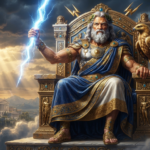
In Greek mythology, winter is not usually embodied by a single sovereign figure in the way a later culture might imagine a “god of winter.” Instead, the season emerges through a cluster of divine powers: the cold north wind, the biting storms that sweep across the sea, the frost that silences the land, and, in some traditions, the absence of growth when Persephone descends beneath the earth. If one asks who personifies winter in Greek mythology, the closest and most enduring answer is Boreas, the North Wind, whose icy breath brings the harshness of the season. Yet the Greeks did not reduce winter to one name alone; they understood it as a force shared among winds, weather, and seasonal myth.
Winter in Greek Mythology: the Figure Behind It
Greek mythology does not present winter as a neatly personified deity with a single, fixed identity. Unlike later personifications of the seasons, Greek tradition tends to distribute winter’s character among gods and daimonic powers connected with weather and the changing year. The Greeks saw the cold months as a time ruled by wind, rain, storm, and barrenness, all of which had divine causes. Thus, the answer to who personifies winter in Greek mythology depends on whether one means the season’s harsh physical presence or its symbolic role within myth.
Among these powers, Boreas stands out most clearly. He is not winter itself in a strict agricultural sense, but he is the divine force most associated with its arrival and severity. Ancient sources describe him as the north wind, fierce and snow-bringing, a wind that darkens seas and stiffens the earth. Other figures, such as Chione, the personification of snow in some later traditions, deepen the seasonal image, but Boreas remains the principal mythic embodiment of winter’s cold.
Who Personifies Winter in Greek Mythology?
If a single figure must be named, Boreas is the strongest candidate. In Greek thought, he personifies the north wind and therefore the cold, stormy aspect of winter. He is one of the Anemoi, the winds, and his presence signals freezing air, rough seas, and the arrival of snow in the northern reaches of the Greek world. His role is elemental rather than royal: he does not govern winter from a throne, but manifests it through motion and force.
At the same time, the Greeks did not consistently treat winter as a fully personal god. The season was often understood through seasonal change itself, especially in relation to Demeter and Persephone. When the earth becomes barren, myth explains the absence of life through divine narrative rather than a single winter deity. So while Boreas personifies winter most directly, the season in Greek mythology is more accurately a network of divine signs than a lone figure.
Boreas and the Cold North Wind of Winter
Boreas is the son of Astraeus and Eos in Hesiodic tradition, belonging to the generation of wind gods. His home is in Thrace, a region often imagined by Greeks as cold, rugged, and close to the edge of civilization. From there he rushes southward, bringing winter’s sharp air. He is frequently described as powerful, bearded, and winged, a violent but natural force rather than an Olympian ruler.
His mythic presence is tied to both destruction and usefulness. Boreas can wreck ships and freeze the land, but he also clears the sky and moves the seasons along. In some stories, he abducts Oreithyia, an Athenian princess, a myth that reflects the wind’s sudden and overpowering nature. That tale also helps explain why Boreas became an important divine figure in Athens, where he was honored as a protector in later tradition.
Chione, the Snow Maiden of Greek Legend
Chione is a more literal personification of snow than winter itself. Her name means “snow,” and in myth she appears as a daughter of Boreas and Oreithyia in some traditions. As with many Greek mythic figures, her role is not uniform across sources, and she is not as prominent as Boreas. Still, she represents the cold, white aspect of winter that Boreas brings with him.
Some stories about Chione are brief and genealogical, while others connect her with beauty, transience, and the fragile nature of snow. She should not be confused with other women of the same name in Greek myth, since “Chione” is used for more than one figure. In the context of winter, however, she belongs to the symbolic language of snow, making her a poetic companion to Boreas rather than a replacement for him.
The Season of Winter in Ancient Greek Thought
For the Greeks, winter was not only weather but a stage in the rhythm of life. The agricultural year depended on the alternation of heat and cold, growth and dormancy. Winter marked the time when cultivation slowed, sailing became dangerous, and communities turned inward. This seasonal reality gave winter a strong place in religious and poetic imagination, even when it lacked a single dominant deity.
Ancient Greek thought often framed the seasons through the actions of gods who control fertility, wind, and the underworld. Winter could be explained by the withdrawal of life-giving powers, especially in myths linked to Demeter and Persephone. The season therefore carried both practical and sacred meaning: it was the time when the land appeared to sleep, and myth gave that sleeping earth a divine explanation.
Harsh Winds, Frost, and the Northern Gods
The Greeks distinguished among different winds, each with its own temperament and direction. Boreas was the north wind, harsh and cold; Notos brought the south wind and storms; Zephyrus was the gentle west wind; Eurus was the unstable east wind in later poetic tradition. Among these, Boreas held the clearest connection to winter because he brought frost and snow from the north.
This network of wind gods reflects how the Greeks experienced climate as a living system. Winter was not abstract; it was felt in the body, in the sea, in the fields, and in the home. The northern gods, especially Boreas, gave shape to those experiences. Their myths explain why winter was feared, respected, and incorporated into sacred language rather than treated as mere weather.
Persephone’s Descent and the Winter Season
In the well-known Homeric Hymn to Demeter, Persephone’s descent to the underworld becomes the mythic explanation for the earth’s barrenness. Demeter mourns her daughter, withdraws her favor, and the land ceases to bear fruit. Although the hymn is not a direct allegory of winter in the later sense, it strongly influenced how Greeks understood seasonal absence and agricultural dormancy.
Different regions and periods may have linked this story to the cold months in varying ways. In that sense, Persephone’s cycle complements Boreas’s role: one explains the loss of fertility, the other the cold force that descends upon the world. Together they form a seasonal mythology in which winter is not one being, but a convergence of divine absence and divine force.
Boreas in Homer, Hesiod, and Later Sources
Hesiod presents Boreas among the wind gods, embedded in the cosmic family of Dawn and the stars. Homer likewise knows the winds as powerful, divine agents, though not always with the same genealogical emphasis. These early sources establish the basic identity of Boreas as a force of nature with personality and agency. He is not a minor poetic invention; he is part of the classical grammar of the world.
Later authors elaborate his character and stories. Apollodorus preserves genealogical details, while Roman-era writers and mythographers often expand Boreas’s relationships and feats. By the time of later antiquity, his connection with winter, Thrace, and snow was firmly established. Across these sources, the consistency is striking: Boreas remains the most enduring mythic face of cold weather in the Greek tradition.
Snow, Storms, and the Greek Landscape in Winter
The Greek landscape made winter vivid. Mountain passes could become treacherous, coastlines dangerous, and inland regions bleak under frost and rain. In such a setting, the image of a snow-bringing wind god was not remote symbolism but a poetic description of lived reality. Boreas belonged to a world where the elements were understood as divine powers moving through visible terrain.
Snow itself was less central in Greek mythology than in northern European traditions, but it still carried symbolic force. When it came, it marked severity and unusual cold, especially in higher regions and northern lands. That is why the mythic imagination associates snow with a figure like Chione, yet leaves the larger dominion of winter to Boreas, whose breath can summon storms, ice, and the silence of the season.
The Mythic Personification of Winter Among Greeks
The most accurate answer to who personifies winter in Greek mythology is Boreas, the north wind. He is the clearest divine embodiment of winter’s cold power, the force that makes the season feel alive and hostile. Chione may personify snow in a narrower sense, while Persephone’s descent explains the earth’s dormancy, but Boreas stands closest to winter as a whole. Greek mythology rarely assigns the season to one exclusive figure, yet Boreas remains its most recognizable face.
Winter in Greek myth is therefore best understood not as a single god, but as a pattern of divine forces gathered around cold, absence, and change. Boreas gives the season its breath, Chione gives it snow, and Persephone’s story gives it the silence of the earth. Taken together, these figures reveal how the Greeks transformed a difficult season into a living mythic landscape, where weather, fertility, and the underworld all belonged to the same sacred order.

Orin Vale has spent the better part of two decades tracing the threads that connect the world’s oldest stories — from the halls of Asgard to the banks of the Nile, from Olympus to the jungles of the Maya. What began as a childhood fascination with flood myths and trickster gods grew into years of independent study across comparative mythology and ancient religion, always chasing the same question: what did these stories mean to the people who first told them? Orin writes for readers who want more than trivia — the ones looking for the beliefs, fears, and truths that myths were built to carry.