In Greek mythology, the stars symbolize far more than distant lights in the night. They are signs of divine presence, marks of cosmic order, and reminders that the boundary between gods and mortals is never fixed. In the poems and myths of Greece, stars can record punishment, reward, guidance, prophecy, and remembrance. They shine above heroes who have fallen, above lovers separated by loss, and above the seasonal rhythms that governed ancient life.
The Greeks looked to the sky as a living mythic landscape. Some stars were imagined as gods’ handiwork, some as transformed beings, and some as celestial warnings sent to those who knew how to read them. Across epic poetry, local legend, and later retellings, the heavens became a place where human stories were preserved in brilliant form.
Stars as signs of divine power in Greek myth
In Greek myth, stars often appear as visible evidence of divine power operating across the cosmos. The sky itself is not empty space but a realm shaped by gods, especially Zeus, whose authority extends over thunder, fate, and the broader order of heaven. When a star flashes, falls, or is placed among the constellations, it can suggest that a divine will has entered the human world and left a mark that ordinary eyes can still see.
This symbolism is especially strong in stories where the gods transform creatures or heroes into celestial forms. Such changes are not merely decorative rewards or punishments; they reveal that the gods possess the power to rewrite a being’s place in the universe. A star becomes a sign that divine action can outlast mortal life, turning fleeting existence into a permanent part of the heavens.
The night sky and the order of Olympus
The Greeks imagined Olympus not only as a mountain but also as the center of a structured cosmic order that reached into the sky. The stars moved according to patterns that suggested balance, hierarchy, and measure, qualities associated with divine rule. Their regular rising and setting reflected a universe governed by forces greater than human will.
This order mattered in myth as much as in observation. The heavens were a domain where gods displayed stability, while mortal life remained changeable and vulnerable. The stars therefore symbolized a higher pattern that humans could glimpse but never fully control, a reminder that the world had been arranged with purpose even when that purpose was difficult to endure.
Astral symbols in Homeric and Hesiodic lore
In Homer and Hesiod, stars are both poetic images and practical markers of time, travel, and labor. Homer often uses celestial references to situate scenes under the fixed rhythms of the night, while Hesiod gives the stars a more explicit role in agricultural and seasonal life. In Works and Days, the rising and setting of certain stars helps guide the farmer’s calendar, linking heaven to human work.
These early texts show that astral symbolism in Greek tradition was not abstract alone. Stars could represent divine order, but they were also tools of knowledge. To watch the sky was to participate in a world where myth, timing, and survival met. The heavens offered not just beauty, but instruction, and the poets treated that instruction as part of the gods’ gift to humankind.
Constellations born from gods and heroes
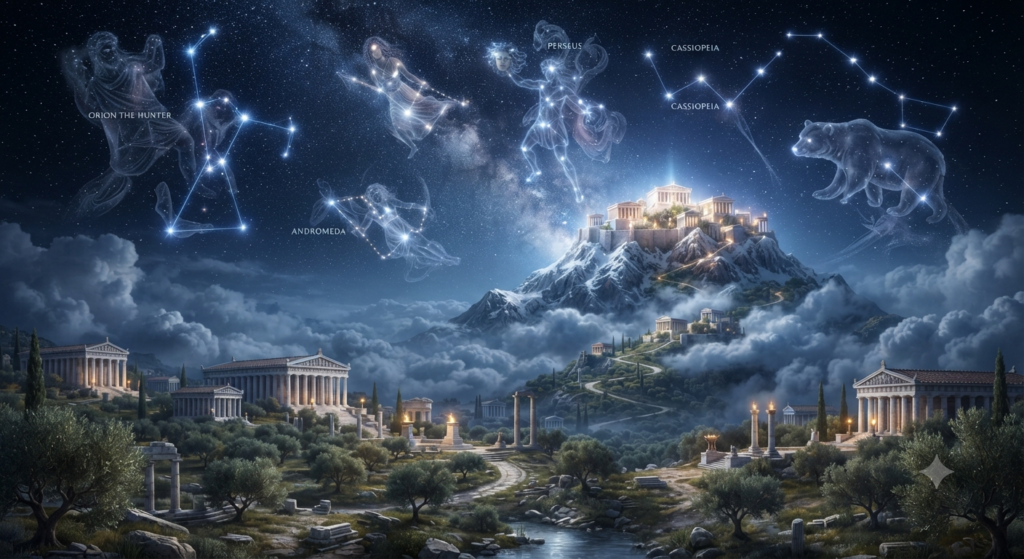
Many Greek constellations were explained as transformed figures, a mythic way of preserving memory in the sky. A hero, hunter, maiden, or beast might be placed among the stars so that later generations could still recognize their story. This gave the constellations a double role: they were patterns for navigation and also monuments to myth.
The logic of such stories is consistent even when details vary by author. A figure lifted into the heavens does not disappear; instead, they become visible in a new, eternal form. In that sense, constellations symbolize remembrance. They ensure that the deeds, sufferings, and relationships of mythic beings remain legible long after their earthly moment has passed.
Orion, Callisto, and other star myths
Orion is among the most famous star-associated figures in Greek tradition, though his story is told in different ways by different authors. In some versions he is a mighty hunter placed among the stars after death; in others, his constellation reflects divine favor or memorialization. His celestial form preserves the image of strength, pursuit, and the dangerous grandeur often attached to heroic figures.
Callisto and Arcas offer another influential example, especially in later mythographic and poetic sources. Callisto, linked with Artemis’s retinue in some traditions, is transformed and then set among the stars as Ursa Major, while Arcas becomes associated with Ursa Minor in certain accounts. These stories show how the heavens could encode themes of transformation, kinship, and separation, with the night sky holding both grief and continuity.
Stars as omens, fate, and celestial guidance
Greek myth and broader ancient thought often treated the sky as a place where signs could be read. Stars might not predict events with fixed certainty, but they could function as omens or indicators of divine attention. A strange light, a meteor, or an unusual celestial pattern could be interpreted as a message whose meaning depended on context and interpretation.
At the same time, stars guided movement through the world. Sailors, travelers, and shepherds relied on them for orientation, which gave celestial bodies a symbolic link to direction and survival. In mythic language, that practical role becomes more than utility: the stars stand for a reliable pattern in a world marked by uncertainty, suggesting that fate, though mysterious, is not entirely without shape.
The Pleiades and seasonal Greek astronomy
The Pleiades occupy a special place in Greek myth and astronomy. In Hesiod, their appearance and disappearance are tied to the agricultural year, especially the timing of sowing and harvesting. Their seasonal visibility made them both a mythic cluster and a working calendar, showing how closely ancient observation and storytelling were bound together.
Mythologically, the Pleiades were also imagined as daughters of Atlas, and later traditions linked their celestial fate to transformation and mourning. Their small, bright cluster became a sign of movement between heaven and earth, between family story and seasonal cycle. As a result, the Pleiades symbolize both guidance and transition, a reminder that the sky regulates time while also preserving memory.
Helios, Selene, and the cosmic light of heaven
Helios and Selene are not stars in the strict sense, but they belong to the same celestial imagination that gives stars their meaning. Helios, the sun god, and Selene, the moon goddess, represent the great lights that structure the heavens and measure the passage of time. Their presence frames the stars as part of a larger cosmic system rather than isolated points of light.
In myth, these luminous powers reinforce the idea that heaven is alive with divinity. The stars shine under the rule of greater celestial beings, and their orderly movement reflects the governance of the cosmos. In this framework, starlight symbolizes a smaller, scattered brilliance within a grander sacred order, a kind of testimony to the layered beauty of the sky.
From mortal life to immortality among stars
One of the most enduring meanings of the stars in Greek mythology is apotheosis in a poetic form: the passage from mortal existence into lasting celestial remembrance. Not every heroic death leads to the stars, and not every star-story is a reward, but the heavens often preserve figures whose lives would otherwise vanish from memory. To be placed among the stars is to be made permanent.
This immortality is not the same as full divine status, yet it is close to mythic survival. The starry sky becomes a place where human limits are transcended without being erased. Through transformation, the Greeks imagined that death could be answered by visibility, and that the night above might hold the clearest proof that a life had mattered.
Greek star symbolism in cult and storytelling
Star symbolism also entered Greek religious practice and local storytelling in subtle ways. Certain constellations and celestial bodies were connected to seasonal rites, navigation, and the marking of sacred time. In some places, the sky’s order supported festivals and agricultural observances, allowing myth to shape ritual life without needing elaborate doctrine.
In storytelling, stars gave myths a durable form. They allowed communities to look upward and recognize figures from their own inherited tales, turning the sky into a public archive of memory. Through cult, poetry, and oral tradition, the stars came to symbolize divine order, guidance, and preservation, linking the human world to the permanence of heaven.
In Greek mythology, stars symbolize the meeting point of divine power and mortal fragility. They can mark punishment, honor, fate, guidance, and memory, while also reflecting the Greeks’ deep sense that the cosmos was structured, meaningful, and alive with story. To look at the stars in this tradition is to see more than light: it is to witness myth made visible across the night sky.
Their enduring brilliance explains why they remain among the most resonant images in Greek lore. They preserve the names of heroes, the grief of transformation, and the order of a world governed by gods. In that sense, the stars are not only symbols of heaven, but also of remembrance itself, shining where human stories rise beyond time.

Orin Vale has spent the better part of two decades tracing the threads that connect the world’s oldest stories — from the halls of Asgard to the banks of the Nile, from Olympus to the jungles of the Maya. What began as a childhood fascination with flood myths and trickster gods grew into years of independent study across comparative mythology and ancient religion, always chasing the same question: what did these stories mean to the people who first told them? Orin writes for readers who want more than trivia — the ones looking for the beliefs, fears, and truths that myths were built to carry.