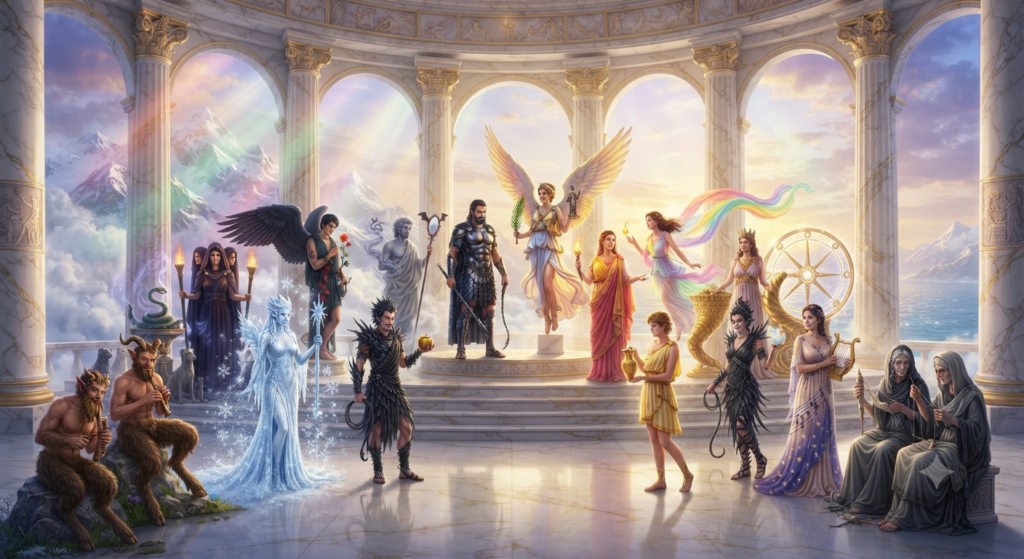
Greek mythology is often remembered through its grandest names: Zeus, Athena, Apollo, Hera, and Poseidon. Yet the mythic world is far wider than the Olympian summit. Beneath and around those famous powers stand lesser-known gods, spirits, and ancestral beings who shaped daily life, guarded springs and forests, presided over death rites, inspired poetry, and gave local communities their own sacred identities. Many appear only briefly in Homer, Hesiod, Apollodorus, Pausanias, or later poets, but they reveal how richly layered Greek religion was.
Lesser-Known Greek Gods and Their Roles in Myth
Among the lesser-known Greek gods are figures such as Hecate, Eileithyia, and Asclepius, each powerful in a distinct sphere yet often overshadowed by the more famous Olympians. Hecate appears in Hesiod as a major divinity of crossroads, night, and magic, and later tradition expands her role as a guardian of boundaries and a helper in liminal places. Eileithyia, the goddess of childbirth, is already present in Homeric poetry, where she stands as a necessary divine force in bringing new life safely into the world.
Other figures hold specialized but vital places in myth. Asclepius, though later widely worshiped as a healing god, appears in epic tradition as a mortal physician elevated to divine status after mastering the art of medicine. His cult spread through sanctuaries where the sick sought dreams and cures. Lesser-known divine powers often governed the moments humans feared most: birth, illness, transition, and the uncertainty of hidden knowledge.
Minor Deities in Greek Mythology and Cult Practice
Greek religion was not built only around the great Olympians. Local cults honored minor deities such as Pan, Priapus, and the river gods, whose influence touched shepherding, fertility, and the land itself. Pan, the wild god of pastures and flocks, is a rustic figure associated with Arcadia and with the untamed music of the pan flute. His presence shows how Greek myth preserved the sacred force of wilderness outside the polished order of city religion.
Priapus, though often treated in later literature with comic emphasis, was originally a fertility figure connected with gardens, livestock, and protection against theft. River gods, meanwhile, were not abstract symbols but living presences tied to particular landscapes, often described as sons of Oceanus and Tethys in Hesiod. In cult practice, such beings mattered because they localized the divine: a river, a hill, or a grove could possess its own god, and worship followed the terrain.
The Primordial Gods Behind the Cosmic Order
Before the Olympians ruled, Greek myth places primordial powers at the beginning of existence. Chaos, Gaia, Tartarus, Eros, and Nyx belong to this earliest layer of the cosmos in Hesiod’s Theogony. These beings are not gods in the later anthropomorphic sense so much as foundational realities, each embodying a force or condition that made the world possible. Chaos is the opening gap, Gaia the earth itself, and Tartarus the deep abyss beneath the world.
Nyx, night personified, is one of the most striking primordial figures because she generates a lineage of abstract and fearsome powers, including Sleep, Death, Doom, and Strife in Hesiod’s account. Eros, likewise, is not merely romantic love but the generative force that draws beings together and drives creation. These primordial figures stand behind the more familiar divine family as the older architecture of mythic order, where cosmos emerges from potent beginnings rather than from a fully formed universe.
Nymphs, Naiads, and Other Nature Spirits
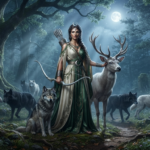
Nymphs occupy one of the broadest categories in Greek mythology, and many are lesser-known only because they are countless. They are tied to trees, springs, mountains, meadows, and caves, appearing as beautiful, often long-lived female spirits rather than fully immortal gods. Naiads inhabit fresh water, Dryads belong to trees, and Oreads dwell among mountains. Their stories are often local and fragmentary, preserved in hymns, epics, and later mythography.
Although nymphs can be gentle protectors, they also reflect the vulnerability of the natural world. In myth, they may rear divine children, accompany Artemis, or become the object of pursuit by gods and mortals alike. Their sacredness lies in place: a spring or grove could be spoken of as alive because a nymph dwelled there. For Greek communities, these spirits made landscape itself a religious environment.
The Muses, Charites, and Divine Patronage
The Muses are better known than many minor figures, yet individual names such as Erato, Terpsichore, and Polyhymnia are often less familiar outside poetic tradition. Hesiod presents them as daughters of Zeus and Mnemosyne, the powers of memory and inspiration who oversee song, history, dance, and the arts. Each Muse represents a specific mode of cultural memory, showing that inspiration in Greek thought was divine rather than purely personal.
The Charites, or Graces, are similarly important as figures of beauty, goodwill, and social harmony. In the earliest traditions their number and names vary, but later Greek and Roman sources often fix them as three. They embody the attractive force that allows society, ritual, and artistry to flourish. Along with the Muses, they reveal a recurring pattern in Greek religion: the divine is not only terrifying or commanding, but also the source of elegance, order, and cultivated human achievement.
Chthonic Figures Tied to Death and the Underworld
Many lesser-known Greek figures belong to the underworld rather than the sky. Thanatos, the personification of death, appears in myth as a stern but necessary power, and his brother Hypnos represents sleep. The Erinyes, or Furies, are chthonic avengers who pursue blood guilt and broken kinship, emerging from older layers of myth as instruments of ancestral justice. Their role in tragedy and epic shows how Greek thought linked death with moral and familial order.
Other underworld figures include Hecate in her nocturnal and crossroads aspect, as well as Persephone in her dual role as queen of the dead and seasonal goddess. Chthonic beings are not simply evil; they are tied to the deep structures of burial, remembrance, and the limits of life. Greek ritual often approached them with caution and reverence, acknowledging that the dead and the powers below remained part of the sacred world.
Lesser-Known Titans, Giants, and Ancestral Powers
The Titans are often reduced to a single generational conflict with Zeus, but many are lesser-known and important in their own right. Oceanus and Tethys, for example, are primordial Titan figures associated with the encircling waters and the generation of rivers and nymphs. Mnemosyne, Titaness of memory, is crucial because she mothered the Muses, linking recollection to cultural creativity. Other Titans, such as Themis and Phoebe, appear as older custodians of divine order and oracular power.
Greek myth also preserves Giants and ancestral powers in ways that differ by source. The Gigantomachy, told in poetic and artistic tradition, pits the Olympians against rebellious earth-born beings, while local genealogies often preserve older sacred lineages. These figures are not always central to narrative myth, but they shape the divine family tree and reveal how Greek religion imagined power as inherited, contested, and rooted in deep time.
Heroic Figures Honored as Local Greek Cults
Some of the most important lesser-known figures were not gods at all, but heroes honored in local cults. These included founders, warriors, healers, and regional ancestors whose tombs or shrines anchored civic identity. Pausanias frequently describes such cults, showing how a city might honor a hero whose story was meaningful primarily in that place. Unlike universal Olympians, heroes often belonged to a single community, where they protected land, lineage, and memory.
The distinction between hero and god could blur, especially after death and veneration. Heracles stands as the best-known example, but many local heroes remained obscure outside their own sanctuaries. Their worship reflects a deeply Greek pattern: the dead could continue to matter, and a community’s past could be made sacred through ritual attention. These cults preserved history as devotion, turning ancestral figures into living parts of the religious landscape.
Daemons, Spirits, and Ambiguous Mythic Beings
Greek daemons were not necessarily evil beings in the later sense of the word. In archaic and classical usage, a daimōn could mean a divine power, intermediary spirit, or fate-bearing presence. Some daemons in myth are unnamed forces rather than individual personalities, while others become personified in later literature. This category is deliberately flexible, which is part of its importance: Greek religion made room for powers that did not fit neatly into god, mortal, or ghost.
Ambiguous beings also include figures like the Keres, spirits of violent death, and the Oneiroi, dream spirits sent from the underworld in Homer and later tradition. They represent experiences humans recognized but could not fully control. Such beings occupy the boundary between order and uncertainty, reminding readers that Greek myth was never only about kings of Olympus. It also preserved the invisible presences that touched sleep, battle, fate, and the unseen crossings of life.
Regional Variants in Greek Gods and Traditions
Greek gods were never identical everywhere. Regional epithets, local myths, and civic cults gave the same divine name different shapes from one place to another. Artemis could be worshiped as a huntress, a guardian of transitions, or a fierce local protector; Apollo might be linked to healing, plague, prophecy, or city foundations depending on the sanctuary. Pausanias often records these local differences, which are essential to understanding Greek religion as a living network of traditions rather than a single fixed system.
This regional diversity also explains why many lesser-known figures survived. A local spring goddess, ancestral hero, or variant Titan could matter intensely in one valley and be nearly unknown elsewhere. Greek mythology, then, is not only the story of famous gods but also the memory of landscapes, communities, and rituals that gave those gods distinct forms. The result is a mythic world both unified and fragmented, where the divine was endlessly refracted through place.
The lesser-known Greek gods and figures reveal the true breadth of Hellenic myth. They show that Greek religion was not limited to the bright summit of Olympus, but extended into springs, tombs, crossroads, forests, and local shrines. Some were primordial forces, some were nature spirits, some were heroes remembered by one city alone, and some were divine names whose power was felt most strongly in specialized moments of human life. Together, they form the hidden structure beneath the better-known stories, giving Greek mythology much of its depth, texture, and enduring mystery.

Orin Vale has spent the better part of two decades tracing the threads that connect the world’s oldest stories — from the halls of Asgard to the banks of the Nile, from Olympus to the jungles of the Maya. What began as a childhood fascination with flood myths and trickster gods grew into years of independent study across comparative mythology and ancient religion, always chasing the same question: what did these stories mean to the people who first told them? Orin writes for readers who want more than trivia — the ones looking for the beliefs, fears, and truths that myths were built to carry.