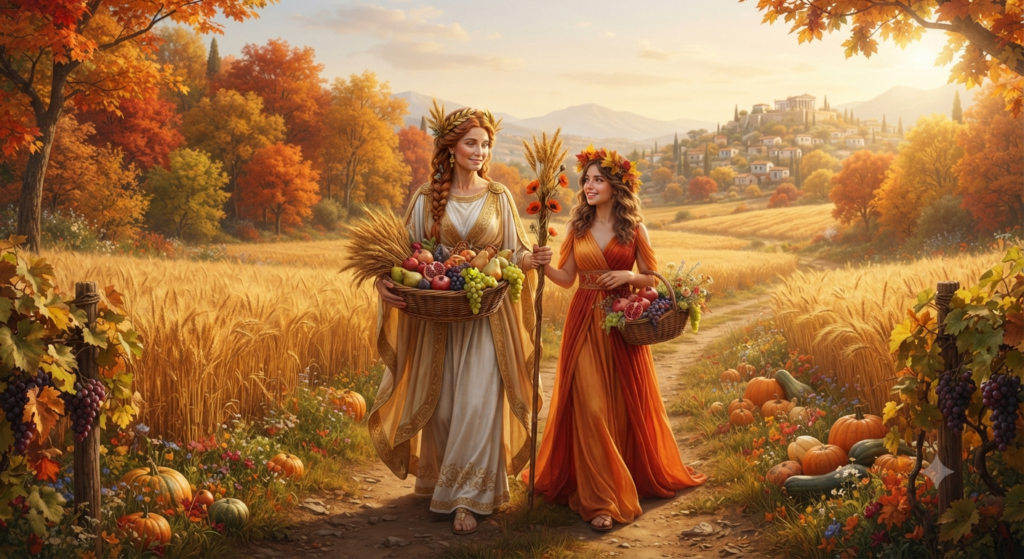
Which Greek goddess is associated with autumn? In Greek myth, the figure most closely linked with autumn is Persephone, daughter of Demeter and queen of the underworld. Her story explains the seasonal rhythm of growth, harvest, decline, and return. Unlike a nature spirit tied to one landscape alone, Persephone stands at the turning point between worlds: the bright surface of the earth and the hidden realm below. Ancient Greek tradition does not assign her to autumn in a simple modern calendar sense, but the season’s descent, fading light, and gathering of crops have long been read through her mythic cycle.
Persephone and the Autumn Season in Greek Myth
Persephone is the Greek goddess most often associated with autumn because her descent to the underworld marks the time when the land begins to lose its fullness. In the best-known version, preserved in the Homeric Hymn to Demeter, she is taken from the meadow while gathering flowers, and her mother’s grief brings famine to the world. The return of Persephone restores fertility, but only part of the year, so the myth naturally invites seasonal interpretation. Autumn becomes the season of withdrawal, when the fields are no longer in their height and the world turns toward dormancy.
This association is later than the earliest telling of the myth itself, yet it became deeply rooted in Greek and Roman imagination. Persephone’s movement between earth and Hades mirrors the visible pattern of the year: abundance, decline, rest, and renewal. Because autumn is the threshold between harvest and winter, it is the time when her presence feels especially near. She is not merely a spring goddess, as some modern summaries suggest, but a divinity of transition whose story encompasses the entire cycle of growth and loss.
Why Persephone Is Linked to Harvest Time
The connection between Persephone and harvest time begins with her mother Demeter, whose concern is the grain that sustains human life. In the Homeric Hymn to Demeter, the loss of Persephone causes Demeter to withhold fertility from the earth until an agreement is reached. That myth binds Persephone to the agricultural calendar, especially the period when crops are gathered and stored. Autumn is the season when the land gives its final abundance before yielding to barrenness, making it the natural time to remember her divided life.
Persephone’s link to harvest is also symbolic. Grain must be cut down in order to sustain life, just as Persephone must descend for part of the year before returning. Ancient audiences did not necessarily describe this in abstract allegorical terms, but the pattern is unmistakable. The myth speaks to the hard truth behind agricultural plenty: life depends on cycles of loss as well as growth. In that sense, Persephone belongs to the harvest not only as a seasonal figure, but as an emblem of nature’s recurring surrender and renewal.
Demeter, Grain, and the Turning of the Fields
Demeter is the elder goddess most directly associated with grain, bread, and cultivated land. Her name appears already in early Greek tradition as the power who makes the fields fruitful and human civilization possible. If Persephone represents the hidden passage into autumn and winter, Demeter embodies the visible labor of the fields themselves. Their relationship is the core of the seasonal myth: when Persephone is absent, Demeter’s sorrow strips the earth of growth; when she returns, grain rises again.
The turning of the fields in late summer and autumn was therefore charged with divine meaning. The harvest did not simply mark a practical change in food supply; it also signaled the temporary loss of green life. In some ancient cult settings, the cutting of grain and the storage of seed would have resonated with the myth of descent and return. Demeter and Persephone together frame this agricultural rhythm, with Demeter standing for nourishment and Persephone for the hidden phase that makes future fertility possible.
Hades, the Underworld, and Seasonal Descent
Hades is not a goddess, but he is essential to Persephone’s autumnal meaning, since her underworld residence explains the season of retreat. In the standard myth, he carries Persephone away to his realm and becomes her husband, though versions differ on the details of consent and circumstance. The sources are clear that her time below ground is not an afterthought: it is the structural reason the earth enters a diminished phase. Autumn, with its shortening days and fading fields, becomes the season that most vividly reflects this descent.
The underworld in Greek thought was not only a place of death, but also a realm of hidden potency. Seeds were buried in the earth before they sprouted, and the dead were imagined below the surface where life had once flourished. That symbolism makes Persephone’s descent especially powerful. Her annual return is not a simple reversal of loss; it is the reappearance of life from concealment. Ancient myth thus places autumn at the border of the visible and invisible, where Hades’ domain presses closest upon the world above.
The Eleusinian Mysteries and Autumn Rituals
The Eleusinian Mysteries, the most famous mystery rites in Greek religion, were centered on Demeter and Persephone and were held in the autumn, around the time of the Athenian month Boedromion. Their precise rites were secret, and the ancient sources are deliberately restrained, but the seasonal setting is well established. The mysteries commemorated the goddesses’ sorrow, reunion, and the promise of blessedness beyond ordinary life. Their timing in the early fall made Persephone’s autumnal significance especially strong in religious practice as well as myth.
For initiates, the Eleusinian rites offered more than an agricultural symbol. They linked the cycle of crops with hopes about death and the afterlife, without reducing one to the other. Autumn was the fitting season for such reflection because it already carried the feeling of descent, memory, and anticipation. Through ritual, the myth of Persephone became a lived experience of seasonal change, where the loss of the fields and the hope of renewal were joined in a single sacred pattern.
Greek Sources on Persephone’s Annual Return
The most influential ancient source for Persephone’s seasonal return is the Homeric Hymn to Demeter, which describes her compromise with Hades and the arrangement by which she spends part of the year below and part above. Other ancient writers preserve variations. Some later authors speak more explicitly of the duration of her stay in each realm, while others leave the length unspecified. What remains constant is the principle of alternation: Persephone does not remain permanently in the underworld, nor does she stay fully among the living.
Later Greek and Roman literature often treats this cycle as the explanation for the seasons, though scholars note that the original hymn is more concerned with the foundations of cult and agriculture than with a neat meteorological theory. Still, by antiquity the annual return had become a powerful explanatory framework. Autumn naturally fits the downward half of that cycle, when Persephone is imagined as moving away from the earth’s brightness and toward her hidden throne beside Hades.
Pomegranate Seeds and the Cycle of the Year
The pomegranate is one of the most enduring symbols in Persephone’s myth. In the traditional story, she eats seeds while in the underworld, which binds her to return there. Different ancient sources vary on the number of seeds and the circumstances of the meal, but the meaning is consistent: the fruit creates a lasting tie between Persephone and the realm below. Because the pomegranate is rich with seeds, it has long suggested fertility, continuity, and the paradox of life enclosed within a hard shell.
The fruit also suits autumn’s symbolic world. Pomegranates ripen as the year turns toward decline, and their red interior evokes both abundance and the color of fading vitality. In mythic terms, the seeds preserve the rhythm of return: the year cannot remain in bloom, but neither can it remain barren. Persephone’s eating of the pomegranate, whether read literally or symbolically, makes her the goddess of a season that contains both ending and promise within itself.
Autumn Equinox Themes in Ancient Greek Lore
Ancient Greek sources do not present a formal doctrine of the autumn equinox in the way modern seasonal symbolism sometimes does, but the equinox fits naturally into Persephone’s mythic landscape. It is the point of balance when day and night are equal, just as Persephone stands between upper world and underworld. That balance is temporary; after it, darkness lengthens. Greek myth repeatedly shows such thresholds as moments of power, and Persephone’s story is one of the clearest examples.
This does not mean the Greeks explicitly framed Persephone as an equinox goddess in the technical sense. Rather, later interpretation has recognized how well her myth matches the season’s character. Autumn is a time of transition, and the equinox marks that threshold with especial clarity. The goddess who belongs to passage, alternation, and return naturally gathers meaning from this moment in the year.
Persephone in Art, Hymn, and Later Tradition
In ancient art, Persephone often appears beside Demeter, enthroned with symbols of fertility, torches, or scenes of descent and return. Vase painting, reliefs, and later Roman works emphasize both her dignity as queen and her association with the hidden world. She is not always shown as a purely sorrowful figure; she can appear solemn, regal, and inward, embodying the gravity that autumn brings to the landscape.
Poets and mythographers after the archaic period reinforced her seasonal identity. Roman writers, especially Ovid, helped spread the story to later audiences, where it became part of a wider European imagination of the seasons. Medieval and modern retellings often simplified the myth, but classical sources keep its complexity intact: Persephone is both daughter and queen, lost and restored, a figure of beauty and constraint. That doubleness is why autumn, with its mixture of fruitfulness and decline, continues to suit her so well.
Other Greek Figures Tied to Harvest and Fall
Although Persephone is the clearest Greek goddess associated with autumn, she is not the only figure connected with harvest and the turning of the year. Demeter remains the primary goddess of grain and cultivated abundance, and her cult is inseparable from the agricultural cycle. Triptolemus, though not a god in the same sense, is associated with the spread of grain agriculture in Eleusinian tradition. Figures such as Dionysus can also be linked to seasonal ripeness, wine, and the late-year transformation of the vine.
Even so, none of these figures occupies Persephone’s particular place at the hinge of the seasons. Demeter governs the fertility of the fields, while Persephone embodies the moment when fertility is withdrawn and hidden. Autumn belongs to that threshold more than to any single harvest deity. In Greek myth, the goddess most closely associated with autumn is therefore Persephone, whose annual movement between worlds gives the season its deepest symbolic meaning.
Persephone is the Greek goddess most closely associated with autumn, not because the ancients assigned her to a modern calendar label, but because her myth explains the world’s seasonal descent. Her story joins harvest, loss, and return into one continuous pattern, while Demeter’s grief and the rites of Eleusis give that pattern religious depth. Autumn, with its ripening fruit and fading light, remains the season that best reflects her place between earth and underworld.

Orin Vale has spent the better part of two decades tracing the threads that connect the world’s oldest stories — from the halls of Asgard to the banks of the Nile, from Olympus to the jungles of the Maya. What began as a childhood fascination with flood myths and trickster gods grew into years of independent study across comparative mythology and ancient religion, always chasing the same question: what did these stories mean to the people who first told them? Orin writes for readers who want more than trivia — the ones looking for the beliefs, fears, and truths that myths were built to carry.