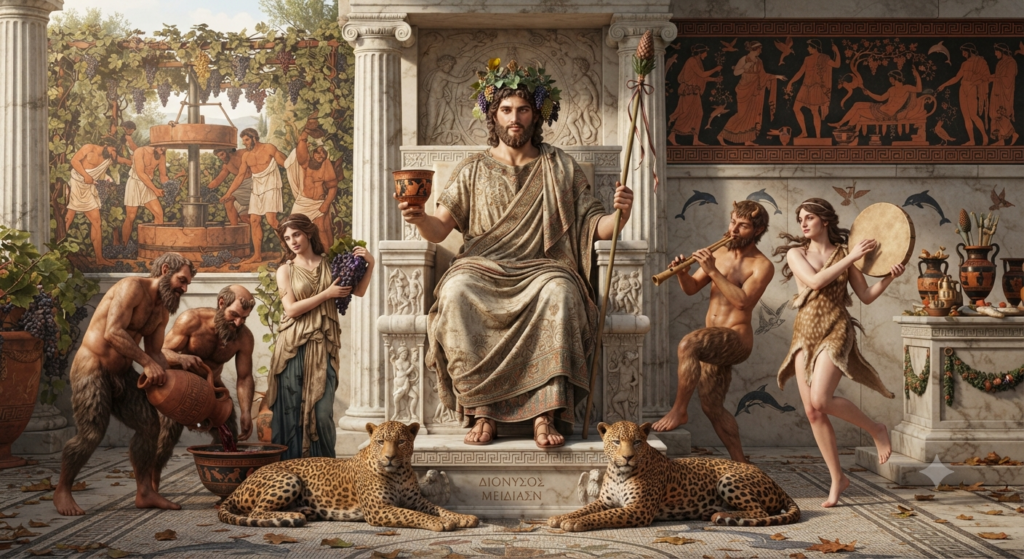
Dionysus, the Greek god of wine, ecstasy, theater, and the loosened boundaries of ordinary life, appears across ancient art in forms that are as changeable as his own myth. He is not depicted in a single fixed way. On painted pottery, carved reliefs, and statues, he may be a serene bearded ruler, a graceful youth crowned with ivy, or a lively figure surrounded by maenads and satyrs. Ancient artists used him to express fertility, ritual intoxication, seasonal renewal, and the strange power of divine presence.
Dionysus in Greek Vase Painting and Reliefs
Greek vase painting preserves some of the clearest early images of Dionysus. In Archaic and Classical scenes, he often appears in symposium settings, aboard ships, or in the company of his retinue, rendered with the visual language of festivity and movement. Red-figure and black-figure painters favored him because his myths offered rich contrast: calm authority beside frenzy, order beside release. Relief sculpture, especially on votive monuments and temple decoration, likewise shows him in processions or seated with attendants, emphasizing his role as a god honored in civic and sacred spaces.
These works are grounded in the broader Greek habit of linking Dionysus with ritual performance and social transition. A famous example is the kylix by Exekias, where Dionysus sails through the sea amid vines, a compact image of divine abundance and transformation. Reliefs from sanctuaries and funerary contexts often present him with grape clusters, animals, or worshippers, suggesting that his image could stand for both the joy of cult and the promise of renewal beyond ordinary life.
The God of Wine, Vine, and Ecstasy
As the god of wine and the vine, Dionysus is usually shown with signs of abundance rather than warfare or dominion. Ancient artists emphasized the cultivated plant world: grape leaves, clusters of fruit, and ritual vessels appear as visual shorthand for his power. In many scenes he is calm, almost distant, as if intoxication were not chaos but a sacred state under divine control. This is one reason he can appear noble and youthful at the same time.
Ecstasy, in the ancient sense, was central to his image. Greek and Roman art often presents Dionysus as a figure who dissolves boundaries between human and divine, male and female, civilized and wild. Literary sources such as Euripides’ Bacchae helped shape this visual tradition, but artists translated the idea into gestures, flowing drapery, and animated companions. His art does not merely show a god of drinking; it shows the force that wine symbolized in Greek religion: release, transformation, and proximity to something beyond ordinary reason.
Sacred Symbols: Ivy, Thyrsus, and Kantharos
Certain objects identify Dionysus immediately in ancient art. Ivy wreaths and garlands are among the most common, since ivy was sacred to him and associated with endurance, growth, and festal decoration. The thyrsus, a staff topped with a pine cone or wrapped in foliage, is another unmistakable attribute. In painted and sculpted scenes, it signals not only the god’s presence but also the ritual dimension of his cult, since the staff is held by Bacchic worshippers as well as by Dionysus himself.
The kantharos, a deep drinking cup with high handles, is equally important. It appears in vase painting and relief as a symbol of wine, feasting, and ritual use. Alongside the ivy and thyrsus, it creates a visual vocabulary that ancient audiences would have recognized at once. These attributes are not decorative additions; they define the god’s identity in art and connect him to the practices of libation, celebration, and sacred consumption that shaped his worship across the Greek world.
Dionysus Among Maenads and Satyrs in Art
Dionysus is rarely shown alone. He is usually accompanied by maenads, the ecstatic female followers who dance in his cult, and satyrs, the half-human, half-animal beings associated with lust, music, and revelry. In vase painting, these companions bring motion and tension into the scene. Maenads may carry thyrsoi, cymbals, or fawns, while satyrs play pipes, pursue figures, or stagger in drunken delight. Together they form a visual chorus around the god.
Their presence reveals how ancient art imagined Dionysian power: not as solitary majesty, but as contagious energy shared through ritual company. Satyrs often inject humor and unruliness into the imagery, while maenads embody the religious intensity of Bacchic worship. In some works Dionysus stands composed at the center, presiding over this wild entourage with quiet authority. In others, he seems to merge into the procession, suggesting a god whose identity is inseparable from the life-force he unleashes.
Birth and Youth in Early Mythic Imagery
Early mythic imagery sometimes focuses on Dionysus’ unusual birth and divine upbringing. Because his mother Semele died before he was born, some traditions say Zeus carried the infant in his thigh until the time of birth; artists occasionally allude to this extraordinary origin through scenes of care, concealment, or divine protection. Other versions, attested in later literary sources, emphasize the child’s rescue from danger and his hidden growth away from Hera’s hostility.
Youthful Dionysus became a favorite in later art because it allowed artists to show divine beauty joined to vulnerability. He can appear as a tender, almost ephebic figure, sometimes crowned with ivy and holding a cup or vine branch. This youthful form does not erase his divinity; rather, it highlights the theme of emergence, as though the god himself were always in the process of becoming. In mythic imagery, that makes him a figure of beginnings as much as celebration.
Processions, Banquets, and the Bacchic Revel
Processional scenes are among the most characteristic depictions of Dionysus in ancient art. He may travel in a chariot, walk in a sacred parade, or approach a banquet with his retinue. These images reflect festival culture, where processions marked the god’s public presence and linked worship to civic life. Artists often composed such scenes with rhythmic order, using musical instruments, animals, and dancing figures to convey the controlled exuberance of Bacchic movement.
Banquet imagery is equally important. Dionysus is frequently shown reclining like a symposium guest or presiding over a feast, a visual sign of his connection to wine and sociability. The Bacchic revel, however, is not merely merriment. In art, it can carry a sense of altered consciousness and sacred abandon, especially when contrasted with the measured discipline of other gods. Roman artists in particular enjoyed elaborating these scenes, turning Dionysian festivity into a rich language of abundance, music, and ritual pleasure.
Sculpted Forms of the God in Marble and Bronze
In sculpture, Dionysus is one of the most adaptable gods in the classical tradition. Marble statues present him in polished serenity, often with soft features, relaxed posture, and luxuriant hair. Bronze works, though less frequently preserved, likely emphasized his supple motion and the play of light across the body. Sculptors could render him as almost androgynous, aristocratic, or sensuous, depending on the era and local style.
The great value of sculpted Dionysus lies in this flexibility. A temple statue could present him as a mature deity of dignity and cult authority, while a domestic statue might focus on charm and beauty. Hellenistic artists especially favored elaborate drapery and expressive gestures, giving the god a more theatrical presence. Whether in sanctuary, villa, or public space, sculpted Dionysus translated myth into physical form, making divine abundance visible in stone and metal.
Dionysus as Bearded King or Youthful Figure
Ancient art depicts Dionysus in two major modes: as a bearded mature god and as an androgynous or youthful figure. The bearded version appears often in earlier Greek art and in certain cult contexts, where he resembles an Olympian ruler with full divine authority. In these images, he may wear a wreath and hold a kantharos or thyrsus, combining majesty with festal identity. The beard gives him gravity, suggesting the god of wine as a power with ancient, sovereign roots.
The youthful Dionysus became especially popular from the Classical period onward. Artists used this form to express beauty, softness, and the seductive force of divine transformation. Roman copies and Hellenistic originals alike often present him with delicate features, flowing hair, and a relaxed stance. The coexistence of both types is important: ancient art does not choose one identity and reject the other. Instead, it shows a god who can be old and young, stern and gentle, depending on the aspect of his power that the artist wished to evoke.
Myth Scenes with Ariadne, Silenus, and Pan
Dionysus often appears in myth scenes alongside Ariadne, Silenus, and Pan. Ariadne’s portrayal is especially significant, since literary tradition gives multiple versions of her story, but in many later visual works she is shown as the mortal woman who becomes Dionysus’ companion or bride. The union of the god and Ariadne offered artists a theme of rescue, transformation, and divine marriage, often set on a joyful island or in a festive procession.
Silenus, the old companion and teacher figure, represents another side of Dionysian mythology. In art he is usually drunken, balding, and satyr-like, yet still wise in his own way. Pan, with his goat features and rural associations, reinforces the god’s link to the wild landscape and pastoral music. When these figures gather around Dionysus, the scene becomes a map of his world: one that joins domestic love, ancient wisdom, and untamed nature under the god’s shifting gaze.
Regional Styles in Greek and Roman Depictions
Regional differences shaped the depiction of Dionysus across the ancient world. In mainland Greek art, especially Attica, he often appears within the refined conventions of vase painting and Classical sculpture, where proportion and symbolic clarity were prized. In South Italian, Etruscan, and later Roman contexts, his imagery can become more elaborate, theatrical, and richly decorative. Artists adapted the god to local tastes while preserving his core attributes.
Roman art, in particular, expanded Dionysian imagery into mosaics, wall paintings, and sarcophagi. There he could signify not only religious devotion but also luxury, fertility, and the pleasures of cultivated leisure. Yet the essential figure remains recognizable across regions: the ivy-crowned god, the wine cup, the thyrsus, the procession, the ecstatic company. Ancient art did not treat Dionysus as a fixed icon but as a living visual idea, one capable of reflecting many cultures while preserving the same divine pulse.
Dionysus in ancient art is never merely a god holding a cup. He is a figure of recurrence and metamorphosis, appearing as ruler, youth, reveler, bridegroom, and divine presence among dancers and beasts. Through vase painting, relief, sculpture, and regional variations, artists gave shape to the mystery at the center of his cult: that wine, ritual, and ecstasy could reveal truths hidden from ordinary sight.

Orin Vale has spent the better part of two decades tracing the threads that connect the world’s oldest stories — from the halls of Asgard to the banks of the Nile, from Olympus to the jungles of the Maya. What began as a childhood fascination with flood myths and trickster gods grew into years of independent study across comparative mythology and ancient religion, always chasing the same question: what did these stories mean to the people who first told them? Orin writes for readers who want more than trivia — the ones looking for the beliefs, fears, and truths that myths were built to carry.