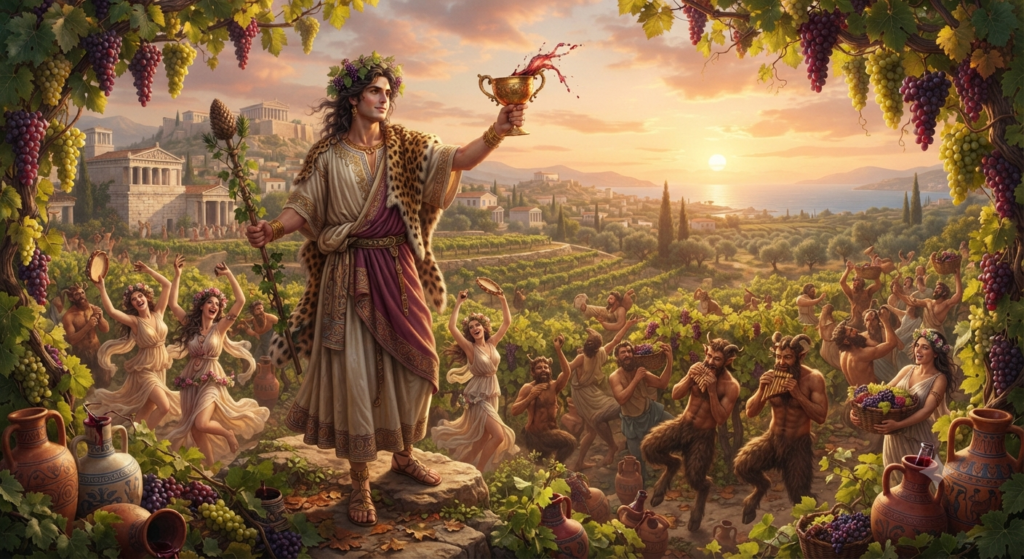
Dionysus is the Greek god most closely tied to wine, but his connection to it reaches far beyond simple intoxication. In myth and ritual, he stands for the vine’s growth, the transformation of the grape into drink, and the strange boundary where joy, loss of self, and sacred revelation meet. Ancient Greeks did not see wine merely as a beverage; under Dionysus it became a force that could bless a household, rouse a festival, or unsettle the mind.
Dionysus and Wine in Greek Myth and Cult
Dionysus is the Olympian god of wine, vine-growing, fertility, and ecstatic experience. Unlike many divine figures who govern a single clear domain, he moves between order and rupture: he is welcomed into the city, yet he also draws people beyond ordinary restraint. In Greek myth, wine belongs to him because it embodies transformation, just as grapes change into drink and human behavior changes under its influence. That association appears not only in stories but in worship, where wine was poured as an offering and consumed in his honor.
The cult of Dionysus treated wine as something sacred and potentially dangerous. It was not praised merely for pleasure, but for its power to loosen social boundaries and open a person to altered states of mind. Greek sources present Dionysus as a god who grants this gift to mortals, sometimes benevolently and sometimes with severe consequences when he is denied or misused. His domain therefore includes both celebration and warning.
Bacchus, Vine, and the God of Ecstasy
In Roman religion, Dionysus was identified with Bacchus, a name that later became widely used in literature for the wine god. The Roman Bacchus preserved the Greek god’s core associations with vine, wine, and revelry, though his image was often filtered through Roman artistic and literary taste. In Greek sources, Dionysus already appears as a figure of divine frenzy and release, so the Bacchic name did not create a new god; it emphasized one of his most forceful aspects.
Ecstasy is central to understanding why Dionysus is linked to wine. The Greek experience of drunkenness was not simply private excess but a state that could resemble possession or inspired abandon. Dionysian ecstasy could be dangerous, yet it was also understood as a channel for music, dance, and communion with the divine. In that sense, wine under Dionysus is not merely alcoholic drink; it is a medium of altered consciousness and ritual power.
How the Vine Became Sacred to Dionysus
The vine became sacred to Dionysus because it was the living plant most visibly connected to the cycle of death and renewal. It dies back, is cut, and returns with new growth, much like the recurring themes of loss and rebirth that surround the god. Ancient imagination often saw in the vine a fitting emblem of Dionysus himself, whose worship repeatedly celebrates vitality springing from apparent destruction. The plant’s twisting form, heavy clusters, and seasonal rhythms made it an apt symbol for a god of transformation.
Classical traditions vary on how Dionysus first received the vine, but they consistently treat it as his distinctive gift to humanity. Some myths describe him wandering through lands to teach cultivation and win acceptance; others emphasize that he arrives already associated with vines and wine-making. What remains constant is the sacred bond between the god and the plant. The vine was not merely useful agricultural produce, but a sign of Dionysus’s presence in the world.
Wine Pressing, Harvest, and Ritual Offerings
In the agricultural calendar, the grape harvest and wine pressing held religious weight because they transformed fruit into something enduring and potent. Ancient sources and later ritual practice show that such work could be accompanied by prayers, songs, and offerings to Dionysus. The act of pressing grapes into wine naturally suited a deity whose power lies in transformation. Even the physical violence of pressing and fermenting could be read as part of the god’s mysterious domain.
Wine was also offered in libations to Dionysus and other gods, linking daily practice with sacred exchange. At meals and rituals, pouring wine honored divine presence and acknowledged the limits of human possession. In Greek religion, offerings were rarely abstract; they involved material substances that carried symbolic force, and wine was one of the most important among them. Dionysus, more than any other deity, stood at the center of that circulation between human hands and divine favor.
Dionysian Festivals and Sacred Drinking Rites
Festivals of Dionysus, especially the city Dionysia and rural celebrations connected with the vintage, made wine central to public worship. These gatherings included processions, songs, masks, sacrifice, and communal drinking, all of which reflected the god’s role in bringing people together through shared ritual. The festival setting mattered: wine was not treated as an isolated indulgence, but as part of a structured religious performance. In that atmosphere, drinking became one expression of civic and sacred participation.
Sacred drinking rites around Dionysus were shaped by both joy and discipline. Greek ritual did not simply encourage drunkenness; it placed wine within a framework of offerings, measured consumption, and collective experience. The god’s festivals could still include exuberance and excess, especially in literary and artistic representations, but the religious reality was more organized than modern stereotypes suggest. Dionysian drinking was therefore symbolic as well as social.
Dionysus in Homer, Hesiod, and Later Sources
Homer and Hesiod do not present Dionysus as a simple “wine god” in a modern sense, yet both authors preserve important early traces of his character. In the Iliad, Dionysus is mentioned in stories of divine conflict and mortal suffering, while in the Odyssey and other archaic material the world of wine already belongs to a broader cultural and religious landscape. Hesiod’s works connect divine order, agriculture, and human labor, themes that later Dionysian tradition also embraces. The fully developed association between Dionysus and wine grows across Greek literature, not from one single line.
Later sources make the connection more explicit. Apollodorus, Euripides, Pausanias, and Ovid all help show how widely Dionysus was understood as the god who gave wine and inspired ritual frenzy. Euripides’ Bacchae is especially important, since it dramatizes the god’s power to challenge human resistance through wine, worship, and ecstatic force. These texts do not all agree in emphasis, but together they establish Dionysus as inseparable from the cultural meaning of wine in the ancient world.
The Gift of Wine as Civilizing Power
In Greek thought, wine could be both a civilizing gift and a test of human self-control. Dionysus was credited with giving wine to mortals as part of a broader pattern of cultural benefaction, much as other gods provide agriculture, craft, or law. Properly used, wine encouraged fellowship, conversation, and ritual order. It was not outside civilization; it was one of the substances through which civilization was enacted.
At the same time, wine revealed the fragility of human restraint. Ancient writers knew that it could sharpen insight or dissolve discipline, depending on use and setting. Dionysus thus represents a double truth: wine belongs to cultivated life, yet it also reminds people that cultivated life rests on unstable ground. That tension helps explain why his myths are never purely cheerful. He is a god of gift and disruption at once.
Maenads, Satyrs, and the Wild Side of Wine
The followers of Dionysus, especially maenads and satyrs, embody the wild side of wine and revelry. Maenads are women portrayed as seized by the god’s power, moving through hills and forests in ecstatic devotion, while satyrs appear as lustful, half-bestial companions of the Dionysian world. These figures are not historical descriptions of all worshipers, but mythic and artistic expressions of what Dionysian energy could look like at the edge of human order. They show wine as a force that escapes the domestic table and enters untamed space.
In literature and vase painting, these followers often blur the line between celebration and danger. The maenads’ ecstatic state can be joyous, but it can also become terrifying, as in Euripides’ Bacchae, where divine frenzy leads to violence. Satyrs, meanwhile, personify appetite, music, and unruly humor. Together they dramatize the social imagination surrounding wine: it delights, liberates, and unsettles in equal measure.
Wine, Tragedy, and the Theater of Dionysus
Theater in Athens was deeply linked to Dionysus, and that connection matters when asking about his relationship to wine. The dramatic festivals held in his honor used performance, chorus, costume, and myth to explore the same boundaries that wine touches: identity, control, suffering, and release. The theater of Dionysus was not a casual venue named after a god of drinking; it was a civic and religious space where the audience encountered themes associated with his power. Wine and drama both altered perception, though in different forms.
Tragedy in particular resonates with Dionysian experience because it exposes the instability of human life under divine and social pressure. Characters often discover too late that they have misread the powers around them, much as drink can strip away illusion. Ancient audiences did not need to see wine on stage in order to feel its symbolic presence. Dionysus presided over a culture that understood performance itself as a kind of controlled possession.
Why Dionysus Remained the Wine God of Greece
Dionysus remained the wine god of Greece because no other deity so fully joined the agricultural, ritual, emotional, and theatrical meanings of wine. He was not only the patron of the vine and the drink produced from it; he was also the god who made wine a medium of transformation. From the harvest to the libation, from festival to tragedy, his presence shaped how the Greeks understood what wine could do to body, mind, and community.
His lasting power lies in that complexity. Dionysus is the god of abundance, but also of boundary-crossing; the bringer of pleasure, but also of excess; the patron of cultivated wine, but also of the wild energies that wine can unleash. Greek myth and cult preserved all of these dimensions, which is why his connection to wine endured so strongly in later memory. Dionysus did not merely rule over wine. He gave it its mythic meaning.
To ask what Dionysus’s connection to wine is, is to ask how the Greeks imagined transformation itself. Wine was his gift, his symbol, and one of the clearest expressions of his strange power over human life. In the myths, rituals, and festivals of Greece, Dionysus stands wherever the grape becomes something greater than fruit, and where drinking becomes a meeting place between civilization and ecstasy.

Orin Vale has spent the better part of two decades tracing the threads that connect the world’s oldest stories — from the halls of Asgard to the banks of the Nile, from Olympus to the jungles of the Maya. What began as a childhood fascination with flood myths and trickster gods grew into years of independent study across comparative mythology and ancient religion, always chasing the same question: what did these stories mean to the people who first told them? Orin writes for readers who want more than trivia — the ones looking for the beliefs, fears, and truths that myths were built to carry.