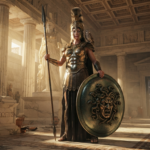
Athena’s eyes and gaze carry far more than physical description in Greek myth. They mark her as a goddess of lucid intelligence, disciplined power, and watchful authority. In Homeric poetry and later tradition, Athena is often recognized not by softness or allure, but by the steady force of her sight: she sees clearly, judges swiftly, and never loses awareness of what must be done. Her gaze can comfort, instruct, intimidate, or protect, depending on the moment and the mortal who stands before it.
Athena’s Eyes in Greek Myth and Iconography
In Greek myth, Athena’s eyes are frequently linked with the idea of sharp intelligence rather than mere appearance. Homer’s epithets for the goddess emphasize her bright, keen, or grey-eyed quality, and later Greek art often presents her with a steady, composed stare. She is not a figure of wandering attention or emotional instability; her vision suggests focus, order, and mastery of the world as it should be understood. Even where myths do not linger on her face directly, the language of sight often surrounds her presence.
Iconography reinforces this same idea. On vases, reliefs, and statues, Athena is commonly shown frontally or in a controlled, direct pose, as though she does not merely look outward but perceives everything around her. Her helmet, shield, and aegis frame the eyes rather than obscure them, making sight itself part of her authority. In this way, Greek visual culture turned Athena’s gaze into a sign of divine intelligence and civic guardianship.
The Gaze of Pallas Athena in Homeric Poetry
Homer gives Athena a vividly active presence through her eyes and gaze, even when he does not describe them in detailed physical terms. She appears to mortals in forms that alter perception, whether as a divine helper at the edge of battle or as a guiding force in disguise. The epithets applied to her in the Iliad and Odyssey present her as bright-eyed and vigilant, a goddess whose attention never falters. Her looking is never passive; it is linked with intervention.
In the Odyssey, Athena’s gaze is especially tied to counsel and recognition. She watches Odysseus, Telemachus, and Penelope with a strategist’s awareness, shaping events through knowledge that others lack. Her interventions often begin with seeing what humans cannot: the right moment to act, the true identity beneath disguise, the hidden structure of a crisis. Homer’s Athena is therefore a goddess whose gaze does not simply observe the world but reveals it.
Eyes as Signs of Wisdom and Clear Sight
Athena’s eyes symbolize wisdom in a distinctly Greek sense: not abstract knowledge alone, but practical discernment. She understands strategy, craftsmanship, law, and ordered thought, all of which require the ability to see connections clearly. In myth, her wisdom is often contrasted with blindness of judgment, impulsiveness, or brute force. Her gaze stands for the mind that can distinguish what matters from what is merely immediate.
This association is not accidental. Greek tradition often treats sight as a metaphor for understanding, and Athena embodies the highest version of that metaphor. She sees through deception, discerns a useful plan, and values measured action over rash display. Her eyes therefore become a visual expression of mētis—the cunning intelligence that works with foresight, patience, and precision. That is why her gaze feels instructive rather than decorative.
Athena’s Watchfulness in War and Strategy
Athena is a war goddess, but not in the sense of indiscriminate destruction. Her presence in battle is associated with discipline, tactical intelligence, and the ability to guide heroes toward victory through reasoned force. The gaze of Athena in war is the gaze of a commander who can survey the field, identify weakness, and exploit opportunity. She does not merely inspire aggression; she orders it.
This watchfulness is visible throughout the epic tradition. Athena aids heroes such as Perseus, Heracles in some traditions, Diomedes, Odysseus, and others by sharpening their judgment and steadiness. Her attention can also unsettle enemies, for to be seen by Athena is to be exposed to a higher intelligence. In martial contexts, her gaze signifies control over chaos, making her the divine patron of strategy rather than blind violence.
The Virgin Goddess and Her Unblinking Presence
Athena’s virginity in Greek tradition is often understood as a sign of independence and inviolability, and her gaze belongs to that same symbolic world. She is not drawn into the vulnerabilities and entanglements that characterize many other divine figures in myth. Her unblinking presence suggests self-possession: she remains whole, centered, and beyond coercion. The eyes of Athena do not invite possession; they establish distance.
This aspect of her character appears in stories where she preserves boundaries, whether divine, civic, or moral. Her gaze can be severe because it is untouched by disorder. Unlike deities whose identities are shaped by desire, disguise, or seduction, Athena is often portrayed as direct and unyielding. Her fixed attention communicates purity in the older Greek sense of being untouched by compromise, a quality that strengthens her role as a protector of cities and skilled labor.
Gorgon Aegis, Eyes, and Protective Terror
One of the most powerful expressions of Athena’s gaze is her association with the aegis, the formidable protective goatskin or shield-like device that sometimes bears the Gorgon’s head. In some traditions, the aegis is linked to terror as much as defense, and the Gorgon’s eyes are a central part of that power. The Gorgon’s stare petrifies, and Athena’s use of this symbol turns fear into protection. What paralyzes the enemy becomes a shield for the goddess and her allies.
This creates a striking paradox. Athena’s own gaze is associated with reason and clarity, yet she carries an object whose stare embodies catastrophic danger. The combination shows that divine sight in Greek myth can work on several levels at once. Athena is not only wise; she is capable of weaponizing dread in the service of order. Her eyes and the eyes she bears through the aegis together form a boundary that hostile forces cannot cross.
Sculpted Gaze in Temples and Archaic Statues
Greek sculpture and temple imagery often emphasize Athena’s composed, forward-facing gaze. From archaic statues to later cult images, she is frequently rendered with calm authority rather than emotional expression. This artistic choice was not accidental. It reflected the goddess’s role as a permanent guardian, one who watches over sanctuaries, cities, and institutions with unwavering attention. Her face becomes a visual pledge of stability.
In temples dedicated to Athena, especially in Athens, the goddess’s presence was inseparable from civic identity. A sculpted gaze that looked beyond the worshipper suggested enduring protection and divine oversight. The frontal stillness of these images made Athena appear almost unchanging, like the order she defended. Her eyes in art therefore worked as a language of permanence, linking divine sight to the life of the polis.
Athena’s Sight Compared with Other Olympians
Compared with other Olympians, Athena’s gaze is distinctive because it combines intelligence with restraint. Zeus sees from the heights of authority, Apollo often represents clarity, and Artemis watches the wild and the vulnerable. Yet Athena’s sight is especially practical and urban, directed toward planning, craftsmanship, and just action. Her eyes do not simply illuminate; they organize. She sees how things fit together.
This makes her different from gods whose vision may be linked to prophecy, desire, or domination. Athena is less about revelation in the ecstatic sense than about lucid understanding in the moment of need. She does not overwhelm mortals with visual splendor as much as she tests them with insight. Her sight belongs to the world of form, measure, and intelligent intervention, which gives her a unique place among the Olympians.
The Symbolic Power of the Owl and Vision
The owl, Athena’s familiar bird, deepens the meaning of her gaze. In Greek culture, the owl was associated with night vision, alertness, and the ability to perceive what others miss. Its large eyes and watchful stillness made it a natural emblem for a goddess of wisdom. The bird does not see by daylight alone; it thrives in darkness, just as Athena’s intelligence can discern through uncertainty and confusion.
In Athens, the owl became a civic and symbolic sign of the goddess’s presence. Coins bearing the owl linked Athena’s vision with the identity and prosperity of the city. The bird’s gaze reflects the same qualities as the goddess’s own: alert, concentrated, and unafraid of the dark. Together, Athena and the owl form one of the most enduring images of wisdom in the ancient world.
Why Athena’s Gaze Still Defines Her Character
Athena’s gaze remains central to her character because it gathers together all the qualities that define her: wisdom, strategy, protection, discipline, and civic order. She is a goddess who looks with purpose. Her eyes do not wander toward illusion; they settle on what is necessary, true, and workable. That is why her presence feels so authoritative across myth, poetry, and art. She is the one who sees clearly when others cannot.
The endurance of this image is not difficult to understand. Athena’s gaze speaks to a timeless human desire for intelligence that is calm rather than reckless, powerful yet measured. In myth, she is the goddess who can guide heroes, guard cities, and expose deception without losing composure. Her eyes are not just part of her appearance; they are the visible form of her divinity.To ask what Athena’s gaze signifies is to ask what wisdom looks like in myth. The answer Greek tradition gives is steady and unsentimental: it looks like clear sight, disciplined attention, and the power to protect without yielding to chaos. Athena’s eyes remain one of the oldest and strongest symbols of intelligent authority in the classical world, and they continue to define her as the goddess who sees, knows, and acts with unwavering purpose.

Orin Vale has spent the better part of two decades tracing the threads that connect the world’s oldest stories — from the halls of Asgard to the banks of the Nile, from Olympus to the jungles of the Maya. What began as a childhood fascination with flood myths and trickster gods grew into years of independent study across comparative mythology and ancient religion, always chasing the same question: what did these stories mean to the people who first told them? Orin writes for readers who want more than trivia — the ones looking for the beliefs, fears, and truths that myths were built to carry.