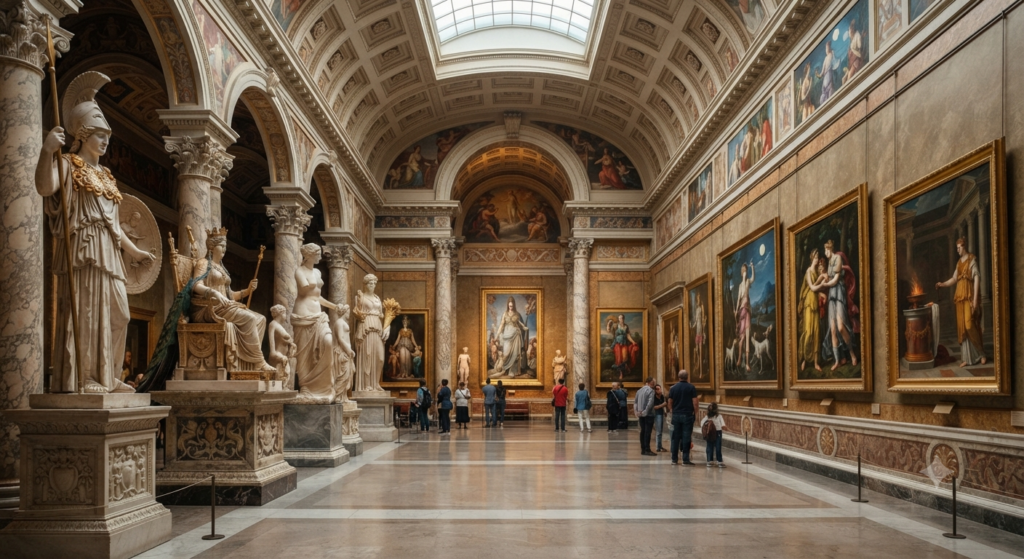
When people ask which female Greek deities are studied in art history, the answer reaches far beyond a single goddess or a single medium. Greek art preserved divine figures in sculpture, vase painting, reliefs, temple decoration, coins, and votive offerings, each medium shaping how a deity was imagined and worshiped. Some goddesses appear constantly in surviving works, such as Athena, Aphrodite, and Artemis; others, like Hestia or Gaia, are rarer but still significant because their images reveal how Greeks linked divinity to civic life, ritual, marriage, fertility, victory, and the natural world.
Art historians study these goddesses not only for beauty or style, but because their images preserve changing ideas about power, gender, cult, and public identity. The written sources of Hesiod, Homer, Pausanias, and later mythographers help explain the myths behind the images, while archaeological evidence shows how those myths were adapted in bronze, marble, terracotta, painted pottery, and architecture. Together, these female deities form one of the richest fields in the study of Greek visual culture.
Athena in Greek art and civic symbolism
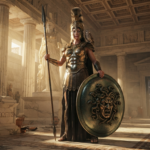
Athena is among the most frequently studied female deities in Greek art because she stands at the meeting point of religion, politics, and craftsmanship. In myth she is the armed daughter of Zeus, and in art she appears in many recognizable forms: helmeted, spear-bearing, and often accompanied by the aegis or owl. The Parthenon sculptures and the Athena Parthenos known from ancient descriptions became lasting models for how divine authority could be visualized in a civic setting. Her image is not limited to martial strength; she also embodies wisdom, measured order, and the patronage of weaving and skilled labor.
Art historians pay close attention to Athena because her iconography changed with context. On Athenian coinage she became a symbol of the city itself, while in vase painting she appears in scenes of myth, judgment, and heroic intervention. The birth of Athena from Zeus, a story recorded in Hesiod and later traditions, inspired numerous artistic treatments that emphasized her fully formed, adult presence rather than infancy. In temples and public monuments, she was not only a goddess of myth but a visual expression of the polis.
Artemis as huntress, maiden, and moon
Artemis is studied in art history as a goddess of wilderness, youthful independence, and ritual transition. Classical art often presents her as a huntress with bow, quiver, short chiton, and running motion, a form that captures her association with wild animals and the untamed spaces beyond the city. Homer and later authors describe her as the daughter of Zeus and Leto, yet in art she is often more self-contained than familial, appearing as a figure of distance and controlled power. Her likeness in sculpture and vase painting helped define how the Greeks imagined the border between civilization and nature.
At the same time, Artemis was not only a huntress. In cult contexts she was linked to maidenhood, childbirth, and stages of female life, which art historians trace through votive offerings, sanctuary finds, and regional images. At Ephesus, for example, her cult image differed greatly from the elegant hunter of Attic art, showing how one deity could be represented in multiple religious traditions. Later associations with the moon also broadened her visual identity, though this was not uniform across all periods. The complexity of Artemis makes her a central figure in the study of Greek sacred imagery.
Hera’s images in marriage and queenship
Hera occupies a major place in Greek art because she represents queenship, lawful marriage, and divine dignity. Ancient literary sources describe her as the wife of Zeus and queen of the gods, and artistic representations often give her a stately, veiled, and commanding presence. In sculpture she may appear enthroned or standing with a scepter, her posture emphasizing rank rather than action. The so-called Hera of Argos and other cult statues associated with sanctuaries show how her image was tied to local worship as well as panhellenic ideas of divine sovereignty.
Her visual history also reveals the Greek concern with marriage as a social institution. Hera’s role as protectress of brides appears in votive dedications and ritual imagery, where she is less a dramatic mythic figure than a solemn guardian of civic order. Some works stress her relation to Zeus, while others focus on her independent authority. Because the surviving art ranges from archaic cult forms to later Roman copies, scholars study Hera to understand how divine queenship could be expressed through costume, gesture, and sanctified space.
Aphrodite’s beauty in sculpture and vase art
Aphrodite is perhaps the most famous female deity in the history of Greek art, especially because her image developed into one of the central forms of idealized beauty. Early Greek art often portrayed her with restraint, but by the classical period she becomes the goddess of grace, sensuality, and allure. Works associated with Praxiteles, especially the Aphrodite of Knidos as reported by ancient writers, marked a decisive shift in divine representation, presenting the goddess in a fully human, vulnerable, and elegant form. This type became one of the most influential images in later art history.
Vase painting and smaller terracotta works also show Aphrodite in scenes of dressing, adornment, and divine encounter. She is often accompanied by Eros, dolphins, doves, or attendants, and these details emphasize her connections with desire, fertility, and the body. Yet she is not only a goddess of erotic attraction. Literary sources and artistic traditions distinguish her celestial and earthly aspects in different ways, and art historians use those variations to study how the Greeks imagined beauty as both divine and socially powerful. Her long afterlife in sculpture makes her essential to the history of the female form in Mediterranean art.
Demeter and Persephone in ritual narratives
Demeter and Persephone are central to art history because their images are inseparable from ritual, seasonal renewal, and the mysteries of Eleusis. Demeter is usually shown as a mature, veiled, and dignified goddess, associated with grain, abundance, and maternal grief. Persephone appears both as Kore, the maiden, and as queen of the underworld, depending on the context. The myth of her descent is told in the Homeric Hymn to Demeter, and artistic scenes often reflect the emotional tension of separation and return rather than dramatic action alone.
Their visual representations are especially important in relief sculpture, votive offerings, and sanctuary art. The Eleusinian context gave these goddesses a solemn and initiatory character that differs from the more openly narrative images of Olympian myth. Art historians study them to understand how the Greeks visualized fertility not as simple abundance, but as a cycle bound to loss, mourning, and restoration. In this way, Demeter and Persephone form one of the deepest intersections between myth, ritual, and image in Greek art.
Hestia’s rare but enduring cult representations
Hestia is less common in surviving Greek art than many other goddesses, yet she remains important because her relative invisibility is itself meaningful. As the goddess of the hearth, she belongs to the interior and the domestic center, and this made her less likely to be depicted in the grand narrative scenes that survive on vases and monuments. When she does appear, she is usually a calm, veiled, seated, or standing figure associated with sacred stillness rather than action. Her presence in art often reflects the idea of ordered household and communal continuity.
Because Hestia’s cult was tied to the hearth in homes, prytaneia, and civic sanctuaries, her image can be harder to separate from ritual space than from mythology. Classical texts present her as one of the Olympians, but artistic evidence is comparatively limited, which makes each representation especially valuable. Art historians study Hestia to see how Greek visual culture treated sacred permanence: not through spectacle, but through restraint, centrality, and quiet authority. Her rarity in art does not diminish her importance; it highlights a different mode of divine presence.
Nike and the goddess of victory imagery
Nike, the goddess of victory, appears frequently in Greek art because victory was a public and political ideal as much as a military one. She is commonly shown winged, swift, and graceful, often hovering above battle scenes, approaching a victor, or crowning a winner. Unlike some older deities, Nike’s image is strongly tied to performance and momentary triumph, which makes her especially visible in sculpture, relief, and coins. Her association with Athena Nike on the Acropolis also shows how victory imagery could be integrated into civic religion.
Art historians are interested in Nike because her body language is so specific: she runs, lands, bends, and extends her hands in gestures of coronation or offering. The famous winged figures on classical monuments, including the Nike of Paionios at Olympia, helped define a visual language for victory that spread widely across the Greek world. In later traditions, Nike becomes a flexible symbol, sometimes independent and sometimes absorbed into the retinues of Zeus or Athena. Her imagery demonstrates how the Greeks turned abstract success into a powerful divine form.
Gaia, Rhea, and older divine personifications
Gaia and Rhea belong to an older stratum of Greek divine imagination, and their images are studied partly because they are less standardized than those of the Olympians. Gaia, the Earth, is often depicted in relief as a maternal figure rising from the ground or emerging half-reclining, especially in scenes involving the birth of heroes or the transfer of infants. Rhea, associated with motherhood and the generation of the gods, appears less often and can be difficult to distinguish from other maternal figures in art. Their representations tend to be symbolic rather than narrative, linking fertility to the body of the earth itself.
These goddesses matter to art historians because they preserve an archaic and cosmic vocabulary of divinity. Gaia appears in many myths as a primordial force, and visual traditions sometimes treat her less as a person than as a living landscape. Rhea, by contrast, is connected in literary tradition to the birth of Zeus and the survival of divine succession. Their art is therefore studied not only for iconography but for what it reveals about early Greek ideas of origin, generation, and the maternal source of order.
The Muses in painting, relief, and poetry
The Muses occupy a special place in art history because they bridge myth, artistic inspiration, and representation itself. These divine women, traditionally nine in number, preside over poetry, song, memory, and the arts. In Greek visual culture they are often shown in groups, each with attributes such as a lyre, scroll, stylus, or musical instrument. Their appearances in painting, relief, and sculpture helped artists and viewers imagine the very act of making art as a sacred practice.
Literary sources from Hesiod onward establish the Muses as patrons of poetic truth, and this authority carries into visual form. Reliefs and vase paintings often place them in the company of Apollo, poets, or cultural heroes, making them figures of inspiration rather than mythic drama. Because they are associated with performance and learning, their images were especially useful in educational and commemorative contexts. Art historians study the Muses as both subjects and symbols: they are deities depicted in art, and at the same time embodiments of artistic creation.
Female deities on vases, temples, and coins
Female Greek deities are studied across many media because no single form tells the whole story. Vase painting preserves mythic action, daily ritual, and divine attendance in compact narrative scenes. Temple sculpture and architectural relief express civic theology on a grand scale, from the Parthenon to local sanctuaries. Coins spread divine images through trade and political circulation, turning goddesses into portable signs of identity, protection, and legitimacy. Together, these media show how Greek religion was visible in public life as well as in private devotion.
Across all these forms, art historians look for patterns of costume, attribute, pose, and setting. A veiled goddess may signal marriage, authority, or ritual reserve; a winged figure may denote victory; a seated mother may point to fertility or earth-born power. The same deity could appear differently in different regions, periods, and cults, which is why comparative study is essential. Greek female deities remain foundational to art history because they reveal how the ancient world translated myth into image, and image into cultural memory.
The female deities of Greece are not a single category but a wide visual tradition shaped by cult, myth, and civic life. Athena, Artemis, Hera, Aphrodite, Demeter, Persephone, Hestia, Nike, Gaia, Rhea, and the Muses each entered Greek art in different ways, from monumental sculpture to the smallest painted vessel. Their images endure because they are more than illustrations of stories; they are records of how the Greeks understood wisdom, beauty, power, fertility, victory, and sacred order.

Orin Vale has spent the better part of two decades tracing the threads that connect the world’s oldest stories — from the halls of Asgard to the banks of the Nile, from Olympus to the jungles of the Maya. What began as a childhood fascination with flood myths and trickster gods grew into years of independent study across comparative mythology and ancient religion, always chasing the same question: what did these stories mean to the people who first told them? Orin writes for readers who want more than trivia — the ones looking for the beliefs, fears, and truths that myths were built to carry.