The Greek calendar was not a neutral ledger of days. In many cities it was a sacred instrument, set to the movements of the moon and ordered around the worship of the gods. Months, festivals, sacrifices, and public rites were timed so that civic life unfolded in rhythm with divine presence. To ask how the Greek calendar related to the gods is to see time itself as part of religion: counted, named, and renewed under divine oversight.
Greek Calendar and the Festival Cycle of Gods
The Greek world did not use a single calendar shared by all poleis. Each city maintained its own system, but most calendars were lunar and organized around recurring religious festivals. These festivals were not added onto the calendar as afterthoughts; they gave the calendar much of its meaning. A month often became legible through the rites it contained, and the year through the divine honors it returned to again and again.
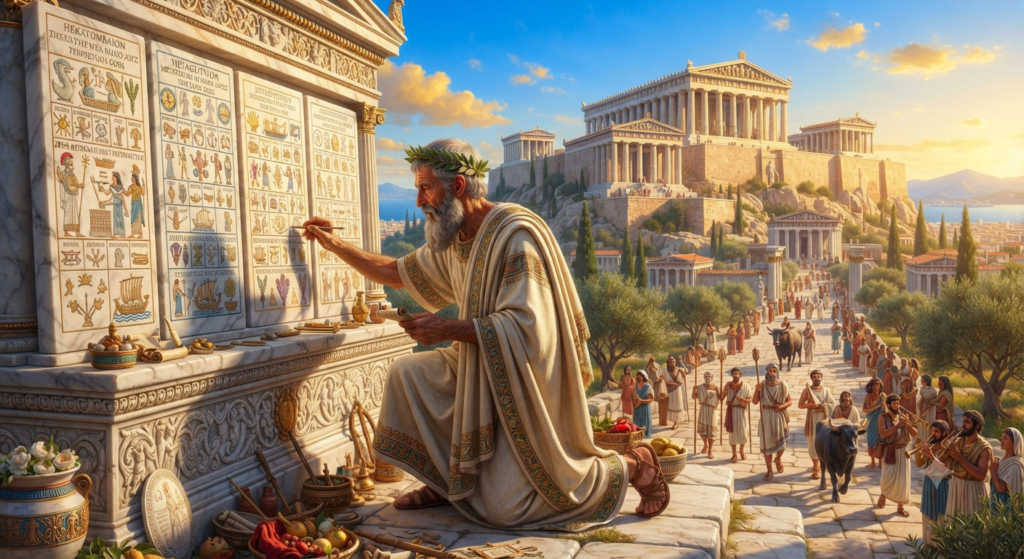
This meant that civic time was deeply ceremonial. In Athens, for example, the sequence of months was tied to sacrifices, processions, and public observances honoring Athena, Dionysus, Apollo, Artemis, Demeter, and other powers. The calendar therefore did more than mark days; it preserved an annual covenant between the community and the gods, renewing obligations through sacrifice, prayer, and feast.
Month Names Tied to Divine Worship in Attica
In Attica, many month names reflect religious life even when they do not explicitly preserve a god’s name. Months such as Hekatombaion, Metageitnion, Boedromion, and Anthesterion were linked to major rites and seasonal observances. Their names often point to sacrifices, processions, or festivals rather than to abstract dates, revealing how the calendar was shaped by worship rather than by detached chronology.
Some month names in the Greek world were directly connected to deities or cult titles. Artemis appears in local month traditions across different regions, while Apollo’s cult could influence civic naming and festival timing. Attic months also carried the memory of ritual labor, harvest, and divine intervention, so that the calendar itself became a map of sacred obligations understood by citizens and priests alike.
New Moon Counting and Sacred Timekeeping
Greek calendars were generally lunar, beginning the month with the first visible new crescent after the dark of the moon. This tied sacred time to the heavens in a direct and observable way. Because the moon’s cycle governed the month, the return of the new moon marked renewal, purification, and the reordering of ritual life.
The new moon had religious importance in its own right. In Athens, the day known as noumēnia opened the month and was treated as auspicious for prayer and offerings. This practice reflects a broader Greek sense that time was not empty or mechanical; it had divine texture, and the moon’s visible phases helped determine when the community should approach the gods.
Zeus, Apollo, and Civic Calendar Authority
Zeus and Apollo both stood close to the structure of sacred time, though in different ways. Zeus was associated with order, kingship, and the authority that upheld civic religion, while Apollo was linked to purification, prophecy, and the regularity of cult practice. In some cities, magistrates or priestly officials acted under divine sanction when regulating the calendar, especially around major festivals and sacrifices.
Apollo’s role at Delphi is especially important for Greek ideas of time and divine guidance. Oracular consultation could affect when a city founded a colony, celebrated a rite, or undertook public action. Zeus, meanwhile, appears in many local cults as the power under whose protection civic order was maintained. The calendar was not controlled by the gods in a bureaucratic sense, but it was framed by the belief that legitimate timing required divine favor.
Artemis, Dionysus, and Seasonal Festivals
Artemis was closely associated with transitions, thresholds, and the life of young people, which made her festivals especially important at certain points in the year. Her rites often marked phases of growth, maturation, or communal preparation. In several Greek cities, Artemis received honors connected to the changing seasons, and her cult helped give religious shape to moments of vulnerability and renewal.
Dionysus, by contrast, dominated festivals of wine, fertility, theatrical performance, and ecstatic release. His worship was often tied to winter or late winter settings, when the social world could be loosened and renewed through ritual. Because Dionysian festivals were among the most dramatic in the Greek year, they show how the calendar could hold not only orderly civic offerings but also moments of transformation and controlled excess.
Panathenaia, Dionysia, and Ritual Dates
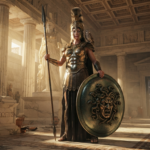
The Panathenaia in Athens honored Athena, city protector and patron deity, and stood among the clearest examples of calendar and cult joined together. Its procession, sacrifices, and competitions were fixed in the annual cycle, giving the city a repeated moment of self-definition under the goddess’s gaze. Major civic festivals like this were not incidental celebrations; they were structural pillars of the calendar.
The Dionysia likewise shaped Athenian time through ritual and performance. The City Dionysia, with its sacrifices and dramatic contests, aligned public religion with artistic and political life. Dating these festivals mattered because the calendar determined when the community could properly honor the god, gather the people, and present offerings in the correct ritual sequence.
Lunar Months and the Rhythm of Offerings
Because Greek months followed the moon, offerings and sacrifices unfolded in a recurring lunar rhythm. Certain days within the month were considered more fitting for particular rites, and the movement from new moon to full moon gave worship a visible pattern. Public and private religious acts were therefore timed not only by season but by the moon’s progress.
This rhythm also reinforced the social function of sacrifice. When a community offered to the gods at fixed times, it reaffirmed shared memory and shared dependence. The calendar made the gods present in repeated intervals, reminding worshippers that divine favor was not a single event but a relationship maintained through carefully ordered offerings.
Intercalary Months in Greek Sacred Practice
A lunar calendar does not fit the solar year neatly, so Greek cities sometimes inserted an extra month to keep festivals in their proper season. This intercalary adjustment was more than a technical correction. If a harvest festival drifted away from harvest time, or a god’s celebration slipped too far from its natural season, the ritual meaning could be weakened.
Different cities handled this in different ways, and the evidence is uneven, but the principle is clear: sacred time needed to remain aligned with the world as the gods had made it. Intercalation therefore shows a practical side of Greek religion. Calendar correction was not merely administrative; it preserved the integrity of rites whose power depended on proper timing.
Oracles, Omens, and Auspicious Feast Days
Greek communities often looked for signs when deciding the right day for important acts. Omens, sacrificial readings, and oracular responses could confirm whether a date was favorable. In a world where divine communication was taken seriously, the calendar was not enough on its own; timing also required assent from the gods.
This concern for auspicious days appears in many forms, from private sacrifices to public embassies. A city might delay an undertaking if signs were unfavorable, or choose a day associated with a god whose protection was desired. The calendar thus worked together with divination, creating a sacred system in which time was evaluated as much as counted.
How Greek Cities Linked Time to the Gods
Greek cities linked time to the gods by making the calendar a religious document as much as a civil one. Festivals, month names, lunar phases, and occasional corrections all expressed the idea that life among humans should be synchronized with divine order. The year was not a blank sequence of dates but a repeating sacred landscape crossed by rites and returns.
Across the Greek world, this produced local variations without losing the larger pattern. Athens had its own festival cycle, Delphi its own sacred rhythms, Sparta its own observances, and other poleis their own divine timetables. Yet the underlying principle remained widely shared: to measure time well was to honor the gods rightly, and to honor the gods rightly was to live within the true shape of the year.
The Greek calendar was therefore a living form of worship. It joined moonlight, sacrifice, festival, and civic memory into one sacred order, reminding each city that time itself belonged to the gods.

Orin Vale has spent the better part of two decades tracing the threads that connect the world’s oldest stories — from the halls of Asgard to the banks of the Nile, from Olympus to the jungles of the Maya. What began as a childhood fascination with flood myths and trickster gods grew into years of independent study across comparative mythology and ancient religion, always chasing the same question: what did these stories mean to the people who first told them? Orin writes for readers who want more than trivia — the ones looking for the beliefs, fears, and truths that myths were built to carry.