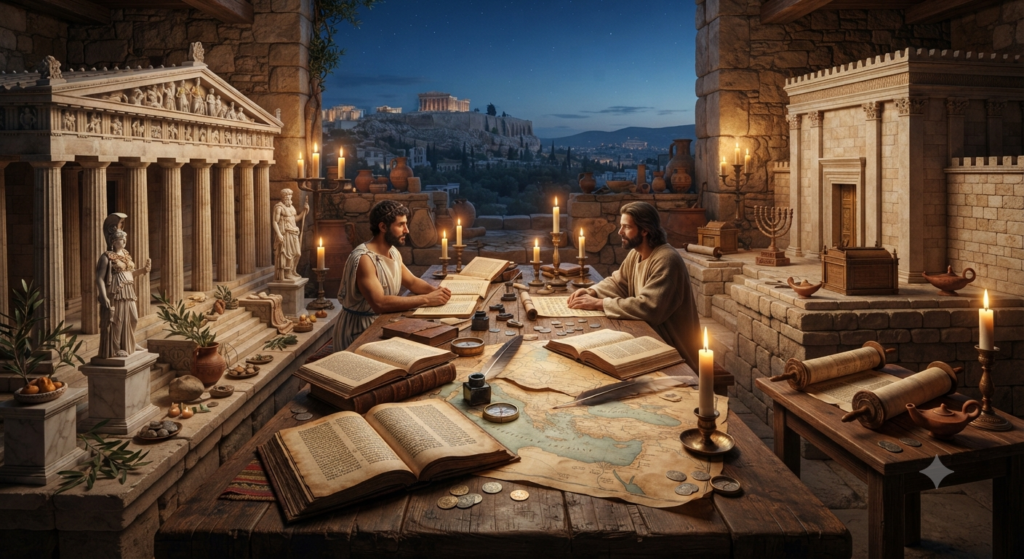
Greek mythology and the Bible belong to different religious worlds, yet they grew up in a shared ancient landscape of storytelling, ritual, and reflection on the divine. The Bible emerges from the traditions of ancient Israel and later Judaism and Christianity, while Greek mythology preserves the poetic memory of the gods, heroes, and sacred histories of the Greek-speaking world. They are not the same tradition, and neither should be flattened into the other, but they often address similar human questions: how the world began, why suffering exists, what justice means, and how mortals should live before powers greater than themselves.
For readers of mythology, the relationship between Greek myth and the Bible is best understood as one of comparison, contrast, and historical proximity. Greek authors and biblical writers did not share a single theology, yet they inhabited the broader ancient Near Eastern and Mediterranean world, where flood traditions, divine councils, sacred mountains, cosmic order, and underworld imagery circulated in different forms. Later Jewish, Christian, and classical writers also read these traditions beside one another, sometimes defensively, sometimes analytically, and sometimes as rival visions of reality.
Greek mythology and the Bible in historical context
Greek mythology took shape across centuries through epic poetry, cult practice, local legend, and later literary retellings such as those of Hesiod, Homer, Apollodorus, and Ovid. The Bible, by contrast, is a library of texts composed and edited over a long period within ancient Israelite and Judean religious life, later preserved and interpreted in Jewish and Christian communities. Because both traditions developed in the ancient Mediterranean, they sometimes share story patterns and symbolic language, but they are rooted in different communities, languages, and theological claims.
Historically, the Greeks and the peoples behind the biblical texts were aware of each other more directly in the classical and Hellenistic periods. After the conquests of Alexander the Great, Greek language and culture spread widely, and Jewish writers such as the authors of the Septuagint, Wisdom of Solomon, and parts of the Maccabean literature engaged a Greek intellectual world. By then, comparison between Greek myth and biblical teaching was no longer accidental; it became part of a living encounter between traditions.
Pagan myths and biblical creation narratives
Greek cosmogony begins not with a single book but with layered accounts. In Hesiod’s Theogony, Chaos comes first, then Gaia, Tartarus, and Eros, followed by the generations of gods and the struggle for cosmic kingship. Other Greek traditions preserve different beginnings, including Orphic material and local myths, showing that Greek creation stories were never fully uniform. The Bible’s opening chapters, especially Genesis 1 and 2, present a different kind of origin story: one sovereign God creates by speech, order rises from formlessness, and humanity is made with a unique role in creation.
The relation between these accounts lies less in borrowing than in shared ancient concerns. Both traditions imagine the world as the product of ordered beginnings rather than random chance, and both treat creation as morally meaningful. Yet their differences are profound. Greek myth often unfolds through divine genealogy and conflict, whereas Genesis presents creation as the work of one transcendent deity, without rivalry. The biblical narrative does not describe the cosmos as emerging from a family of gods, and that sharp distinction is one of the clearest contrasts between the two worlds.
Gods, angels, and divine councils compared
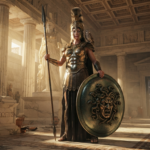
Greek mythology is filled with gods who look, think, and argue like heightened humans. Zeus rules the Olympians, Athena advises, Apollo proclaims, and lesser divine beings fill forests, seas, and thresholds. In the Bible, God is not one deity among many, yet the texts sometimes speak of a divine council, heavenly beings, or “sons of God,” language found in passages such as Psalm 82, Job 1–2, and 1 Kings 22. These beings are not rivals to the Lord in the same way Greek gods often compete with one another; they belong to a different conceptual order.
This comparison is helpful because it shows how ancient texts could picture the divine realm in relational terms. Greek myths portray a crowded heaven governed by hierarchy and conflict, while the Bible usually stresses the absolute sovereignty of one God who commands angels or heavenly attendants. Where Greek poetry dramatizes the personalities of many immortals, biblical writing tends to limit such beings to service, witness, or judgment. The result is a shared celestial vocabulary, but a very different theology.
Flood stories in Genesis and ancient Greece
Flood traditions appear in both biblical and Greek literature, though with different emphases. In Genesis, the flood of Noah comes as judgment on human violence and corruption, yet it also becomes a means of preservation through covenant. Outside the Bible, Greek mythology preserves several flood stories, the best known being the tale of Deucalion and Pyrrha, told in later form by Ovid and linked to earlier Greek tradition. In that myth, Zeus sends a flood to wipe out a wicked generation, and the survivors repopulate the earth by following divine instruction.
The resemblance between Noah and Deucalion has long attracted attention, but the stories are not identical. Both describe catastrophe, survival, and a renewed human race, which suggests that flood memory was widespread in the ancient world. Still, the biblical narrative is framed by covenant and moral history in a way that differs from Greek mythic storytelling. Greek versions often connect the flood to divine displeasure and renewal, while Genesis embeds it in a larger ethical and theological account of humanity before God.
Temptation, prophecy, and moral order in both
Greek mythology often presents temptation through the play of desire, divine trickery, or the frailty of mortals placed before choices with costly consequences. Pandora, in Hesiod, is a foundational example: she brings evils into the human world, not as a moral allegory in the later biblical sense, but as part of a mythic explanation for hardship. Prophecy also matters deeply in Greek tradition, from Delphi to seers like Tiresias, where divine knowledge may be granted, obscured, or misunderstood. Human beings move in a world where signs must be interpreted, often at great risk.
The Bible also gives central place to moral order and prophetic speech, though in a different register. Temptation appears in stories such as Eden, where disobedience follows persuasion and distrust, and prophecy functions as a covenantal call to justice and repentance. Greek myth often treats fate, divine will, and human weakness as intertwined forces; biblical literature more often presents obedience and disobedience in relation to a personal God who judges. Both traditions recognize that words matter, choices matter, and the visible world is shaped by invisible realities.
Heroes, patriarchs, and covenant language
Greek heroes and biblical patriarchs are not the same kind of figure, but they can be compared as ancestors through whom a people remembers itself. Heracles, Perseus, Jason, and Odysseus move through perilous landscapes and encounter divine intervention, while Abraham, Isaac, Jacob, and Moses stand at the center of Israel’s ancestral memory. Both sets of figures are marked by promise, testing, and the formation of identity, though Greek heroism often emphasizes exceptional accomplishment, while biblical patriarchal narrative often emphasizes covenant and trust.
Covenant language is particularly distinctive in the Bible. The promises made to Abraham, the covenant at Sinai, and later renewal traditions frame history as a relationship between God and a people. Greek myth does contain oaths, obligations, and sacred bonds, but not covenant in the biblical sense of a binding, unfolding divine-human pact that structures national memory. Even so, both traditions preserve the idea that the past is not merely past: ancestral deeds shape a community’s present obligations and future destiny.
Underworld beliefs in Greek lore and Scripture
Greek mythology offers one of the ancient world’s richest imaginations of the underworld, or Hades, a realm associated with the dead rather than a place of simple punishment. Homer’s Odyssey presents a shadowy afterlife where souls retain memory and longing, while later myths develop regions of reward and torment, such as the Elysian fields and Tartarus. These images are not uniform across all Greek sources, but they clearly show a sustained interest in what lies beyond death.
Biblical texts speak more cautiously. Early Hebrew Scripture often uses Sheol to denote the realm of the dead, a place of silence and descent rather than the fully developed heaven-and-hell schema familiar from later tradition. By the Second Temple period, Jewish literature and later Christian texts develop stronger language of resurrection, judgment, and final destiny. Greek and biblical underworld imagery can look similar at a distance, yet they differ in theological purpose: Greek myth explores the geography of death, while the Bible increasingly frames death within divine judgment and hope for restoration.
Idolatry, cult practice, and biblical critique
Greek religion was not only mythic narrative but also temple sacrifice, festival, procession, and local cult. The gods were honored through statues, offerings, hymns, and civic rites that tied communities to divine presence. The Bible repeatedly critiques idolatry, especially the making and worship of images, from the golden calf episode in Exodus to the prophetic polemics of Isaiah and Jeremiah. This is one of the sharpest points of contact between the two traditions, because biblical writers often define faithfulness by refusing the worship of other gods.
That critique should not be read as a misunderstanding of Greek practice so much as a different religious claim. Greek cult did not usually separate myth from ritual in the same way later monotheistic criticism did; image, story, and sacred place formed a single religious world. Biblical texts, especially in their monotheistic forms, reject that world as devotion misplaced. In doing so, they provide not a neutral description of Greek religion but a theological argument against it.
Shared ancient Near Eastern imagery and themes
Many similarities between Greek mythology and the Bible do not arise from direct borrowing but from the broader ancient world they shared. Sacred mountains, storm deities, sea chaos, primeval waters, divine assemblies, and royal ideology all appear across Mesopotamian, Levantine, Greek, and biblical texts in different forms. What changes from one tradition to another is not only the story but the meaning attached to it. A sea monster, for instance, may signal cosmic conflict in one tradition and a symbol of subdued chaos in another.
This wider background matters because it reminds us that the Bible did not develop in isolation, just as Greek myth did not. Ancient authors reused and transformed inherited imagery to express distinctive beliefs. The result is a network of parallels that can be illuminating without reducing one tradition to the other. Greek myth and Scripture are best read as neighboring voices in a long ancient conversation about gods, order, kingship, humanity, and the edges of the known world.
How classical writers read myths beside Scripture
Classical and later writers often encountered the Bible through translation and interpretation, especially once Greek became a major language of Jewish and Christian thought. Some Hellenistic Jewish authors, such as Philo of Alexandria, interpreted Scripture through philosophical categories familiar to the Greek world. Early Christian writers, in turn, read Greek myth with a mixture of critique and comparison, sometimes treating it as poetic fiction, sometimes as corrupted memory, and sometimes as a rival system of sacred history. The relationship was rarely simple admiration or rejection alone.
Across antiquity and late antiquity, comparison served many purposes. Greek myth could be read beside Scripture to highlight moral contrast, shared symbols, or the difference between poetic plurality and monotheistic revelation. At the same time, educated readers in the classical tradition continued to value Homer and Hesiod as foundational authors, even when they approached biblical texts with curiosity or resistance. The history of interpretation shows that Greek mythology and the Bible did not merely exist in parallel; they also met in the minds of readers who tried to make sense of both.
Greek mythology relates to the Bible less as a source and copy than as a neighboring tradition with overlapping imagery, shared ancient concerns, and sharply different theological claims. Both speak of creation, divine power, human failure, judgment, and the hope of order beyond chaos. Yet the Bible consistently moves toward monotheism, covenant, and prophetic ethics, while Greek myth preserves a many-voiced universe of gods, heroes, and local sacred stories.
For modern readers, the value of comparison lies in clarity. Greek mythology becomes richer when read in the broader ancient world, and the Bible becomes more historically grounded when placed beside the other literatures of its time. The two traditions do not collapse into one another, but they illuminate each other’s language, imagination, and cultural depth.

Orin Vale has spent the better part of two decades tracing the threads that connect the world’s oldest stories — from the halls of Asgard to the banks of the Nile, from Olympus to the jungles of the Maya. What began as a childhood fascination with flood myths and trickster gods grew into years of independent study across comparative mythology and ancient religion, always chasing the same question: what did these stories mean to the people who first told them? Orin writes for readers who want more than trivia — the ones looking for the beliefs, fears, and truths that myths were built to carry.