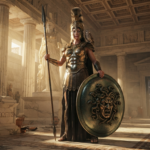
The Greek word for truth is aletheia (ἀλήθεια), a term that carries more weight than a simple dictionary translation can capture. In Greek thought, it can suggest truth as disclosure, unconcealment, and the lifting of what had been hidden. That makes it especially fitting for mythology and philosophy alike, where truth is often not merely a fact stated aloud, but something brought into the light.
Aletheia: the Greek word for truth
Aletheia is the standard ancient Greek word for truth, though its force is broader than the English term. In ordinary use it could mean truthfulness, accuracy, or reliability, but in deeper literary and philosophical contexts it often points toward something revealed rather than something merely asserted. The word is written ἀλήθεια, and it became one of the central terms in Greek reflection on language, knowledge, and being.
In mythology and classical literature, the idea behind aletheia often stands in contrast to concealment, deception, and forgetfulness. Greek authors did not treat truth as a purely abstract concept; it was tied to speech, memory, divine revelation, and the proper naming of things. For that reason, asking “what is the Greek word for truth?” leads not only to a vocabulary lesson, but to a major theme in Greek intellectual and religious life.
Literal sense and older Greek usage
The etymology of aletheia is traditionally explained as involving negation and forgetting or concealment. Ancient and modern scholars have often connected it with the prefix a- and a root related to lethe, “forgetfulness” or “hiddenness,” though the full historical development is complex. Even so, the association is meaningful: truth is what is not hidden, not forgotten, and not lost to obscurity.
In older Greek usage, the word could describe factual correctness, sincerity, or dependable testimony. It was not confined to philosophy. A witness could speak with aletheia, a person could answer truthfully, and a report could be accurate. At the same time, Greek poets and thinkers increasingly gave the word a more profound sense, so that truth became linked with revelation and with the clearing away of illusion.
Truth in Homeric and early poetry
In Homer, the language of truth is less abstract than in later philosophy, but the concern is already present. Epic poetry values words that match events, oaths that bind, and stories that preserve what actually happened. When speakers lie or disguise their identity, the tension is not merely social; it reflects a world where speech can uncover or obscure reality. Truth is therefore part of the moral and narrative order of the poems.
Early poetry also associates truth with memory and inspired speech. The Muses, in Hesiod’s Theogony, can “tell lies like the truth” or “tell the truth,” depending on the poet’s phrasing and interpretation, which shows how ancient Greek thinking could already hold truth and poetic invention in close relation. In that world, truth is not the absence of poetry, but the right relation between divine knowledge, human speech, and what has truly been revealed.
How philosophers defined aletheia
For pre-Socratic philosophers, aletheia began to move toward a more technical meaning. Parmenides is especially important, because his poem contrasts the way of truth with the way of opinion or seeming. In that framework, truth is what is stable, knowable, and real, while deceptive appearances belong to a lesser mode of understanding. This is one of the earliest and most influential philosophical uses of the term.
Later philosophers, especially Plato and Aristotle, continued to refine the idea. For Plato, truth is connected to the soul’s turning toward what is genuinely real, beyond shifting appearances. Aristotle offered a more formal account, famously associating truth with saying of what is that it is, and of what is not that it is not. Across these thinkers, aletheia becomes increasingly philosophical, but it retains its older sense of uncovering what lies beneath surface appearance.
Aletheia versus falsehood and secrecy
Greek authors often set aletheia against pseudos, falsehood, as well as against concealment and deceptive speech. A lie was not simply incorrect information; it was a distortion of the relationship between word and reality. Because of this, truthfulness carried ethical force. To speak truth was to align speech with what is, while falsehood broke that alignment and could damage trust between mortals and gods alike.
Secrecy is a related but distinct theme. Not everything hidden is false, yet Greek myth and literature repeatedly show that what is concealed exerts power until it is revealed. This is one reason aletheia matters so much in Greek thought: truth is active, not passive. It does not merely exist; it comes forth, is disclosed, and may even be resisted before it is finally seen.
The word’s role in myth and ritual
In myth, truth often appears through divine revelation, prophecy, and sacred speech. Apollo, as a god of prophecy, is associated with messages that reveal what mortals cannot see unaided. Oracles did not simply offer information; they mediated between hidden divine knowledge and human uncertainty. In such settings, truth is not casual speech but a charged act of disclosure.
Ritual also mattered. Greek religion was deeply attentive to correct form, correct naming, and proper sequence, all of which belong to a world where truth and order are closely linked. While the word aletheia itself is not a ritual slogan, its underlying idea fits the sacred logic of revelation: what is hidden is made present, what is unclear becomes known, and the community responds to what has been shown.
Truth, memory, and revealing speech
One of the deepest Greek associations of truth is with memory. Forgetfulness, whether literal or symbolic, dissolves continuity, while truth preserves what really happened. This is why the figure of Lethe, the river of forgetting in later Greek tradition, stands in such striking contrast to aletheia. To know truth is to resist erasure and to keep reality from slipping into obscurity.
Revealing speech is equally important. In Greek literature, a truthful statement is often one that names things correctly and brings hidden identities into the open. Disguises, riddles, and recognition scenes depend on this movement from concealment to clarity. Truth, then, is not only a property of propositions; it is an event in language, a moment when what was veiled becomes visible to the listener.
Greek terms related to truthfulness
Several Greek words cluster around the idea of truth. Alēthēs means true or truthful, and alēthōs means truly or indeed. These forms show how deeply the root of aletheia shaped the language of honesty and accuracy in Greek. Other related terms can emphasize sincerity, reliability, or openness, depending on context.
At the same time, Greek has distinct words for lying, deception, and cunning, and these distinctions matter. A hero might be praised for intelligence yet still be capable of deceit; a prophet might speak truly but in riddling form. The vocabulary around truthfulness was therefore precise and flexible. Aletheia sat at the center of that field, while related words marked the shades between honest disclosure, strategic concealment, and outright falsehood.
Aletheia in classical and later sources
In classical literature, aletheia appears across genres, from history and drama to philosophy and rhetoric. Historians such as Herodotus and Thucydides are concerned with presenting truthful accounts, though they differ in method and tone. Tragedy, meanwhile, often stages the painful arrival of truth, as hidden actions, family bonds, and divine judgments emerge into view.
In later antiquity and beyond, aletheia remained a powerful philosophical and theological term. Greek-speaking Christian writers adopted it as part of their scriptural and doctrinal vocabulary, though its meaning was shaped by new religious contexts. The word did not lose its classical heritage; instead, it continued to carry the old Greek sense of disclosure, while also entering new traditions of thought about divine and human truth.
Why aletheia still matters today
Aletheia matters because it reminds modern readers that truth is more than correctness alone. In the Greek imagination, truth is tied to unveiling, remembrance, trustworthy speech, and the struggle against illusion. That broader sense still speaks clearly in a world shaped by competing narratives and hidden motives. The word holds onto an ancient conviction: what is real must be brought into the open.
For readers of mythology, the term is especially useful because it connects story, ritual, and philosophy in one concept. Greek myths often revolve around what is concealed and later revealed, and aletheia names that movement with remarkable precision. It remains one of the most enduring Greek words, not only because it means truth, but because it captures the drama of truth coming to light.
So, the Greek word for truth is aletheia, a term that reaches beyond simple factual accuracy into the realms of revelation, memory, and disclosure. In the ancient Greek world, truth was not only something said correctly; it was something uncovered, remembered, and set before the eyes of gods and mortals alike.

Orin Vale has spent the better part of two decades tracing the threads that connect the world’s oldest stories — from the halls of Asgard to the banks of the Nile, from Olympus to the jungles of the Maya. What began as a childhood fascination with flood myths and trickster gods grew into years of independent study across comparative mythology and ancient religion, always chasing the same question: what did these stories mean to the people who first told them? Orin writes for readers who want more than trivia — the ones looking for the beliefs, fears, and truths that myths were built to carry.