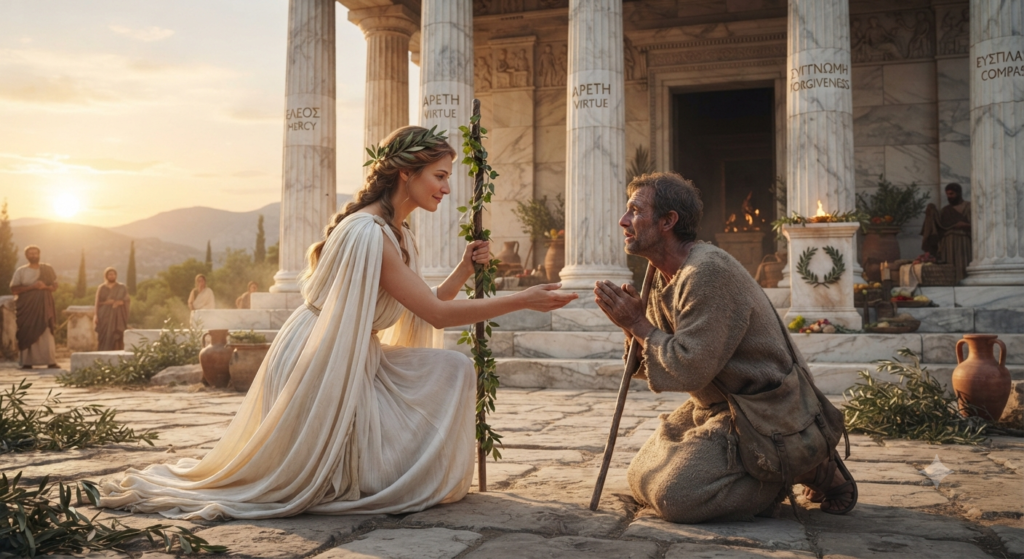
In Greek, the word most often translated as mercy is eleos (ἔλεος). It carries a wide range of meaning that can include pity, compassion, tenderness toward the suffering, and the willingness to spare someone who is vulnerable or defeated. Unlike a neat modern definition, eleos belongs to a world where emotion, obligation, religion, and social standing are closely joined. It appears in poetry, drama, prayer, and philosophical language, where it can describe both human feeling and divine response.
The Greek language did not treat mercy as a single simple idea. Alongside eleos, writers used related terms such as oiktirmos for pity or compassionate feeling, and expressions connected to charis for favor or grace. In mythic and literary Greece, mercy could soften a king’s judgment, move a god’s heart, or mark the fragile bond between supplicant and protector. The result is a term that reveals much about how the Greeks understood suffering, power, and the possibility of restraint.
Greek Word for Mercy: Eleos and Its Meaning
The Greek word eleos is the closest and most common equivalent to “mercy.” In classical usage, it could mean pity for someone in misery, compassion toward the unfortunate, or leniency shown to a defeated person. The word does not always imply the moral or theological weight that “mercy” can carry in later religious traditions. Instead, it often describes an emotional response that leads to practical action: sparing, helping, or lifting up someone in distress.
In Greek literature, eleos is closely tied to human vulnerability. It is the feeling awakened by suffering, exile, supplication, age, or defeat, and it can appear in both noble and dangerous forms. A ruler may show eleos by sparing an enemy, but Greek writers also recognized that pity can be manipulated, resisted, or overridden by duty, honor, or divine will. The term therefore lives at the boundary between feeling and conduct.
Eleos in Homer, Tragedy, and Prayer
Homer does not build a single doctrine around mercy, yet the emotional world of the epics leaves room for pity, restraint, and supplication. In the Iliad, scenes of kneeling and entreaty create moments when a stronger figure is asked to feel compassion for a weaker one. Priam’s appeal to Achilles is one of the most powerful examples: he evokes Achilles’ memory of his own father, and the language of shared mortality opens a space where sorrow and pity briefly overcome wrath.
Greek tragedy gives eleos an even sharper edge. In plays by Aeschylus, Sophocles, and Euripides, characters plead for mercy from kings, cities, and gods, and the audience is invited to feel pity for those caught in ruin. Tragedy often tests whether compassion can survive fear, revenge, and necessity. Prayer works in a similar way, especially in supplicatory contexts, where the petitioner asks not merely to be heard but to be moved to mercy by the one receiving the plea.
Pity, Mercy, and Compassion in Greek
English often collapses several Greek emotional terms into one word, but the distinctions matter. Eleos is mercy or pity in the sense of a response to suffering. Oiktos and oiktirmos are also terms for pity or compassion, and they can overlap with eleos depending on context. Greek authors were attentive to subtle differences in tone, especially in rhetoric and moral argument, where the right word could imply either dignified compassion or uncomfortable emotional disturbance.
Compassion in Greek thought was not always praised without reserve. Some philosophers treated excessive pity as a weakness if it clouded judgment, while poets and dramatists often made pity a mark of civilized feeling. The tension is revealing. To feel eleos is to recognize another person’s fragility, but Greek culture also asked whether such recognition should govern action, and if so, under what limits. Mercy was admired, yet never simplistic.
Eleos as a Divine Quality in Olympus
Among the gods, mercy is not a fixed attribute in the way that justice or power might be imagined. Still, divine figures can be associated with acts of sparing, protecting, or responding to prayer. Zeus as supplicant’s guardian, Athena as protector of cities, and Apollo as healer and purifier may all be linked with merciful outcomes, depending on the myth or cult context. In such settings, mercy is less a formal title than a mode of divine presence.
At the same time, Greek mythology is full of gods who are severe, remote, or punitive. This is part of the ancient landscape rather than a contradiction to it. Divine mercy in Olympus often appears as a temporary suspension of suffering, a reprieve, or a carefully measured favor. The gods may grant relief, but they do not erase the larger structure of fate, obligation, and consequence that shapes mortal life.
Greek Terms Related to Mercy and Grace
Besides eleos, Greek uses several words that touch the same emotional and moral territory. Charis means favor, grace, goodwill, or gratitude, and in some contexts it comes close to a gracious act that is freely given. Eunoia refers to goodwill or benevolence, a more stable disposition than a momentary feeling of pity. Together these words show that Greek thought did not isolate mercy from kindness, favor, or reciprocity.
The network of related terms is important because Greek mercy often occurs within social exchange. A request for pity may be answered by a favor; a spared life may create gratitude; a divine blessing may be framed as charis. This is one reason the Greek vocabulary feels less abstract than later doctrinal language. Mercy is not only an inner virtue. It is a relationship, a response, and sometimes a gift that reshapes standing between giver and receiver.
How Eleos Differs from Oiktirmos
Eleos and oiktirmos are close enough to be confused in translation, but they are not identical. Eleos is the broader and more established term for mercy or pity, especially in literary and rhetorical Greek. Oiktirmos emphasizes the feeling itself more directly, often as compassion or heartfelt pity. In practical use, both can overlap, yet the nuance shifts depending on whether the focus is on the emotion, the response, or the ethical effect.
This distinction matters when reading Greek texts because translators sometimes choose the same English word for both. A passage with oiktirmos may feel more inward and emotive, while eleos can sound more active, as though pity is moving toward leniency or aid. The difference is subtle, but in a culture attentive to speech and posture, such subtleties shape meaning. Mercy in Greek is never just one flat term; it is a field of closely related ideas.
Mercy in Ancient Greek Ethics and Law
In Greek ethics, mercy could be admired as a mark of moderation and nobility, but it was not always required. Civic life valued justice, order, and the protection of the polis, and these could outweigh private pity. A judge, king, or magistrate might be praised for restraint, yet the same mercy could be criticized if it seemed to weaken law or reward wrongdoing. Greek moral thought often places mercy in conversation with measure, prudence, and desert.
Law and custom also shaped the expression of mercy. Suppliants could appeal to shared religious norms, public reputation, or the sanctity of asylum-like spaces. A plea for eleos was not only emotional; it was a social performance supported by ritual and convention. In this setting, mercy became a test of authority. To show mercy could display greatness, but to deny it could affirm severity, consistency, or devotion to law.
Eleos in Cult Worship and Supplication
Supplication was one of the most important religious settings for mercy in Greek culture. A person in danger might grasp the knees, chin, or altar of another and ask for protection. Such gestures turned mercy into a visible act, framed by ritual and witness. The supplicant did not simply ask to be liked; they asked to be treated with restraint in the name of divine and human order.
In cult practice, mercy could also be linked to specific gods or sacred places where sanctuary and aid were sought. Temples and altars offered a framework in which the powerful were expected to respond properly to the vulnerable. This made eleos both sacred and practical. It was not only a feeling in the heart but an obligation recognized by ritual, memory, and communal expectation.
Translating Mercy from Greek Texts Today
Translating eleos into English is straightforward only at first glance. “Mercy” works well in many biblical and devotional contexts, but in Homer, tragedy, and philosophical prose it may sometimes be closer to pity, compassion, leniency, or clemency. The right rendering depends on context, speaker, and genre. A battlefield scene and a prayer to a god do not ask for exactly the same nuance.
Modern translations therefore have to balance precision with readability. If a passage emphasizes emotional response, “pity” may be best; if it emphasizes sparing a life or softening a judgment, “mercy” or “clemency” may fit better. Because Greek is sensitive to context, one English word rarely covers everything. Eleos remains the central answer to the question, but it opens into a wider semantic field than English usually assumes.
The Greek Word for Mercy in Later Tradition
In later Greek, especially within the language of the Septuagint and Christian texts, eleos became even more prominent as the standard word for mercy. It carried strong scriptural and liturgical associations and came to suggest divine compassion, forgiveness, and saving favor. This later usage helped stabilize eleos as the familiar Greek term many readers encounter first when asking what mercy means in Greek.
Yet the older classical background never disappears entirely. The word still remembers the world of supplication, tragedy, and human frailty that shaped it long before later religious tradition gave it new depth. For that reason, eleos is best understood not as a narrow translation but as a living Greek idea: mercy seen from the side of the weak, the defeated, and the one who asks to be spared.

Orin Vale has spent the better part of two decades tracing the threads that connect the world’s oldest stories — from the halls of Asgard to the banks of the Nile, from Olympus to the jungles of the Maya. What began as a childhood fascination with flood myths and trickster gods grew into years of independent study across comparative mythology and ancient religion, always chasing the same question: what did these stories mean to the people who first told them? Orin writes for readers who want more than trivia — the ones looking for the beliefs, fears, and truths that myths were built to carry.