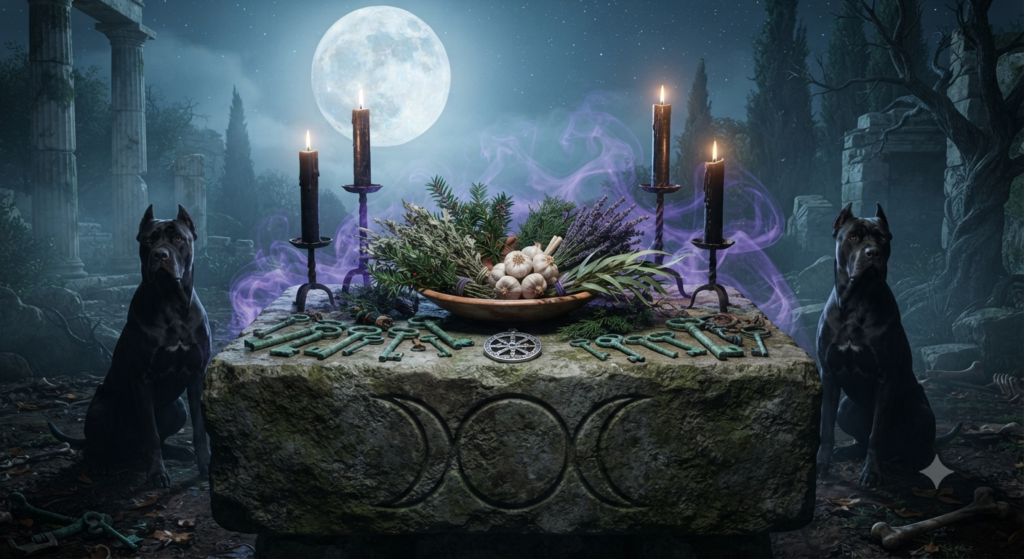
Hecate is the Greek goddess most often linked with thresholds, night journeys, magic, and the restless border between worlds, and the plants associated with her reflect that liminal power. In the surviving ancient sources, no single “official” list of Hecate’s herbs exists, but a number of plants recur in later magical tradition, in ritual contexts, and in scholarly reconstructions of her cult. Some are tied to protection, some to purification, some to sleep and dreaming, and some to the underworld itself. Together they form a botanical language of crossroads, torches, and hidden knowledge.
Hecate’s sacred herbs in Greek mythology
Classical literature does not preserve a fixed canon of sacred herbs for Hecate in the way later occult traditions sometimes imply. What it does preserve is a strong association between the goddess and plants used in magic, boundary rites, and chthonic worship. Hecate appears in Hesiod as a powerful goddess honored by Zeus, and later sources connect her with nocturnal rites, ghostly processions, and the kind of ritual action that depended on herbs, smoke, and offerings laid at thresholds.
Much of what people now call “Hecate’s herbs” comes from the wider world of ancient Greek pharmacology and ritual practice rather than from one mythic episode. Plants with bitter odors, lunar associations, purifying qualities, or dangerous medicinal properties were naturally drawn into her sphere. That is why mugwort, garlic, bay laurel, cypress, poppy, and mandrake are so often named in connection with her, even though the evidence comes from different periods and genres.
Mugwort and the goddess of crossroads
Mugwort is one of the plants most often associated with Hecate in later tradition, and the association makes cultural sense even if it is not laid out as a formal rule in the earliest texts. Mugwort was widely used in antiquity and later folk practice for purification, protection, women’s health, and the easing of trance-like states. Those functions place it close to Hecate’s role at the edge of ordinary life, where healing and danger often overlap.
The plant’s lunar and liminal character also suits a goddess of crossroads. Hecate’s torches illuminate hidden paths, and mugwort, with its reputation for sharpening dreams and warding off harmful forces, belongs to that same symbolic world. In modern Hecate devotion, mugwort often appears on altars or in ritual teas, but this is best understood as a continuation of the goddess’s broader magical profile rather than a direct prescription from a single ancient source.
Dittany in rites of protection and healing
Dittany, especially Cretan dittany, is famous in Greek tradition as a plant of healing and recovery. Ancient writers, including later natural historians, describe it as remarkable for drawing out arrows or easing wounds, and that reputation made it useful in protective and curative rites. While not uniquely Hecatean, it fits the goddess’s power over dangerous thresholds: the moment when harm can be turned back, soothed, or contained.
Its link to Hecate emerges through ritual logic. A goddess invoked in spells, roadside offerings, and household protection would naturally be paired with a herb associated with remedy and safety. In later magical settings, dittany could symbolize the mending of what has been fractured, whether the body, the household, or the boundary between the human and the uncanny. Its role is less about dramatic myth than about the practical religious life that surrounded Greek magic.
Garlic, onions, and apotropaic folk magic
Garlic and onions belong to the everyday magic of protection, and that is why they are frequently connected with Hecate in later folk belief. Their strong smell and ordinary availability made them effective apotropaic objects, suited to repelling evil influences, the evil eye, and wandering spirits. Hecate, as a goddess approached at doorways and crossroads, stands naturally within that protective sphere.
Ancient practice often relied on the power of simple, pungent things. Offerings to Hecate at thresholds were not always elaborate; they could include the kinds of foods and plants that marked a house off from danger. Garlic and onions are therefore less a “mythic herb list” than an expression of Hecate’s domestic and boundary-centered cult. Their place in her later magical associations reveals how the goddess moved from temple and altar into the lived habits of protection at home.
Bay laurel and moonlit priestly offerings
Bay laurel was one of the most prestigious ritual plants in the Greek world, closely tied to Apollo, divination, and purification. Its connection to Hecate is therefore indirect rather than primary, but it appears in some later ritual settings where boundaries between divine powers were flexible. Because Hecate could be invoked in purification and in lunar rites, laurel sometimes entered her circle as a cleansing or honoring plant.
The moonlit aspect matters here. Hecate was strongly associated with night, the moon, and the invisible powers that move after sunset, while laurel was used in ceremonial acts that marked sacred presence. When placed in offerings, garlands, or incense mixtures, bay laurel could help frame a rite meant to summon divine attention at the edge of visibility. Its role in Hecatean devotion is therefore ceremonial and symbolic, shaped more by ritual atmosphere than by mythic narrative.
Cypress, yew, and plants of the underworld
Cypress is one of the clearest plant symbols of death and mourning in the Mediterranean world, and it fits Hecate’s chthonic dimension with little difficulty. The tree was associated with graves, cemeteries, and funerary landscapes, all of which overlap with the goddess’s presence among spirits and the dead. When Hecate is imagined in her underworld aspect, cypress becomes one of the most natural trees to stand near her.
Yew belongs to a similar symbolic field, though with more caution, since its specific ritual role in ancient Greek worship is less securely documented. Its evergreen endurance and toxic reputation made it a fitting plant for the border between life and death. In Hecatean imagery, both cypress and yew evoke the stillness of the grave, the persistence of shadow, and the solemnity of powers that do not fully belong to the daylight world.
Poppy, mandrake, and Hecatean sleep
Poppy is strongly tied to sleep, oblivion, and dream, all of which connect it to Hecate’s magical reach. In Greek art and later tradition, poppy heads can appear among symbols of rest and chthonic abundance. The plant’s heavy, narcotic associations place it close to the goddess who governs not only roads and spirits but also states of altered consciousness.
Mandrake belongs even more clearly to the world of dangerous magic. Its root was famous in antiquity for its medicinal and sedative properties, but also for its uncanny, human-like shape and its role in spells. Later traditions often linked mandrake to witches and nocturnal rites, which made it easy to associate with Hecate. The evidence is strongest for mandrake as a magical plant in general, and its Hecatean connection emerges from the broader culture of sorcery rather than from a single canonical myth.
Verbena and ritual cleansing at the threshold
Verbena, or sacred flowering plants grouped under that name in later tradition, is commonly associated with purification and ritual cleansing. In the Greco-Roman world, such plants were often gathered for ceremonial use, especially when a person or place needed to be ritually set apart. That makes verbena well suited to Hecate, whose rites often concern the maintenance of boundaries and the removal of contamination.
At the threshold, cleansing has special force. Hecate’s power is not only to guard the crossing point but to make it usable. Verbena fits that task neatly, whether used in washes, garlands, or hand-held ritual bundles. Its association with the goddess is therefore practical and symbolic at once: a plant that clarifies space belongs to a deity who governs passage through darkened places.
Herbal offerings in ancient Greek curse tablets
Curse tablets, or defixiones, reveal another side of the ancient magical world in which Hecate was important. These inscriptions were often deposited in graves, wells, or other liminal places, and some were directed to chthonic powers or accompanied by ritual materials. The surviving tablets do not always name specific herbs, but the broader magical procedures connected with them likely included plant offerings, incense, and binding substances.
Because Hecate was invoked in spells and in nocturnal rites, herbs with strong odor, purifying smoke, or binding associations would naturally have accompanied such acts. Myrrh, sulfurous substances, bitter roots, and protective plants all belong to this atmosphere, even when the tablets themselves are silent about a precise recipe. The point is not that one herb was mandatory, but that Hecate’s cult and Greek curse magic shared a ritual grammar of concealment, descent, and control.
Which plants appear in Hecate’s cult today
Modern Hecate devotion draws from ancient fragments, later magical traditions, and contemporary pagan practice, so the plants most often used today are a combination of historical echo and devotional choice. Mugwort, garlic, bay laurel, poppy, cypress, and mandrake are among the most common names, with rosemary, rosemary-like cleansing herbs, and incense blends also appearing in some circles. These choices usually reflect the goddess’s ancient themes: protection, moonlit rites, crossroads, and contact with the unseen.
It is worth keeping the distinction clear between attested ancient evidence and modern devotional continuity. Ancient sources confirm Hecate’s role in magic, boundaries, and the chthonic sphere; they do not give one standardized herbal calendar. Even so, the plants that gather around her today do so for good reason. They preserve the old atmosphere of night offerings, purifying smoke, and quiet power at the edge of the road.
The herbs associated with Hecate are best understood as part of a ritual ecology rather than a fixed list. Mugwort, garlic, bay laurel, cypress, poppy, mandrake, dittany, and other protective or chthonic plants all reflect different aspects of her worship: cleansing, guarding, healing, sleep, mourning, and magical passage. Ancient texts preserve the goddess’s power more clearly than her recipes, but the plants that cluster around her still reveal the shape of her ancient presence.

Orin Vale has spent the better part of two decades tracing the threads that connect the world’s oldest stories — from the halls of Asgard to the banks of the Nile, from Olympus to the jungles of the Maya. What began as a childhood fascination with flood myths and trickster gods grew into years of independent study across comparative mythology and ancient religion, always chasing the same question: what did these stories mean to the people who first told them? Orin writes for readers who want more than trivia — the ones looking for the beliefs, fears, and truths that myths were built to carry.