Hecate, the Greek goddess of crossroads, night, ghosts, and household protection, has long been associated with objects that carry a sense of boundary and power. In surviving ancient sources, she is not tied to a single official list of crystals, because classical Greek religion did not preserve a standardized gemstone canon for her cult. The modern association of Hecate with certain stones comes from a blend of ancient chthonic symbolism, later magical practice, and contemporary devotional use. In that wider tradition, dark protective stones, lunar gems, and translucent minerals are often treated as fitting offerings to the goddess who moves between worlds.
Hecate’s sacred stones in Greek tradition
Classical texts speak far more clearly about Hecate’s torches, keys, crossroads, and underworld authority than about specific crystals. In Hesiod, she is honored with wide-ranging power among gods and mortals; in the Homeric Hymn to Demeter, she becomes a witness to Persephone’s disappearance and later a companion in her return. Stones are not named there, but the goddess’s sphere naturally invites materials linked to liminality, burial, night, and moonlight.
For that reason, later devotional traditions have attached to Hecate stones that seem to mirror her functions. Black, reflective, or luminous crystals are favored because they evoke protection, hidden knowledge, and passage between realms. This is not a matter of canonical ancient doctrine, but of symbolic continuity: if Hecate rules the threshold, then the stones chosen for her are often those that seem to stand at a threshold themselves, between light and darkness, surface and depth.
Black tourmaline and protective witchcraft lore
Black tourmaline is one of the most common modern stones associated with Hecate, especially in protective witchcraft. Its reputation rests on its dark color and its role as a ward against harmful influence, both qualities that suit a goddess who guards liminal places and can also turn away hostile spirits. While ancient Greeks did not classify tourmaline in the way modern crystal traditions do, the stone has become a natural fit for Hecate in contemporary practice.
The association is strengthened by Hecate’s longstanding link with apotropaic power. She is not only a mistress of ghosts and witchcraft but also a defender at doorways and boundaries, as shown in later household and crossroads devotion. Black tourmaline, then, serves as a modern analogue for that protective force: placed at an altar, carried for ritual grounding, or offered at the dark moon, it reflects the goddess’s role as a guardian of the unseen edge.
Obsidian as a mirror of the underworld
Obsidian is often named alongside Hecate because of its dark glassy surface, which seems to absorb light rather than reflect it plainly. In Greek imagination, such a substance can easily evoke the underworld, night vision, and hidden truths. Though obsidian itself was known in the ancient world as volcanic glass and used for cutting tools, its ritual use in Hecate devotion belongs more to later magical symbolism than to documented classical cult.
Its connection to the goddess is especially strong in divinatory work. A dark mirror or polished obsidian sphere suggests the kind of vision associated with Hecate’s threshold power: not ordinary sight, but sight gained in stillness, darkness, and symbolic descent. As a stone for scrying, it echoes the goddess’s role as one who reveals what lies beneath appearances, and what waits at the boundary between living and dead.
Moonstone, lunar magic, and Hecate’s path
Moonstone is frequently linked with Hecate because of her association with the moon, especially in later occult and devotional traditions. Ancient Greek religion did not consistently identify Hecate as a moon goddess in the same way it treated Selene, yet by the Hellenistic and later periods she is often drawn into lunar symbolism. The goddess’s torches, nocturnal journeys, and guidance through darkness make moonstone feel appropriate to her presence.
The stone’s pale shimmer suggests movement across hidden surfaces, much like moonlight on a road at night. For devotees, that quality connects to Hecate’s path as guide and guardian, particularly at liminal times such as the dark moon or the end of the month. Moonstone thus becomes less a historical proof of ancient worship than a poetic extension of Hecate’s enduring image as a sovereign of nocturnal passage.
Amethyst in rites of wisdom and trance
Amethyst is sometimes associated with Hecate because of its connection to clarity, altered states, and spiritual discipline. In ancient Greek culture, the stone was already linked with protection and sobriety in broader symbolism, and later traditions expanded its role into mystical work. Its purple tone also places it near the realm of twilight and ritual intensity, which suits a goddess of deep knowledge and liminal power.
For Hecate devotees, amethyst can represent guided trance rather than chaotic enchantment. That matters because Hecate is not merely a figure of fear or spells; she is also a goddess of discernment, the one who stands between paths and allows a choice to be made. In that sense, amethyst supports meditative devotion, dream work, and practices that seek insight without losing balance.
Jet, graves, and chthonic devotional offerings
Jet has a strong place in modern Hecate devotion because of its funerary associations. Ancient cultures valued jet and similar black materials for mourning ornaments and ritual objects, and its dark organic origin gives it a distinctly chthonic character. Hecate’s ties to graves, restless dead, and underworld passage make jet feel especially fitting as a devotional offering.
The stone also belongs to the language of remembrance. Hecate is often approached where endings and transitions meet, so jet can symbolize grief, ancestral contact, and respect for the dead. In offerings to the goddess, it stands not for morbidity, but for acknowledgment of the unseen dead and the solemn dignity of the threshold she governs.
Garnet and the symbolism of night fire
Garnet is associated with Hecate less for darkness than for the deep red of hidden fire. That color recalls embers, blood, and the glow of a torch seen through night mist, all images that fit the goddess well. In classical myth, Hecate is famously torch-bearing, especially in the Homeric Hymn to Demeter, where she aids in the search for Persephone. Garnet’s inner brightness can therefore be read as a stone of nocturnal guidance.
Its symbolism also bridges life and death. Red stones have often been connected with vitality, protection, and the force that persists beneath darkness, which makes garnet suitable for a goddess who moves through the underworld without being confined by it. In modern practice, it can serve as an offering for strength, devotion, and the steady flame that Hecate carries through the night.
Clear quartz in ancient ritual practice
Clear quartz has become one of the most versatile stones in Hecate-centered work because it is seen as amplifying intention and clarifying spiritual focus. Ancient Greeks knew quartz as rock crystal and valued it for its purity and hardness, though not in the modern crystal-healing sense. Its transparent appearance made it symbolically powerful, especially in rituals concerned with light captured in solid form.
For Hecate, clear quartz works as a liminal mineral: it is neither dark nor colored, but lucid, like a bright point held within stone. That makes it useful in rites of invocation, divination, and dedication. As a devotional offering, it can stand for clarity at the crossroads, helping the worshipper seek direction from a deity whose wisdom often appears in the meeting place between uncertainty and revelation.
Crystals linked to crossroads and thresholds
The best-known stones associated with Hecate are not chosen arbitrarily; they reflect her dominion over thresholds. Crossroads, doorways, grave boundaries, and moonlit roads all belong to her mythic landscape, so stones used in her rites are often selected for qualities that echo passage, protection, or hidden sight. Dark stones, reflective stones, and stones with a visible inner light are especially common in this symbolic field.
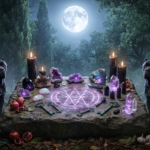
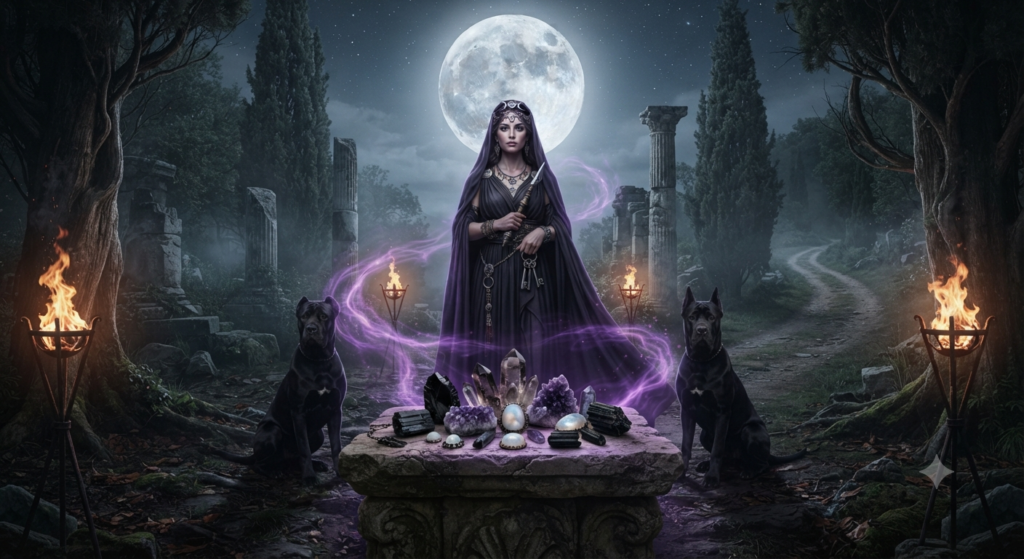
This is why black tourmaline, obsidian, moonstone, amethyst, jet, garnet, and clear quartz appear again and again in modern Hecate practice. Each captures a different aspect of her presence: defense, descent, lunar mystery, trance, mourning, fire, and clarity. None of them can be treated as a fixed ancient requirement, but together they form a coherent devotional language shaped by Hecate’s ancient reputation as the goddess who stands where one road becomes another.
Choosing offerings for Hecate’s modern cult
Modern offerings to Hecate often draw on personal intention as much as inherited symbol. A devotee may choose a stone for protection, guidance, trance, ancestral remembrance, or a simple act of respect at the new moon or crossroads. Because ancient sources do not preserve a strict gemstone list for her, the most meaningful offerings are those that remain faithful to her documented qualities: torchlight, boundaries, hidden knowledge, and contact with the unseen.
In practice, the strongest offerings are usually the ones that feel ritually coherent with Hecate’s nature. A black stone may honor her as guardian of the threshold; moonstone may speak to her nocturnal guidance; jet may acknowledge her chthonic depth. Whether used in a household shrine or in a carefully made crossroads rite, the crystal becomes part of a living devotional conversation with a goddess whose power has always been bound to edges, passages, and the mystery beyond the road.
Hecate’s crystal associations belong to a later ritual language, not to a single ancient list carved in stone. Yet the choices made by modern devotees are not arbitrary. They grow from the oldest features of her myth: the torch in the dark, the key at the door, the road that splits in two, and the silence of the underworld below. For that reason, the stones most closely linked with her remain those that embody protection, vision, and passage.

Orin Vale has spent the better part of two decades tracing the threads that connect the world’s oldest stories — from the halls of Asgard to the banks of the Nile, from Olympus to the jungles of the Maya. What began as a childhood fascination with flood myths and trickster gods grew into years of independent study across comparative mythology and ancient religion, always chasing the same question: what did these stories mean to the people who first told them? Orin writes for readers who want more than trivia — the ones looking for the beliefs, fears, and truths that myths were built to carry.