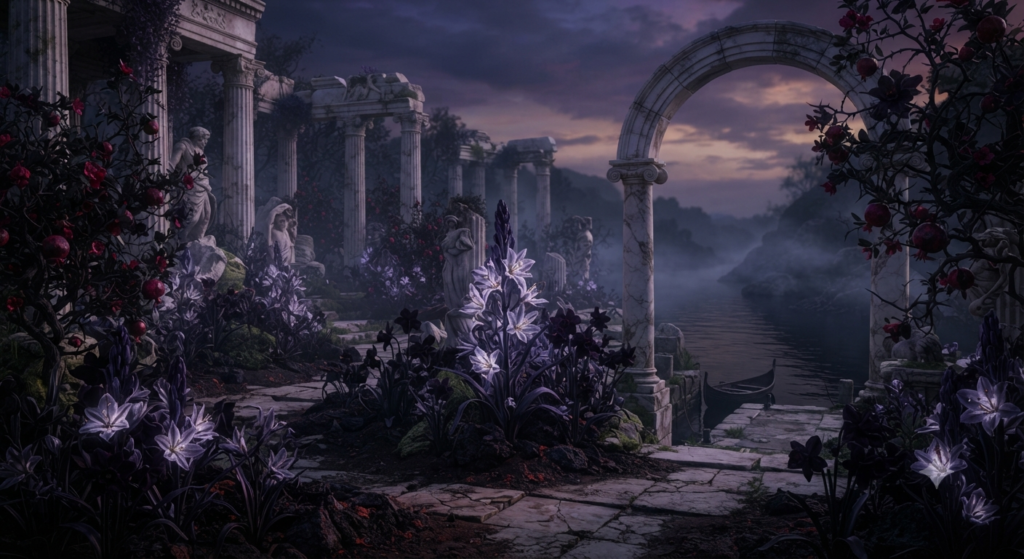
In Greek myth, the flower most often associated with Hades is not a single, fixed blossom in the way later popular culture might suggest. The strongest floral connection belongs instead to the pomegranate, a fruit rather than a flower, because of its central role in the story of Persephone and the realm of the Underworld. At the same time, several flowers and plants become linked to Hades through mythic scenes, chthonic worship, and poetic imagery, especially the narcissus and other underworld plants that mark the boundary between life and death.
What flower is associated with Hades in myth?
If one asks which flower belongs to Hades in Greek tradition, the answer is not entirely straightforward. Classical sources do not assign him one official flower in the way some gods are linked to particular trees or plants. Instead, Hades is tied to the dark, fertile, and liminal vegetation of the Underworld, and later interpretation often centers on the pomegranate because of its mythic weight in the story of Persephone.
The confusion is understandable. Hades is a god of hidden wealth, earth’s depths, and the dead, so the plants linked to him are usually those that grow at thresholds: seeds buried in soil, blossoms that signal loss or return, and flowers from the meadow where Persephone was taken. In Greek myth, his botanical associations are symbolic rather than ornamental, and they draw their power from narrative rather than from a simple floral emblem.
The pomegranate and the lord of the Underworld
The pomegranate is the plant most strongly associated with Hades, though it is not a flower. Its importance comes above all from the Homeric Hymn to Demeter, where Persephone eats pomegranate seeds in the Underworld, binding her to Hades and making her seasonal return conditional. That single act turned the fruit into one of the most enduring symbols of the god’s realm.
Because the pomegranate contains many seeds within a hard shell, it naturally evoked fertility, hidden life, and the mystery of descent and return. Ancient readers could see in it a perfect emblem of Hades: concealed abundance beneath an unyielding exterior. Later Greek and Roman art and literature continued to use the fruit as a sign of marriage, death, and the power of the Underworld, even when the story was retold with variations.
Persephone, seeds, and the bond to Hades
Persephone’s eating of the seeds is the mythic event that makes Hades’ botanical association so famous. In the earliest surviving version, the Homeric Hymn to Demeter, the number of seeds is not fixed in the same way across later retellings, but the principle is constant: food from the Underworld creates a binding tie. The myth explains why Persephone spends part of the year below and part above.
This seasonal bond gives Hades a plant-linked significance unlike that of other Olympians. He is not simply the ruler of the dead; he is also connected to the cycle by which life is hidden, preserved, and then returned. The seed becomes a powerful image for this process, since it must be buried before it can rise again in new growth. In that sense, the pomegranate stands at the edge of Hades’ identity, where death and fertility meet.
Ancient sources on Hades and floral symbols
Ancient texts do not describe Hades with a single floral attribute in the way later art sometimes does. Hesiod presents him as one of the great divine rulers, but not through botanical symbolism. Homer emphasizes his sovereignty over the dead, while the Homeric Hymn to Demeter gives the Underworld its most famous plant image through Persephone’s fruit, not through Hades himself.
Later authors expand the symbolic field. Apollodorus preserves mythic summaries in which the pomegranate episode remains central, and Roman poets such as Ovid recast the story with rich vegetation imagery. Pausanias, meanwhile, records local cult practices and sacred spaces where flowers and plants could take on chthonic meaning. The result is a tradition in which Hades is associated less with one named flower than with a whole vocabulary of underworld growth, seed, and seasonal transition.
Flowers of the Underworld in Greek tradition
Greek tradition often treats certain flowers as belonging to the boundary between worlds rather than to Hades alone. These are flowers of grief, loss, sleep, or descent, chosen because they grow in liminal places or appear in myths of divine abduction and return. Their association with the Underworld is poetic as much as religious.
Among these, the narcissus stands out most clearly because of its role in Persephone’s abduction. Other plants also carry chthonic meaning, especially those connected with funeral practice or wild, untamed landscapes. The Greek imagination often placed such flowers in meadows, groves, and sacred precincts where divine encounters occur suddenly, and where beauty can become a sign of danger.
The narcissus and the abduction of Persephone
The narcissus is one of the most important flowers in the mythic background of Hades, because it is mentioned in the Homeric Hymn to Demeter as the flower Persephone plucked before her abduction. According to the hymn, Gaia caused the wondrous bloom to appear as bait, and its beauty lured the maiden into the moment when the earth opened and Hades seized her.
This flower is therefore not a casual detail. It marks the transition from innocence to separation, from upper world to Underworld. In the hymn, the narcissus is not merely decorative; it is a divine device woven into the plot of abduction. That is why it has remained one of the clearest floral links to Hades in Greek myth, even if the flower itself is not “his” in a possessive sense.
Hades, spring bloom, and autumn return myths
The myth of Persephone explains seasonal change through the language of flowers and plants. When she is with Demeter, the earth blooms; when she descends to Hades, fertility withers. This pattern appears most vividly in agricultural interpretation of the Homeric Hymn, where the sorrow of Demeter and the absence of Persephone account for the barrenness of the land.
Later Greek and Roman retellings often emphasize spring flowers, meadow blooms, and the return of growth as signs of reunion. Yet the story also carries an autumnal note, since the descent into darkness and the burial of seed suit the season of fading. Hades is thus linked not only to death but to the hidden half of the agricultural cycle, when life is concealed rather than absent.
Floral imagery in Homeric and later retellings
Homer himself does not build Hades’ character around flowers, but his epic language helps establish the Underworld as a realm of shadows and deep places, where the living flower of the world is absent. The later Homeric Hymn to Demeter transforms that silence into a vivid botanical drama, giving Greek audiences a powerful image of blossoms, seeds, and loss.
Ovid, in the Roman tradition, retells the Persephone myth with greater ornamental detail, and later writers continue to treat flowers as symbols of fragile youth interrupted by divine power. These retellings do not always agree on emphasis, but they consistently keep the floral imagery close to Hades’ story. The flowers matter because they mark a crossing: from field to cave, from light to darkness, from abundance to confinement.
Which plants belong to Hades in iconography?
In Greek iconography, Hades is often shown with symbols of rule rather than with a bouquet of flowers. The most common attributes are the scepter, the cornucopia in some later depictions, and the presence of Cerberus or Persephone. When plants appear, they usually signal fertility, the earth beneath, or the wealth hidden below ground.
The pomegranate is the most recognizable plant in this visual language, especially where Persephone is present. Other chthonic plants may accompany funerary scenes or local cult images, but they are not standardized. What belongs to Hades in iconography is therefore not one canonical flower, but a cluster of earth-born symbols that suggest depth, return, and the sealed abundance of the Underworld.
The symbolic meaning of flowers in chthonic cults
In chthonic cults, flowers were never only decorative. They could honor the dead, mark sacred boundaries, or express the delicate balance between life above and the powers below. Offerings to underworld deities often involved dark or seasonal plants, and the language of blooming and withering fit the religious idea that the earth itself participates in divine cycles.
Hades stands within that symbolic field as the god of what is hidden beneath the surface. Flowers associated with him, whether the narcissus of Persephone’s meadow or the pomegranate of her binding, express more than beauty. They speak of descent, return, and the strange fertility of the earth’s depths, where even death is folded into the cycle of growth.
So, if the question is asked plainly, the best answer is that Hades is most strongly associated with the pomegranate, while the narcissus is the most important flower in the mythic story connected to him. Greek tradition does not give Hades a single official flower, but it does surround him with plants that belong to the Underworld’s logic: hidden seeds, fatal blossoms, and the vegetation of return. That is why his floral symbolism remains less about ornament than about the ancient mystery of life passing into darkness and coming back again.

Orin Vale has spent the better part of two decades tracing the threads that connect the world’s oldest stories — from the halls of Asgard to the banks of the Nile, from Olympus to the jungles of the Maya. What began as a childhood fascination with flood myths and trickster gods grew into years of independent study across comparative mythology and ancient religion, always chasing the same question: what did these stories mean to the people who first told them? Orin writes for readers who want more than trivia — the ones looking for the beliefs, fears, and truths that myths were built to carry.