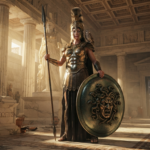
In Greek mythology, Elpis means hope, but not in a simple, modern sense of cheerful optimism. The word can signify expectation, expectation of good, or the inward sense that something still remains to be endured or awaited. In the mythic imagination of archaic Greece, Elpis stands close to suffering, uncertainty, and the limits of human knowledge. She is not only a feeling, but also a force that shapes how mortals live before powers larger than themselves.
Elpis in Greek Myth: Hope After Pain and Fear
In Greek thought, hope was rarely separated from hardship. Elpis belongs to a world where life is exposed to illness, violence, aging, and divine unpredictability. It is the feeling that rises after fear has already entered the mind, and after pain has made certainty impossible. For that reason, hope in Greek mythology is not naïve confidence; it is a fragile but necessary companion to human endurance.
The mythic setting of Elpis reflects this condition. Mortals do not control destiny, and even the gods do not always act in a way humans can easily understand. Hope becomes a way of living within that uncertainty, an inward shelter against despair. In the Greek worldview, to hope is to remain open to what may come, even when the present offers little reason for comfort.
What Hesiod Says About Elpis and Pandora
The central source for Elpis in myth is Hesiod, especially Works and Days. There, Pandora receives a jar, and after it is opened, a host of evils escape into the world. Elpis remains inside, and this detail has generated debate since antiquity. Hesiod does not explain the matter in a fully simple way, which is part of why the passage remains famous.
Because of that silence, scholars and readers have long asked whether Elpis staying in the jar is a blessing or a loss. Hesiod presents Pandora as a response to Prometheus’s theft of fire, tying human suffering to divine retaliation. In that context, hope becomes something enclosed, withheld, or preserved beyond ordinary reach. The myth does not reduce it to comfort alone; it places hope at the boundary between what mortals suffer and what they are permitted to expect.
The Jar of Evils and the Fate of Mortals
The jar commonly called Pandora’s “box” in later tradition is, in the older Greek account, a pithos, a large storage jar. When it is opened, diseases, labor, grief, and other afflictions enter human life. Elpis remains behind, and this has led to two major interpretations: either hope was kept from humanity, or hope remained available as the one thing not yet released among the evils.
Both readings fit the ambiguity of the source, and that ambiguity matters. Greek myth often refuses to state whether a divine gift is entirely beneficial. If Elpis stayed inside the jar to prevent human beings from clinging to false expectation, then it is a restraint. If it stayed behind so that mortals would still possess hope amid suffering, then it is a mercy. Either way, the myth links hope to the human condition after innocence has been lost.
Hope as a Blessing or a Silent Deception
Ancient interpreters sometimes treated Elpis as a help to mankind, while others saw it as a subtle deception. Hope can sustain a person through pain, but it can also delay acceptance of reality. In a world shaped by fate and divine power, expecting too much may become its own danger. Greek mythology often stands exactly at that tension, where a good thing can also mislead.
This is why Elpis is not simply equivalent to modern positivity. It may be a blessing because it prevents despair, yet it may also be silent because it does not guarantee fulfillment. The Greeks understood that expectation and outcome are not the same thing. Hope may accompany action, prayer, and endurance, but it does not command the gods. That restraint gives Elpis its tragic depth.
Elpis in Homeric Poetry and Early Greek Thought
In Homer, the noun elpis appears less as a personified goddess and more as a mental state, often bound to anticipation. A warrior may hope for return, a household may hope for safety, and a petitioner may hope for favorable divine response. This usage shows that the concept was already familiar before later philosophical reflection. Hope belongs to the emotional architecture of early Greek narrative.
Homeric poetry also suggests that hope can be precarious. Heroes frequently act under uncertain expectations, and the outcome may contradict what they had imagined. In that environment, Elpis is not a guarantee but a posture toward the unknown. The early Greek mind recognized that human beings live by anticipation even when the world remains unstable.
Divine Hope and Mortal Endurance in Greek Lore
Greek lore often places mortal endurance under divine pressure. Men and women suffer at the hands of gods, fate, or inherited curse, yet they continue to live, labor, and remember. Elpis helps explain this persistence. It is the inward capacity to continue despite being aware that the future may not improve. In that sense, hope is almost heroic in itself.
Still, the gods are not usually described as “hoping” in the human way. Elpis belongs primarily to mortals, whose lives are incomplete and vulnerable. Divine beings know more and need less expectation. The separation is important: hope marks the difference between immortal certainty and human exposure. To have hope is to be mortal.
How Greeks Linked Hope, Luck, and Trust
Hope in Greek culture often stood near chance, fortune, and trust. A person hoped for favorable winds, a safe harvest, or a just outcome from a ruler or deity. Yet Greek experience taught that luck could change suddenly. Elpis therefore worked alongside uncertainty rather than removing it. It was a way of living with risk.
Trust was different from hope, though the two could overlap. Trust implied confidence in a person, oath, or god; hope implied anticipation of an outcome not yet known. A Greek might trust Zeus or Athena while still hoping for success. In myth and ritual alike, this distinction made Elpis part of a larger emotional world shaped by dependence and unpredictability.
Elpis Compared with Prayer, Fate, and Zeus
Prayer in Greek religion sought favor from the gods, while hope accompanied that request. One prayed because the future was not secure; one hoped because the answer had not yet come. Elpis was therefore closely linked to ritual life, but it did not replace divine action. It was the human companion to supplication, not its master.
Fate, however, remained above hope. Greek myth repeatedly shows that even Zeus does not always overturn what is destined. In some traditions, Zeus weighs outcomes, but he is not portrayed as the source of all mercy in a simple way. Elpis exists within this hierarchy of power. It is meaningful precisely because the future is not entirely open, nor entirely closed.
The Symbolic Role of Hope in Human Life
Symbolically, Elpis expresses the part of the human spirit that reaches beyond present suffering. It is not denial, but orientation. The Greeks recognized that a life without hope would be unbearable, yet they also knew that hope could not erase suffering itself. This double truth gives the concept its enduring strength in myth.
As a symbol, Elpis also marks the threshold between despair and endurance. When evils have entered the world, hope remains as a final inward possibility. Whether that is a comfort or a limitation depends on the reading, but in either case it defines human resilience. Greek mythology makes hope less a happy ending than a way of continuing before the ending arrives.
Why Elpis Still Matters in Classical Mythology
Elpis remains significant because it captures a distinctly Greek understanding of what it means to be human. Mortals are finite, exposed, and always living between knowledge and uncertainty. Hope is the feeling that carries them across that gap, even when the gods are distant and fate is severe. In that sense, Elpis is one of the most human powers in Greek myth.
Its lasting appeal also comes from its ambiguity. Hope can heal, deceive, sustain, or delay. Hesiod’s silence around Pandora’s jar ensures that Elpis will never be fully settled into one meaning. That uncertainty is part of its mythic power. In classical mythology, hope is not a simple promise, but a fragile light held inside a difficult world.
Elpis in Greek mythology is hope, but hope understood through suffering, divine limitation, and the uncertainty of mortal life. Hesiod’s Pandora myth gives it a lasting place in classical tradition, while Homeric and later Greek thought show it as a deeply human response to an unstable world. Whether seen as blessing, restraint, or quiet illusion, Elpis remains one of the clearest symbols of how the Greeks imagined endurance itself.

Orin Vale has spent the better part of two decades tracing the threads that connect the world’s oldest stories — from the halls of Asgard to the banks of the Nile, from Olympus to the jungles of the Maya. What began as a childhood fascination with flood myths and trickster gods grew into years of independent study across comparative mythology and ancient religion, always chasing the same question: what did these stories mean to the people who first told them? Orin writes for readers who want more than trivia — the ones looking for the beliefs, fears, and truths that myths were built to carry.