Who Is Montu in Egyptian Mythology?
Montu is one of the important war gods of ancient Egypt, especially associated with royal power, military might, and the scorching force of the sun. In Egyptian mythology, he was widely revered as a protector of the pharaoh and a divine embodiment of aggressive strength in battle. Although he never became as universally prominent as Ra, Osiris, or Amun, Montu held a major place in local and state religion for much of Egyptian history.
His cult was especially strong in Upper Egypt, and he appears in inscriptions, temple reliefs, and royal titulary from the Middle Kingdom onward. As a god of war, Montu was not simply a figure of destruction. He was also connected with legitimacy, courage, and the order maintained by a victorious king. In Egyptian belief, military success was not merely political; it was a sign that the ruler had the backing of divine forces. Montu stood near the center of that ideology.
Origin and Meaning
The name Montu is usually rendered in modern scholarship from the ancient Egyptian mnṯw or related forms, though the exact vocalization is uncertain because Egyptian writing did not record vowels in the way alphabetic scripts do. Different transcriptions and spellings appear in academic works and translations.
The meaning of the name is not fully certain. Some scholars connect it with ideas of “nomad” or “to strengthen”, but no interpretation is universally accepted. Because ancient Egyptian language is only partly recoverable in pronunciation and because names often carried layered religious meanings, caution is necessary when discussing etymology.
Montu is attested very early in Egyptian religious history. He was originally a local god of the Theban region and was later absorbed into broader royal ideology as the political importance of Thebes increased. Over time, his character developed from a regional deity into a major martial god.
Historical Context
Montu’s rise is closely linked to the changing political fortunes of Thebes in Upper Egypt. As Thebes became a powerful religious and political center, its gods gained greater national prominence. Montu, associated with war and kingship, benefited from this process.
He was particularly important during:
- the Middle Kingdom,
- the Second Intermediate Period,
- and parts of the New Kingdom.
Several pharaohs emphasized Montu in their names and titles. This reflects a long-standing Egyptian pattern in which gods were connected to royal identity. Kingship in Egypt was not only hereditary and political; it was also divine, and military success was often described as proof of cosmic legitimacy.
Montu was also linked with the broader Egyptian idea of ma’at, the principle of truth, order, and balance. A war god might seem opposed to order, but in Egyptian thought violence could be legitimate when used to defend order against chaos. Montu thus represented controlled force in service of the state and the gods.
Main Characteristics
Montu is primarily known as a warrior god, but his character is broader than that label alone suggests.
Key traits
- War and combat: He was called upon to grant strength, victory, and aggression.
- Royal protection: He was closely tied to the pharaoh as a divine supporter of rule.
- Solar energy: In some contexts, he was associated with the heat and power of the sun.
- Male vigor and strength: Ancient texts sometimes portray him as an embodiment of force and virility.
- Fierce, protective power: He could be a guardian deity as well as a destroyer of enemies.
Montu is often depicted as a powerful man with a falcon or bull association, carrying weapons or standing in a martial pose. His iconography makes him easy to distinguish from other Egyptian gods when temple reliefs preserve enough detail.
Family and Genealogy
Montu’s family relationships are not uniform across all Egyptian traditions. Like many ancient deities, he could be integrated into different local theological systems.
Commonly associated consorts
- Raet-Tawy: often described as a female counterpart or consort in the Theban tradition.
- Tjenenet: in some traditions, associated with him as a divine partner.
Children and related divine figures
- Harpocrates/Herunefer and other related forms are not consistently attested as children in a single standardized myth.
- In some local traditions, Montu becomes part of a broader divine family connected to Theban theology, but the details vary.
It is important to note that Egyptian religion did not have a single fixed canon. Gods were frequently paired, merged, or localized in different ways depending on the temple, period, and theological school. For that reason, Montu’s genealogy is less standardized than that of some other deities.
Symbols
Montu’s symbols reflect his role as a warrior and royal protector.
Common symbols and insignia
| Symbol | Meaning |
|---|---|
| Falcon | Solar power, speed, and royal association |
| Bull | Strength, virility, aggressive force |
| Weapons | Martial power, divine protection |
| Plumes or crowns | Royal and divine authority |
| Sun disk | Solar connection in some iconographic forms |
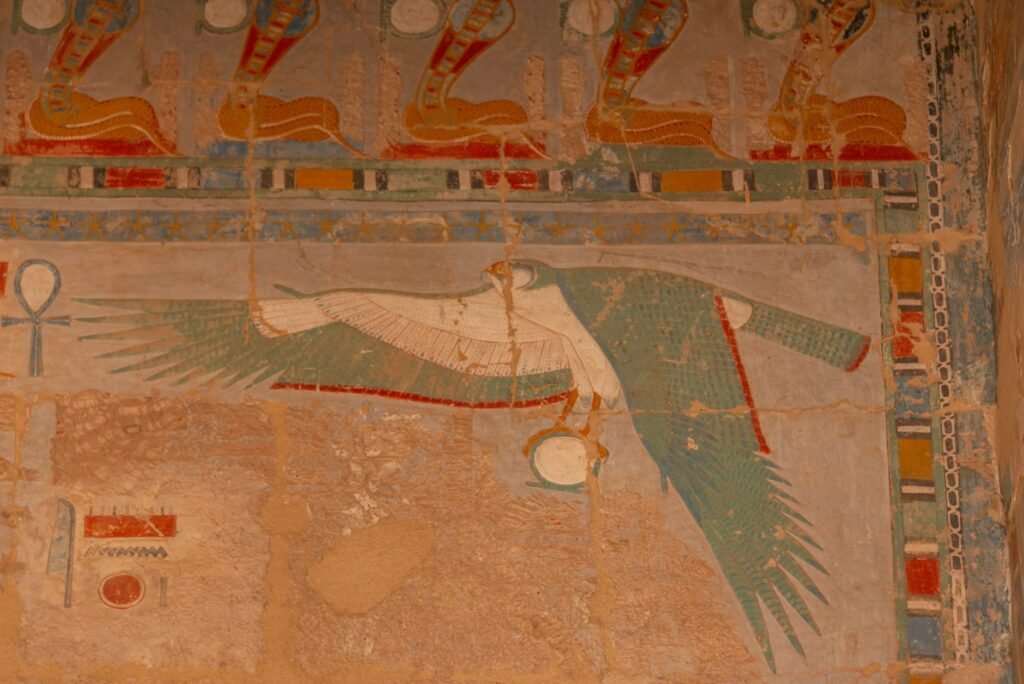
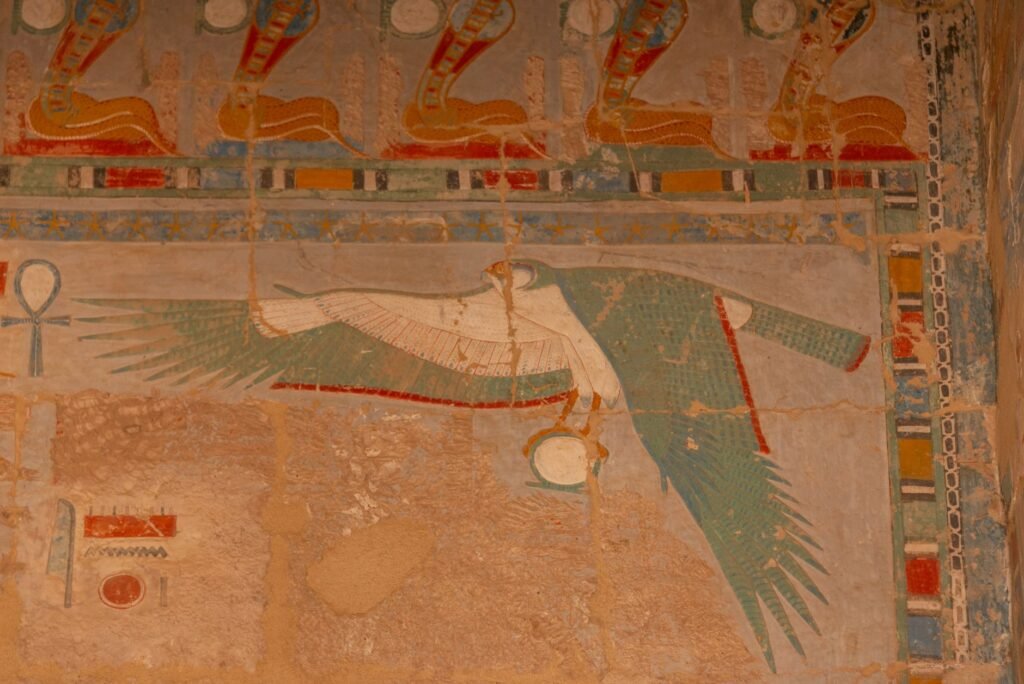
Montu is frequently shown with a falcon head, emphasizing his connection to sky and sun imagery. In some representations, he appears as a bull, known for strength and violent power. The bull symbolism was especially important in expressing his forceful, protective character.
The colors most associated with him are not universally standardized in surviving sources, but in Egyptian art, divine power and solar energy were often expressed through gold, red, and vivid pigments where available. Red in particular could symbolize strength, danger, and destructive heat.
Sacred Animals
Montu is linked above all with two animals: the falcon and the bull.
Falcon
The falcon was a prominent royal and solar symbol in ancient Egypt. For Montu, the falcon conveyed:
- speed in battle,
- sharp vision,
- dominance from above,
- and a connection to divine kingship.
Bull
The bull symbolized:
- raw strength,
- masculine potency,
- protection,
- and aggressive force.
Montu could appear in bovine form or as a bull-headed deity in some local traditions. The bull also had broad religious significance in Egypt, and Montu’s bull aspect fit the wider symbolic language of strength used by Egyptian religion.
It should be noted that sacred animal associations in Egypt were often shared among multiple gods. The same animal could represent different divine qualities depending on context.
Sacred Plants
Unlike some Egyptian deities, Montu is not strongly associated with a single universally recognized sacred plant. There is no major plant cult that defines him in the way that lotus imagery is linked to other divine themes.
However, in Egyptian religious symbolism more broadly, plants could be associated with renewal, fertility, or royal presentation in temple scenes. If Montu appears with vegetal motifs, this is generally part of the wider symbolic environment of temple art rather than evidence of a specific plant cult centered on him.
Because the surviving evidence does not support a clear plant association, any claim that Montu had a major sacred plant should be treated cautiously.
Sacred Places
Montu was strongly linked to Thebes and its surrounding sacred landscape.
Important locations associated with Montu
- Hermonthis (modern Armant): one of his principal cult centers.
- Thebes: the major religious and political center where his significance grew.
- Medamud: site of a temple dedicated to Montu.
- Tod: another important cult location connected with him.
- Karnak: where Montu had a place within the broader sacred complex.
Hermonthis / Armant
Hermonthis, near modern Armant, was one of the main centers of Montu worship. The site underscores his deep Upper Egyptian roots and his connection to local Theban religion.
Medamud
The temple at Medamud was important in later periods and provides valuable archaeological evidence for Montu’s cult. Temple remains and inscriptions show his continued worship and local significance.
Tod
At Tod, Montu was also honored in temple contexts. The site’s remains help historians understand how his cult spread through Upper Egypt.
Theban sacred landscape
As Thebes rose to prominence, Montu became integrated into a larger religious network alongside Amun, Mut, and Khonsu. Even when Amun eventually became the dominant Theban deity, Montu retained a respected position.
Powers and Attributes
Montu’s powers are closely tied to warfare, protection, and regal strength.
Main domains
- War and battle
- Military victory
- Royal legitimacy
- Protection of the pharaoh
- Fierce energy and martial courage
- Solar heat and destructive force
Montu was not usually a god of strategy in the abstract modern sense. Rather, he embodied the force that makes victory possible: courage, attack, and divine favor. Egyptian kings could invoke him as a source of confidence and as a sign that their campaigns had divine sanction.
In some texts, Montu’s strength is described in highly energetic terms, reflecting the Egyptian tendency to personify power in concrete, active forms.
Main Myths
Montu does not have a single, famous myth cycle equivalent to the Osiris or Isis narrative. Instead, he appears in a variety of religious and royal contexts.
Royal war god
One of Montu’s most important mythic roles is as the god who empowers the pharaoh in battle. In inscriptions, a king may be described as acting with the courage and force of Montu. This makes Montu a divine model for victorious warfare.
Solar and fiery force
In some traditions, Montu is linked with the burning power of the sun. This is not always a separate myth but rather a symbolic layer that aligns him with radiant destructive energy. Egyptian gods often had overlapping roles, and Montu’s martial force could be imagined as solar in intensity.
Divine bull or falcon manifestations
Myths and iconography sometimes present Montu in animal form or as a being whose power manifests through sacred animals. These forms are not necessarily part of a single narrative, but they reveal the way Egyptians conceptualized divine strength.
Because his surviving mythology is fragmented and often embedded in royal inscriptions rather than literary stories, Montu is better understood as a cult and ideological deity than as the subject of one canonical myth.
Relationship with Other Mythological Figures
Montu interacted with several major gods in Egyptian religion, often through association, substitution, or theological competition.
Montu and Ra
Montu could be connected with Ra, the sun god, especially when divine power was described in solar terms. This reflects the Egyptian habit of combining gods with similar or complementary functions.
Montu and Amun
Montu’s relationship with Amun is particularly important because both were major gods in the Theban sphere. As Amun rose to national prominence, Montu remained significant but somewhat secondary. In some religious contexts, the two gods occupied overlapping space within the Theban triad and broader temple theology.
Montu and Horus
Because Montu is sometimes shown in falcon form, he can resemble Horus, another falcon-associated deity linked to kingship. The two should not be confused, but their iconography and royal connections can overlap.
Montu and Seth
Seth is also associated with force, conflict, and disruption. However, Seth often represents a more chaotic or ambivalent power, while Montu more typically represents legitimate martial strength in service of the king.
Montu and the pharaoh
Montu’s most important relationship may be with the king. Egyptian rulers were frequently portrayed as acting under Montu’s protection or embodying his power. This relationship reinforced the ideological link between divine favor and military success.
Worship and Cult
Montu was worshipped through temple ritual, offerings, and royal patronage.
Forms of worship
- daily temple offerings,
- processions,
- festival celebrations,
- dedication of royal monuments,
- prayers for victory and protection.
As with other Egyptian gods, worship centered on temples and priestly ritual. Offerings would have included food, drink, incense, and ritual objects, though the exact forms varied by site and period.
Temple cult
Montu had temples at several important locations, especially in Upper Egypt. Temple iconography and inscriptions show that priests maintained his cult over long periods.
Military significance
Because of his warlike nature, Montu was especially relevant to kings before military campaigns. A pharaoh might seek his blessing for strength, courage, and defeat of enemies. This practical function made him an important god in state religion.
Festivals
Specific festival calendars differ by location and era, and the surviving evidence does not always allow precise reconstruction. However, processional worship and temple celebrations were common in Egyptian religion generally, and Montu likely participated in such cycles at his major cult centers.
Ancient Sources
Montu is known mainly from Egyptian inscriptions, temple reliefs, and religious texts, rather than from the better-known Greek literary canon.
Egyptian primary evidence
Important evidence includes:
- temple inscriptions from Karnak, Medamud, Tod, and Armant,
- royal titulary and victory scenes,
- hymns and ritual texts,
- iconographic depictions in temple art.
Classical authors
Greek and Roman writers mention Egyptian religion broadly, but Montu is not as prominently discussed in surviving classical literature as some other Egyptian deities. When classical authors describe Egyptian gods, they often use Greek interpretive frameworks that can obscure local distinctions.
Notable ancient authors for Egyptian religion more generally include:
- Herodotus
- Diodorus Siculus
- Plutarch
- Strabo
However, these authors are not always specific or reliable on Montu. For detailed knowledge, modern readers should rely primarily on Egyptian archaeological and epigraphic evidence.
Roman Equivalent
Montu did not have a single exact Roman equivalent. In interpretatio graeca and interpretatio romana, he was sometimes compared broadly with Mars, the Roman god of war, because of his martial character. In some contexts, he could also be likened to Ares, the Greek war god.
These are approximate analogies, not true one-to-one equivalents. Egyptian gods often had multi-layered identities that do not map neatly onto Greco-Roman categories.
Influence on Modern Culture
Montu is not as widely known in modern popular culture as Isis, Anubis, or Ra, but he still appears in modern interpretations of Egyptian mythology.
Modern appearances and influence
- Egyptology and museum displays: Montu features in academic study and exhibits about Theban religion and temple art.
- Historical fiction: He may appear in novels set in ancient Egypt, especially those involving kings or war.
- Games and fantasy media: Egyptian gods are often adapted into role-playing games and fantasy settings, where Montu may be included as a war deity.
- Reference works and documentaries: He is occasionally highlighted in overviews of Egyptian gods or temple religion.
His relative obscurity in mass media likely reflects the fact that he was a powerful but more locally centered deity, rather than one of the most universally mythologized figures in the Egyptian pantheon.
Curiosities
- Montu was one of the gods whose identity could shift between human, falcon, and bull forms.
- Several pharaohs used “Montu” in royal names, signaling divine martial legitimacy.
- He is especially important for understanding Theban theology, where local gods became politically significant.
- His cult shows how Egyptian religion connected warfare and sacred order, rather than treating war as purely destructive.
- In some temple contexts, Montu’s role overlaps with other gods so much that scholars must compare inscriptions carefully to avoid oversimplification.
- He is a useful example of how Egyptian gods were often regional before becoming national.
- Montu’s association with strength made him a natural divine patron for rulers seeking to project military authority.
Frequently Asked Questions
1. Who is Montu in Egyptian mythology?
Montu is an ancient Egyptian war god associated with military strength, royal protection, and powerful solar energy. He was especially important in Thebes and nearby cult centers.
2. Is Montu a major Egyptian god?
Yes, but his importance was more regional and political than universal. He was highly significant in Upper Egypt and in royal ideology, though less famous today than gods like Ra or Osiris.
3. What animal represents Montu?
Montu is commonly represented by the falcon and the bull. The falcon suggests speed and royal power, while the bull symbolizes strength and virility.
4. What was Montu the god of?
Montu was mainly the god of war, battle, kingship, and vigorous protection. In some contexts, he was also associated with the sun’s fierce heat.
5. Where was Montu worshipped?
His main cult centers were in Hermonthis/Armant, Thebes, Medamud, and Tod. These sites were all located in or near Upper Egypt.
6. Did Montu have a wife or children?
Some traditions associate him with Raet-Tawy or Tjenenet as a consort, but Egyptian sources do not give one fixed family tree. His genealogy varies by place and period.
7. Is Montu the same as Horus or Ares?
No. Montu is a distinct deity, though he shares some features with Horus because of falcon symbolism and with Ares or Mars because of his warlike role. These are comparative analogies, not direct identities.
8. Why is Montu important?
Montu is important because he reveals how ancient Egyptians linked war with divine legitimacy, royal authority, and cosmic order. He is a key figure for understanding Egyptian kingship and Theban religion.
Conclusion
Montu is a significant deity in Egyptian mythology whose identity centers on war, strength, and royal protection. Though not always as globally famous as other Egyptian gods, he played a major role in religious and political life, especially in Upper Egypt and the Theban region. His images as falcon, bull, or armored divine force reflect the Egyptian understanding that legitimate violence could defend order and support kingship.
For historians and readers of mythology, Montu is especially valuable because he demonstrates how Egyptian religion connected local cults, military power, and royal ideology. He remains an enduring example of the way ancient Egyptians imagined divine strength in action.

Orin Vale has spent the better part of two decades tracing the threads that connect the world’s oldest stories — from the halls of Asgard to the banks of the Nile, from Olympus to the jungles of the Maya. What began as a childhood fascination with flood myths and trickster gods grew into years of independent study across comparative mythology and ancient religion, always chasing the same question: what did these stories mean to the people who first told them? Orin writes for readers who want more than trivia — the ones looking for the beliefs, fears, and truths that myths were built to carry.