Who Is Serqet in Egyptian Mythology?
Introduction
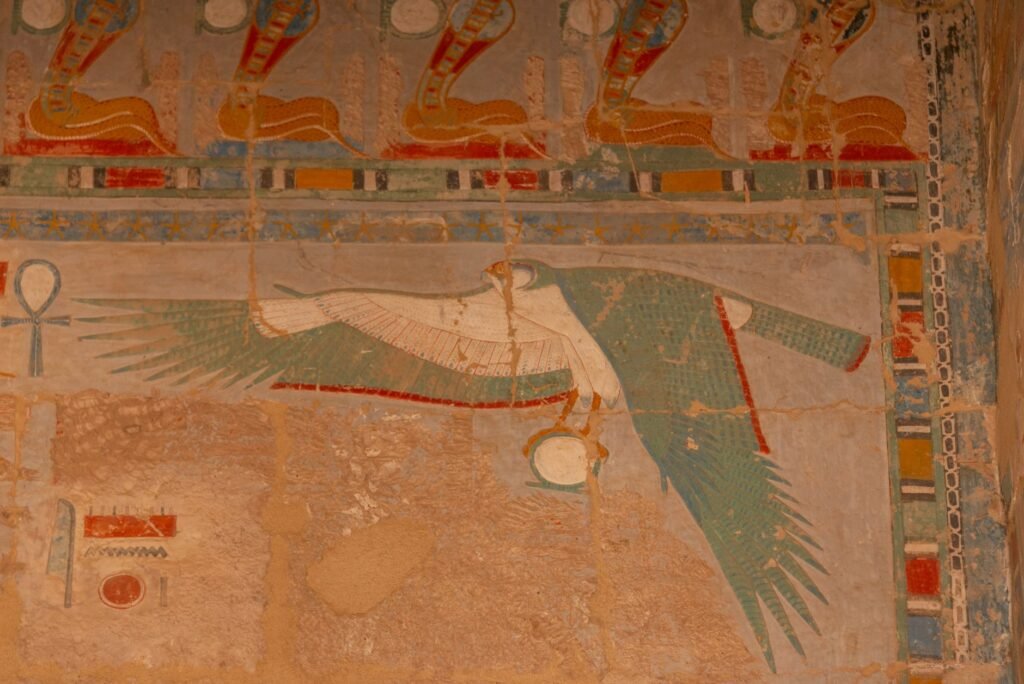
Serqet, also written as Serket, Selket, or Selkis in modern transcriptions, is one of the most recognizable protective deities in ancient Egyptian mythology. She is best known as a goddess associated with scorpions, venom, healing, magical protection, and the safeguarding of the dead. In ancient Egyptian religion, where divine powers could both harm and heal, Serqet occupied a particularly important role as a guardian against poisonous creatures and supernatural threats.
She appears in funerary texts, royal iconography, and protective amulets, and she is especially famous for her role in the Canopic shrine of the deceased, where she was linked with the protection of the jar containing the intestines. Although she is often described as a goddess of scorpions, her significance is broader: Serqet represents the power to control dangerous forces and turn them toward protection.
Origin and Meaning
The name Serqet is generally understood to be related to the Egyptian word for the scorpion. Her name is commonly translated along the lines of “She Who Causes the Throat to Breathe”, though such renderings depend on uncertain linguistic reconstructions and ancient spelling variants. Egyptian divine names often carried layered meanings, and Serqet’s identity likely combined the visible creature—the scorpion—with ideas of breath, healing, and life-preserving magic.
Her name appears in multiple transliterations because ancient Egyptian writing did not record vowels in the way modern alphabets do. As a result, scholars and popular works use several forms:
- Serqet
- Serket
- Selket
- Selkis
The goddess was known in Egypt from an early period, though the details of her cult and mythology are scattered across a wide range of sources rather than preserved in a single narrative tradition.
Historical Context
Serqet belongs to the complex religious world of ancient Egypt, where gods were deeply integrated into daily life, kingship, medicine, magic, and burial practices. Egyptians viewed the natural world as filled with divine forces, including animals that could be both feared and revered. The scorpion was one of these creatures: dangerous, hidden, and capable of sudden attack, but also linked to protection through the power to ward off evil.
In this context, Serqet developed as a goddess who could:
- protect people from venom and snakebite
- guard the dead during the journey to the afterlife
- support magical healing
- stand beside other protective deities in royal and funerary settings
She is closely associated with the funerary religion of the New Kingdom and later periods, especially in the context of the Four Sons of Horus and the canopic vessels. Yet her role was not limited to the dead. Her protective function extended to childbirth, healing rituals, and royal safeguarding.
Ancient Egyptian religion did not usually separate “mythology” from practical ritual. A goddess like Serqet was not only a figure in stories; she was an active divine presence invoked in amulets, spells, and temple rites.
Main Characteristics
Serqet is usually described as a protective goddess with strong ties to scorpions and medicine. Her main characteristics include:
- Guardian against venomous creatures
- Protector of the dead
- Goddess of healing and magical protection
- Associated with the desert and dangerous liminal spaces
- A divine figure of hidden, potent power
In art, she is often shown as a woman with a scorpion on her head or as a scorpion itself. In some depictions, she bears a modest and controlled appearance, reflecting her protective role rather than overt aggression. She is sometimes shown with raised arms in a protective gesture, emphasizing her function as a guardian.
Her nature is dual:
| Aspect | Meaning |
|---|---|
| Dangerous | Linked to scorpions, stings, and poison |
| Protective | Able to neutralize venom and ward off harm |
| Funerary | Guards the deceased and sacred organs |
| Magical | Invoked in spells and healing rites |
This duality is central to Egyptian theology. Dangerous powers were not necessarily evil; rather, they had to be understood, appeased, and harnessed.
Family and Genealogy
Unlike some major Egyptian deities such as Osiris, Isis, or Horus, Serqet does not have a single universally accepted family tree. Ancient sources do not consistently present her as part of a fixed divine genealogy.
In some traditions, she is loosely connected with the divine order that includes protective goddesses such as Isis, Nephthys, Neith, and Selqet/Serqet herself in funerary contexts. These associations are functional rather than strictly genealogical.
Some modern summaries may call her the daughter of a particular god or connect her with specific local cults, but such claims are not uniformly supported across the ancient record. The safest conclusion is that Serqet’s identity was primarily defined by role, not by a detailed mythic family line.
She is often linked with:
- the Four Sons of Horus in funerary protection
- Isis and Nephthys as mourning and guarding goddesses
- Neith, another protective female deity sometimes associated with the same funerary sphere
No universally accepted spouse or offspring is consistently attached to Serqet in the surviving sources.
Symbols
Serqet’s symbols reflect her protective and dangerous nature. The most important symbols associated with her include:
- The scorpion: her primary emblem and source of identity
- The headdress with a scorpion motif
- Protective knots and amuletic forms
- Funerary shrines and canopic imagery
- Associations with breath, life, and magical safeguarding
Common symbolic meanings
| Symbol | Meaning |
|---|---|
| Scorpion | Danger, venom, protection, hidden power |
| Raised arms | Defense, guarding, magical warding |
| Funerary shrine | Protection of the dead and sacred contents |
| Amulet | Healing and apotropaic power |
Color symbolism is less securely documented for Serqet than for some other deities. Ancient Egyptian religious art often used symbolic color schemes, but there is no single standardized “Serqet color” confirmed across the tradition.
Sacred Animals
Serqet is most famously associated with the scorpion, an animal deeply embedded in Egyptian symbolic thought. The scorpion could represent immediate physical danger, but by divine association it also became a source of protection against the very poison it embodied.
Sacred animals associated with Serqet
- Scorpion: the defining animal of the goddess
- Snake: often connected by contrast, since Serqet’s powers included protection against venomous bites
- Possibly other desert creatures: by extension, as part of the dangerous frontier she governed
The scorpion was especially significant because Egyptian medicine and magic often addressed bites and stings through ritual language. Serqet’s role as a deity of healing does not mean she was gentle in a modern sense; rather, she represented mastery over a fearsome force.
Sacred Plants
There is no universally established sacred plant uniquely tied to Serqet in the way that some other deities are strongly associated with particular trees or flowers. Ancient texts more often connect her with medical and magical practice than with a specific botanical symbol.
That said, Egyptian healing and protective rituals frequently involved plants, oils, resins, and herbal preparations. Serqet’s presence in magical texts suggests an indirect association with medicinal substances used to counter venom and promote healing.
Because the evidence is limited, it is better to say that Serqet is linked to healing substances and ritual medicine rather than to a single sacred plant.
Sacred Places
Serqet was not tied to one exclusive major cult center in the way that some gods were. Her worship and imagery appear across Egypt, especially in funerary and protective contexts.
Important settings connected with Serqet
- Royal tombs and burial chambers
- Funerary shrines and canopic equipment
- Temple contexts where protective magic was performed
- Household amulet use
- Desert-edge and liminal regions in symbolic geography
In funerary art, Serqet appears prominently in the tomb of Tutankhamun, where she is one of the deities guarding the king’s canopic shrine. This does not indicate a temple dedicated solely to her, but it does show the high status of her protective role in royal burial practice.
Because Egyptian religion was highly local and decentralized, Serqet’s sacred presence was often portable and ritual rather than fixed to one sanctuary.
Powers and Attributes
Serqet’s powers are among the clearest aspects of her identity. She was invoked for protection against immediate physical threats and for safeguarding the dead in the afterlife.
Main powers and responsibilities
- Protection from scorpion stings and snakebite
- Healing through magic and ritual
- Guardianship of embalmed organs
- Defense of the deceased in the afterlife
- Control over harmful venom
- Protection during childbirth and vulnerable transitions
Her powers were closely related to heka, the Egyptian concept of sacred magic. In Egyptian thought, magic was not separate from religion; it was one of the practical ways divine power was made effective.
Role in the afterlife
One of Serqet’s best-known roles is as a guardian of the canopic chest. She protects the jar associated with the intestines, one of the four organs preserved during mummification. In many funerary scenes, she stands alongside the other protective goddesses assigned to the Four Sons of Horus.
This function placed her in the cosmic system that preserved bodily integrity, essential for resurrection and eternal life.
Main Myths
Unlike gods such as Osiris or Ra, Serqet is not the central subject of a large, continuous mythological cycle. Instead, she appears in spells, hymns, funerary texts, and protective narratives. Her mythology is therefore dispersed across many sources.
Key mythic and ritual themes
Protection of the god and the king
In some traditions, Serqet is among the deities who protect divine and royal figures from danger. This protective role is consistent with her association with venomous creatures and magical defense.
Association with the birth of divine children
Some later or interpreted traditions place Serqet among the divine guardians surrounding childbirth and vulnerable life transitions. As with other protector goddesses, she could be invoked to safeguard mother and child.
Guarding the dead
Her most persistent mythic function is not a single story but a recurring role in funerary religion: guarding the bodily remains and helping ensure the deceased’s safe passage into the next world.
Because ancient Egyptian mythology is highly textual and ritualistic, Serqet’s “myths” are often best understood as roles in sacred narratives rather than as one fixed legend.
Relationship with Other Mythological Figures
Serqet interacts with several major figures in Egyptian religion, primarily through protective and funerary associations.
With the Four Sons of Horus
Serqet is strongly linked to the Four Sons of Horus, the gods who protect the canopic jars and internal organs of the deceased.
| Son of Horus | Protected organ | Associated protective goddess |
|---|---|---|
| Imsety | Liver | Isis |
| Hapy | Lungs | Nephthys |
| Duamutef | Stomach | Neith |
| Qebehsenuef | Intestines | Serqet |
This association is one of her most important religious functions.
With Isis and Nephthys
Serqet often appears alongside Isis and Nephthys, both major female deities involved in mourning, protection, and ritual care for the dead. Together, these goddesses form a protective network around the deceased.
With Neith
Neith is another goddess with protective and martial dimensions, and in funerary contexts she can stand near Serqet as part of the divine guardianship of the dead.
With Ra and solar mythology
Serqet also appears in solar contexts as a guardian figure. In Egyptian religion, the sun god’s nightly journey through the underworld required defense against hostile powers. Serqet could be part of the divine protection surrounding this journey.
With venomous creatures
Symbolically, Serqet stands in relation to snakes, scorpions, and harmful desert life. Her role is not to eliminate danger but to control it.
Worship and Cult
Serqet was worshiped through protection rituals, funerary practices, and household magic rather than through a large, exclusive temple cult known from the surviving record.
Forms of worship
- Recitation of spells
- Use of amulets
- Funerary offerings and protective rites
- Invocation in healing contexts
- Placement in tomb decoration and burial equipment
Ritual significance
Egyptians may have called on Serqet in situations involving:
- venomous bites or stings
- childbirth
- illness
- funerary purification
- protection of sacred objects
Her worship demonstrates how Egyptian religion blended theology, medicine, and magic. The goddess was not merely honored in distant myth; she was actively summoned to solve practical and spiritual problems.
Festivals
There is no widely attested major annual festival uniquely dedicated to Serqet in the surviving sources. Her importance was more diffuse, expressed through ritual use rather than large public celebrations.
Ancient Sources
Serqet appears in a variety of ancient Egyptian sources, though not always under the same narrative form. Relevant evidence comes from:
- Pyramid Texts
- Coffin Texts
- Book of the Dead
- Funerary and tomb iconography
- Protective magical spells
- Canopic shrine decoration
Classical authors
Classical Greco-Roman writers sometimes mention Egyptian gods and practices, but Serqet is not as prominently discussed by them as major gods like Isis or Osiris. Later Greek and Roman writers often transcribed her name in forms such as Selkis.
When using classical sources, caution is needed: they often interpret Egyptian deities through Greek categories, which can distort local meanings.
Reliability of sources
The best evidence for Serqet comes from Egyptian religious texts and archaeological remains, not from later classical summaries. Her role is therefore best reconstructed from primary Egyptian material.
Roman Equivalent
Serqet does not have a perfect Roman equivalent. There is no single Roman goddess who exactly matches her functions.
Later Greco-Roman interpretations sometimes linked Egyptian deities with familiar figures from their own pantheon, but Serqet’s combination of scorpion symbolism, healing magic, and funerary protection is distinctive. If any approximation is made, it is only partial and should be treated cautiously.
She is sometimes compared loosely with protective or healing goddesses in Roman religion, but such comparisons do not reflect a direct one-to-one equivalence. In practice, Serqet was more often adapted into Hellenistic and Roman Egypt as a specialized Egyptian deity rather than replaced by a Roman counterpart.
Influence on Modern Culture
Serqet has remained a recognizable figure in modern writing about ancient Egypt, especially in books, documentaries, and popular culture focused on Egyptian gods and symbolism.
Areas of modern influence
- Egyptology and museum displays
- Fantasy literature
- Role-playing games and video games
- Comics and illustrated mythology books
- Modern spiritual and symbolic reinterpretations
In popular culture, she is often simplified as a “scorpion goddess,” sometimes with emphasis on danger, desert mysticism, or hidden power. While these portrayals capture part of her identity, they can overlook her critical role as a protective and healing deity.
She also appears in modern educational resources about Egyptian religion, where she is frequently used as an example of how ancient peoples associated divine protection with dangerous animals.
Curiosities
Interesting lesser-known facts about Serqet
- Serqet is one of the few Egyptian goddesses strongly associated with a venomous animal rather than a large sacred beast.
- Her protective role extended to the dead, but also to the living, especially in relation to poison and bites.
- She is one of the deities most closely associated with the canopic system of mummification.
- In some art, her presence is more functional than narrative: she appears as a guardian rather than as the subject of a myth.
- Her worship highlights the Egyptian idea that dangerous forces could be transformed into protective power.
- She is sometimes confused with other protective goddesses, but her scorpion symbolism makes her distinctive.
- Modern spellings vary because Egyptian names are reconstructed from consonantal scripts and later transcriptions.
Frequently Asked Questions
1. Who is Serqet in Egyptian mythology?
Serqet is an ancient Egyptian goddess associated with scorpions, venom, healing, and protection, especially in funerary contexts. She is best known as a guardian deity who protects the dead and helps ward off dangerous creatures.
2. What does Serqet protect?
She protects people from scorpion stings, snakebite, poison, illness, and harmful magic. She is also a guardian of the deceased, especially in relation to the canopic system used in mummification.
3. Is Serqet a major Egyptian goddess?
Yes, although she is not as universally famous as Isis or Osiris, Serqet is an important deity in Egyptian religion. Her role in protective magic and burial practices made her highly significant.
4. What animal is Serqet associated with?
Serqet is primarily associated with the scorpion. This animal symbolizes both danger and the power to defend against danger.
5. Does Serqet have a known family?
Not clearly. Ancient sources do not provide a single fixed genealogy for her. Her identity is defined more by her function and symbolism than by a detailed family tree.
6. What is Serqet’s role in mummification?
She is one of the guardian goddesses associated with the Four Sons of Horus and the canopic jars. Her protection is linked especially to the jar containing the intestines.
7. Are there temples dedicated specifically to Serqet?
No major exclusive temple center for Serqet is securely documented in the surviving evidence. She was mainly worshiped through rituals, amulets, tomb decoration, and protective spells.
8. Why is Serqet important today?
She is important because she shows how ancient Egyptians understood the relationship between danger, healing, magic, and protection. She also remains a recognizable figure in studies of Egyptian mythology and religion.
Conclusion
Serqet is a distinctive and powerful goddess in Egyptian mythology. As a scorpion deity linked to protection, healing, venom, and the safeguarding of the dead, she reflects a central principle of ancient Egyptian religion: dangerous forces could be controlled and transformed into sources of divine help. Her role in funerary religion, especially in connection with the canopic shrine, made her an enduring figure in royal and ritual contexts.
Although she does not have a single dominating myth or an elaborate family genealogy, Serqet’s importance lies in her function. She stands as a symbol of the ancient Egyptian belief that divine protection could arise from the very creatures most feared in the natural world. For that reason, she remains one of the most fascinating and distinctive goddesses in the Egyptian pantheon.

Orin Vale has spent the better part of two decades tracing the threads that connect the world’s oldest stories — from the halls of Asgard to the banks of the Nile, from Olympus to the jungles of the Maya. What began as a childhood fascination with flood myths and trickster gods grew into years of independent study across comparative mythology and ancient religion, always chasing the same question: what did these stories mean to the people who first told them? Orin writes for readers who want more than trivia — the ones looking for the beliefs, fears, and truths that myths were built to carry.