Introduction
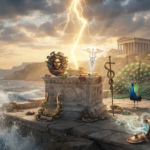
Titanomachy is the legendary war in Greek mythology between the Titans—the older generation of divine beings—and the younger Olympian gods led by Zeus. In its most familiar form, the Titanomachy marks the cosmic transition from primordial and archaic powers to the rule of the Olympians. It is one of the foundational myths of Greek religion and literature, explaining how Zeus and his allies established order over chaos, secured divine kingship, and divided the cosmos among themselves.
The Titanomachy matters because it is not only a battle story. It is a myth of succession, sovereignty, and cosmic order. Ancient Greek poets used it to explain why the Olympian pantheon ruled the world and how divine authority was transferred from one generation to the next. The myth also influenced later Roman literature, Hellenistic scholarship, and modern fantasy, art, and popular culture.
Origin and Meaning
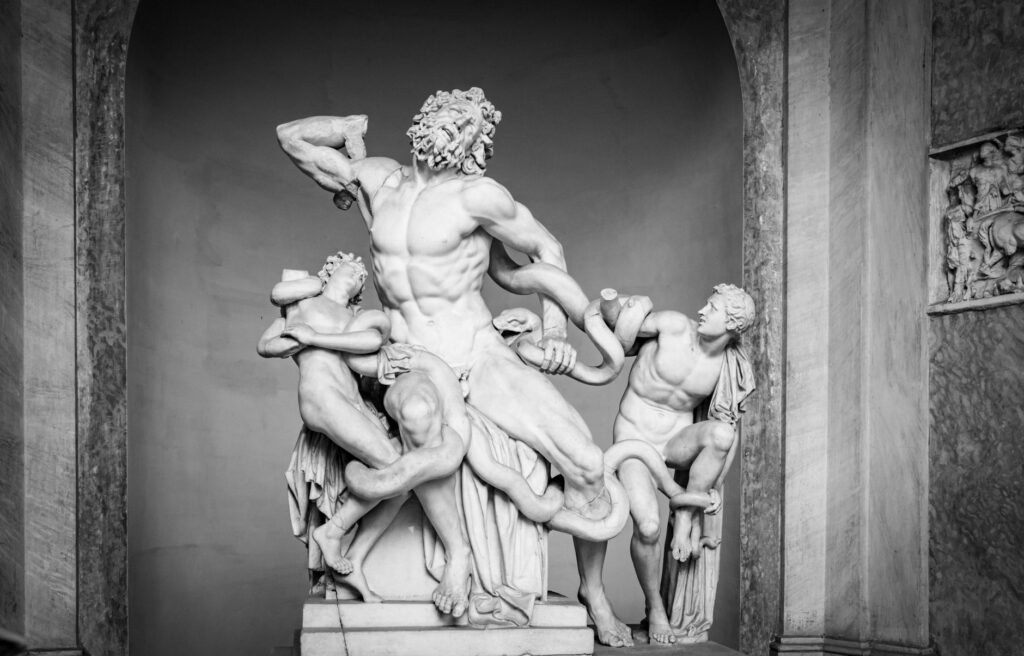
The word Titanomachy comes from Greek Τιτανομαχία (Titanomakhía), meaning “battle of the Titans” or “war against the Titans.”
- Titan refers to the ancient divine race known as the Titans.
- -machy comes from Greek máchē, meaning “battle” or “fight.”
The term itself is a later scholarly label for the war. Ancient Greek sources do not always use the exact word in the same way, but they clearly describe the conflict between Zeus and the Titan powers. In modern usage, “Titanomachy” usually refers specifically to the war that overthrew Cronus and the Titans and established Olympian rule.
Historical Context
The Titanomachy belongs to the broader mythic tradition of succession myths, in which a younger ruler overthrows an older one. Similar patterns appear in other ancient Near Eastern and Indo-European traditions. In Greek thought, the myth reflects a world in which divine order emerges through struggle.
The story developed in the context of ancient Greek religion, oral poetry, and later literary systematization. Its most influential early version appears in Hesiod’s Theogony, likely composed in the late 8th or early 7th century BCE. Hesiod presents the history of the gods as a structured genealogy culminating in Zeus’s victory.
The myth also reflects important Greek concerns:
- the legitimacy of kingship
- the relationship between force and justice
- the replacement of older, more chaotic powers by a stable order
- the idea that cosmic authority must be won and maintained
In some local traditions, details differ. Ancient authors do not always agree on the exact participants, the duration of the war, or the manner of the Titans’ defeat.
Main Characteristics
The Titanomachy is characterized by several features that make it distinct among mythic wars.
Cosmic Scale
The conflict is not a human war but a struggle involving divine beings whose actions shape the universe. Mountains, heavens, the underworld, and the seas all figure into the battle.
Generational Conflict
At its core, the myth is about succession. Cronus had already overthrown his father Uranus, and Zeus in turn overthrows Cronus. This pattern creates a chain of divine revolutions.
Alliance-Building
Zeus does not win alone. He frees and allies with other powerful beings, including the Cyclopes and the Hundred-Handers, who become decisive in the war.
Symbolic Weapons
The war features archetypal divine weapons:
- Zeus’s thunderbolt
- the Cyclopes’ forged gifts
- massive rocks and fire hurled by the Hundred-Handers
Resolution and Division
After victory, the cosmos is divided among the new rulers:
- Zeus receives the sky
- Poseidon receives the sea
- Hades receives the underworld
This division marks the establishment of an ordered divine regime.
Family and Genealogy
The Titanomachy is embedded in a complex divine genealogy.
The Older Generation
The central older figures are the Titans, children of Uranus (Sky) and Gaia (Earth). The chief Titan involved in the succession struggle is Cronus (Kronos), who overthrows Uranus and becomes ruler.
Other Titans commonly associated with the mythic conflict include:
- Rhea
- Oceanus
- Coeus
- Crius
- Hyperion
- Iapetus
- Themis
- Mnemosyne
- Phoebe
- Tethys
- Theia
Ancient sources vary on whether all Titans actively fought against Zeus or whether some remained neutral.
The Younger Generation
The Olympian side is led by Zeus, son of Cronus and Rhea. His siblings are:
- Hestia
- Demeter
- Hera
- Hades
- Poseidon
In Hesiod’s account, Cronus swallowed his children to prevent them from overthrowing him, but Zeus was hidden away as an infant and later forced Cronus to disgorge them. These freed siblings became Zeus’s core allies.
Key Allied Figures
Important non-Titan allies of Zeus include:
- The Cyclopes, especially associated with the forging of Zeus’s thunderbolt
- The Hundred-Handers or Hecatoncheires: Briareus, Cottus, and Gyges in Hesiod
They had been imprisoned by Uranus or Cronus and were released by Zeus.
Symbols
The Titanomachy is associated with several powerful symbols, though not all are formal cult symbols.
| Symbol | Meaning |
|---|---|
| Thunderbolt | Zeus’s authority, divine force, and victory |
| Lightning | Cosmic power and sudden destruction |
| Mountain peaks | Warfare on a cosmic scale; Olympus and Othrys are often named in later traditions |
| Chains and imprisonment | The confinement of older divine powers |
| Fire | Destruction, divine energy, and transformation |
| Massive rocks | The overwhelming strength of the Hundred-Handers |
The most important symbol is the thunderbolt, which represents Zeus’s supreme power. In literary tradition, it is often treated as the defining emblem of his kingship.
Sacred Animals
The Titanomachy itself is not centered on a single sacred animal, but several animals are associated with the Olympian gods who emerge victorious.
Eagle
The eagle is strongly associated with Zeus and imperial power. It symbolizes:
- divine sovereignty
- height and vision
- dominance over the sky
Bull
The bull appears in broader Greek divine symbolism and can represent strength and fertility. It is more generally connected with Zeus and other deities than specifically with the Titanomachy.
Serpentine and Monstrous Beings
In some mythic and artistic traditions, the Titans and their allies are linked with enormous, chaotic forms, including giant and serpent-like imagery. This is more symbolic than systematic.
Sacred Plants
No plant is uniquely and universally tied to the Titanomachy in ancient sources. However, certain plants and trees belong to the wider symbolic world of Zeus and Olympian rule.
Oak
The oak is sacred to Zeus, especially in some cultic contexts such as Dodona. It signifies:
- endurance
- divine power
- prophetic authority
Laurel
The laurel is more associated with Apollo than with the Titanomachy, but it belongs to the broader Olympian religious landscape.
Because the Titanomachy is a myth of cosmic conflict rather than a localized fertility cult, plant symbolism is secondary and often indirect.
Sacred Places
The Titanomachy is associated with several mythic locations, some of which differ by source.
Mount Olympus
Olympus is the home of the Olympian gods and the symbolic center of Zeus’s new order. It represents the victorious divine regime.
Mount Othrys
In later tradition, Mount Othrys is often associated with the Titans, especially as their base during the war. This association is not equally emphasized in all sources but became common in later retellings.
Tartarus
Tartarus is the deep abyss where defeated Titans are imprisoned in some versions, especially in Hesiod. It serves as a cosmic prison and a boundary between ordered divine life and primordial darkness.
Dodona
While not directly a Titanomachy site, Dodona matters because of Zeus’s cultic authority and prophetic presence.
Powers and Attributes
The Titanomachy is not a deity, but as a mythic event it is associated with the powers of the new divine order.
Zeus’s Attributes in the War
Zeus’s main attributes in the Titanomachy include:
- storm control
- thunder and lightning
- royal legitimacy
- strategic intelligence
- the ability to bind alliances
Olympian Attributes
The victory of the Olympians establishes several enduring divine responsibilities:
- regulation of the heavens
- maintenance of cosmic justice
- distribution of realms among gods
- protection of order against older forces
Titan Attributes
The Titans, by contrast, often represent:
- archaic power
- immense physical strength
- older cosmic forces
- resistance to new sovereignty
It is important to note that “Titan” does not always mean “evil.” Some Titans, such as Oceanus or Themis, are not universally portrayed as hostile in all traditions.
Main Myths
The Titanomachy appears within a larger cycle of divine succession narratives.
The Overthrow of Uranus
The myth begins with Uranus, who is overthrown by his son Cronus with the help of Gaia. Cronus becomes ruler of the cosmos.
Cronus and the Devouring of His Children
Cronus learns that one of his children will overthrow him. To prevent this, he swallows each newborn child. His wife Rhea saves Zeus by hiding him and giving Cronus a stone wrapped in swaddling clothes.
Zeus’s Return and the Rescue of His Siblings
When Zeus grows up, he forces Cronus to disgorge his swallowed children. These siblings then join him.
The War Against the Titans
The Titanomachy begins in earnest when Zeus and his allies confront Cronus and the Titans. Different sources vary on the length and details of the conflict. Hesiod famously gives the war a duration of ten years.
Release of the Hundred-Handers and Cyclopes
Zeus releases the Cyclopes and the Hundred-Handers from imprisonment. This is crucial because:
- the Cyclopes forge Zeus’s thunderbolt
- the Hundred-Handers provide overwhelming force by hurling enormous rocks
Defeat and Imprisonment of the Titans
The Titans are defeated. In Hesiod’s version, many are cast into Tartarus, guarded by the Hundred-Handers. Some later traditions soften or alter this punishment.
Division of the Cosmos
After victory, the victorious brothers divide rule:
- Zeus: sky and supreme kingship
- Poseidon: sea
- Hades: underworld
This division is one of the myth’s most important conclusions.
Relationship with Other Mythological Figures
The Titanomachy is central to the broader Greek divine family drama.
Cronus
Cronus is the principal opponent of Zeus. His fear of being overthrown mirrors the fate he imposed on Uranus.
Rhea
Rhea is both mother and protector. She helps Zeus survive infancy and makes the later revolt possible.
Gaia
Gaia’s role varies by source. She often functions as a prophetic and supportive earth figure, though her exact loyalties are not always the same across traditions.
The Cyclopes
The Cyclopes are essential craftsmen and allies. Their gift of the thunderbolt symbolizes the technological and divine advantage that enables Zeus’s victory.
The Hundred-Handers
These beings embody overwhelming force. Their hundred arms make them nearly unbeatable in direct battle.
Prometheus
Prometheus is more prominent in later myths than in the Titanomachy itself, but he belongs to the Titan lineage and appears in the wider post-war divine order.
Other Olympians
The war establishes the status of the Olympian family as a ruling dynasty. Gods such as Hera, Demeter, Poseidon, and Hades become part of the postwar structure.
Worship and Cult
There was no universal cult of the Titanomachy as a single event. However, the myth was deeply embedded in Greek religious thought and ritual storytelling.
Ritual and Religious Function
The myth helped explain:
- Zeus’s supremacy
- the legitimacy of divine kingship
- the ordering of festivals and sacrificial systems
- the moral superiority of a stable cosmic order over rebellion
Public Recitation and Education
Epic poetry, hymns, and later philosophical commentary transmitted the story. It likely formed part of the cultural education of Greek audiences.
Local and Regional Variations
Some Greek communities had their own divine genealogies and preferred local traditions. As a result, the Titanomachy could be adapted to fit regional religious identities.
It should be stressed that the Titanomachy is more a mythological narrative than a cult object of worship in the narrow sense.
Ancient Sources
The Titanomachy is known mainly through literary sources. Different authors preserve different versions.
| Author | Work | Contribution |
|---|---|---|
| Hesiod | Theogony | The most influential early account of the divine succession and Titan war |
| Homer | Iliad, Odyssey | Allusions to Zeus’s authority and older divine conflicts |
| Apollodorus | Bibliotheca | A later prose summary of mythic genealogy and the war |
| Pausanias | Description of Greece | Records local traditions and mythic references |
| Ovid | Metamorphoses | Roman retelling of Greek mythic conflict and divine change |
| Euripides and others | Fragmentary or indirect references | Supplementary literary evidence |
Hesiod’s Theogony
Hesiod’s account is especially important because it presents a coherent genealogy and a structured divine history. It is the standard reference point for the Titanomachy.
Apollodorus
The Bibliotheca offers a more systematic mythological handbook, useful for comparing variants.
Pausanias
Pausanias preserves local mythic traditions and references to artworks or cultic associations that illuminate how the story was received in different regions.
Homer
Homer does not narrate the Titanomachy in full, but his epics assume Zeus’s established supremacy and preserve echoes of divine struggle.
Roman Equivalent
There is no exact Roman equivalent with the same genealogical role and mythic structure. Roman religion adopted and adapted Greek myth extensively, and the Titanomachy became part of the broader Greco-Roman tradition.
In Roman literature, especially in Ovid, the Greek divine struggle is retold for a Roman audience. Roman writers often treated the Olympian gods as equivalents of Roman deities:
- Zeus = Jupiter
- Hera = Juno
- Poseidon = Neptune
- Hades = Pluto
Thus, the Titanomachy was absorbed into Roman mythological literature rather than replaced by a distinct Roman foundational myth.
Influence on Modern Culture
The Titanomachy has had a strong afterlife in modern culture because it offers a dramatic image of cosmic war, generational conflict, and the overthrow of old powers.
Literature
Modern fantasy and historical fiction often draw on the Titanomachy as a template for wars between gods, titans, giants, or elder races and younger divine powers.
Art
Paintings, sculptures, and decorative arts have long used scenes of the Olympians battling giant or monstrous forces. The Titans themselves became a visual shorthand for archaic, overwhelming strength.
Cinema and Television
Films and series inspired by Greek mythology often reference the war between Zeus and the Titans, sometimes loosely or with significant creative adaptation.
Games
Video games frequently use the Titanomachy as a source of characters, boss battles, and worldbuilding. Titans, Olympians, and divine rebellions are common motifs in fantasy gaming.
Popular Culture
The word “Titan” itself has gained broad cultural use to mean something enormous or powerful. While not always directly tied to the myth, this usage reflects the myth’s enduring symbolic force.
Curiosities
1. The Titanomachy is often confused with the Gigantomachy
These are different myths. The Titanomachy is the war between Olympians and Titans. The Gigantomachy is the later battle between Olympian gods and the Giants.
2. The Titans are not uniformly monstrous
Modern usage sometimes treats “Titan” as a term for a villain or giant brute, but ancient traditions were more varied. Some Titans played relatively neutral or even positive roles in the wider divine genealogy.
3. The war can be read as a story of political legitimacy
Ancient audiences may have understood the myth not only as a cosmic event but also as a model for rightful rule and the dangers of tyrannical succession.
4. The thunderbolt is a technological symbol as well as a divine one
In mythic terms, the thunderbolt marks Zeus as the god who controls a uniquely destructive and awe-inspiring force, distinguishing him from older powers.
5. Some ancient traditions differ on where the Titans were imprisoned
Hesiod places them in Tartarus, but later writers and local traditions sometimes adapt the punishment or describe other outcomes.
Frequently Asked Questions
What is the Titanomachy?
The Titanomachy is the mythological war in Greek tradition between the Titans, led by Cronus, and the Olympian gods, led by Zeus.
How long did the Titanomachy last?
In Hesiod’s Theogony, the war lasted ten years. Other sources do not always emphasize the duration in the same way.
Who won the Titanomachy?
Zeus and the Olympians won. The Titans were defeated, and many were imprisoned in Tartarus according to Hesiod.
Who helped Zeus in the Titanomachy?
Zeus was aided by his freed siblings, the Cyclopes, and the Hundred-Handers. These allies were crucial to his victory.
Is the Titanomachy the same as the Gigantomachy?
No. The Titanomachy is the war against the Titans. The Gigantomachy is the battle against the Giants, a separate myth.
Why is the Titanomachy important in Greek mythology?
It explains how Zeus and the Olympians came to rule the cosmos and symbolizes the transition from older, chaotic power to ordered divine kingship.
Are all Titans enemies of Zeus?
Not necessarily. Different traditions vary, and some Titans are not portrayed as active combatants or are later integrated into the broader divine order.
Conclusion
The Titanomachy is one of the most important myths in Greek mythology because it explains the rise of Zeus and the establishment of Olympian rule. More than a simple battle story, it is a myth of succession, legitimacy, and cosmic order. Through Hesiod and later ancient authors, the story became central to the Greek understanding of divine history.
Its influence has endured for centuries. The Titanomachy continues to shape literature, art, film, and popular imagination as a powerful symbol of generational conflict and the struggle between old and new orders. As a foundational myth, it remains one of the clearest expressions of how the ancient Greeks imagined the universe, its rulers, and the forces that hold it together.

Orin Vale has spent the better part of two decades tracing the threads that connect the world’s oldest stories — from the halls of Asgard to the banks of the Nile, from Olympus to the jungles of the Maya. What began as a childhood fascination with flood myths and trickster gods grew into years of independent study across comparative mythology and ancient religion, always chasing the same question: what did these stories mean to the people who first told them? Orin writes for readers who want more than trivia — the ones looking for the beliefs, fears, and truths that myths were built to carry.