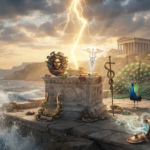
Birth of Zeus in the Cretan Cave
Introduction
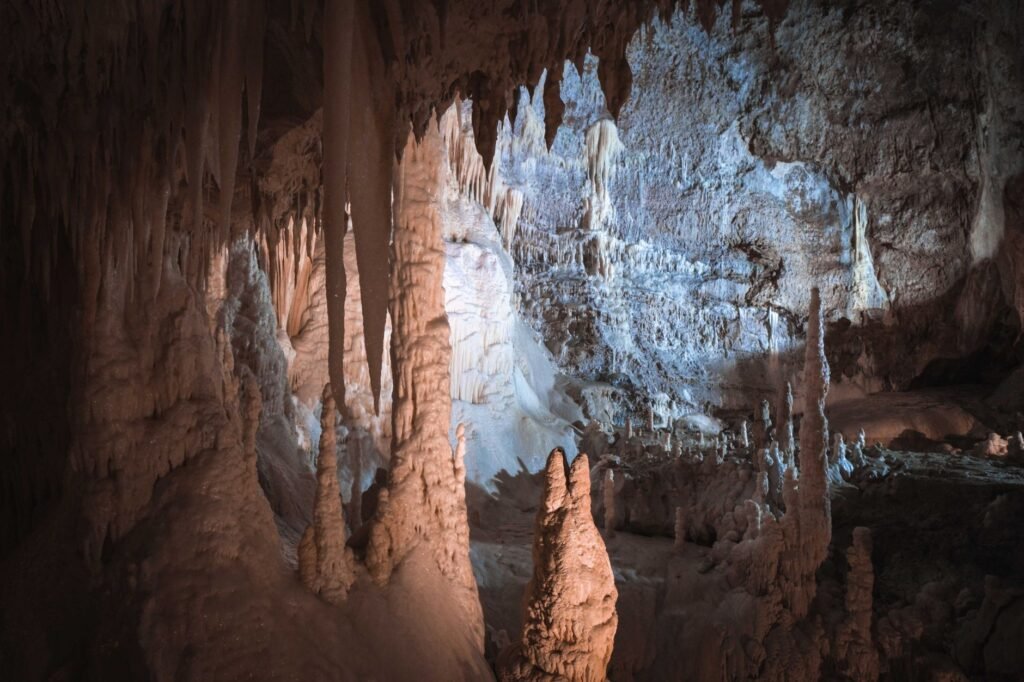
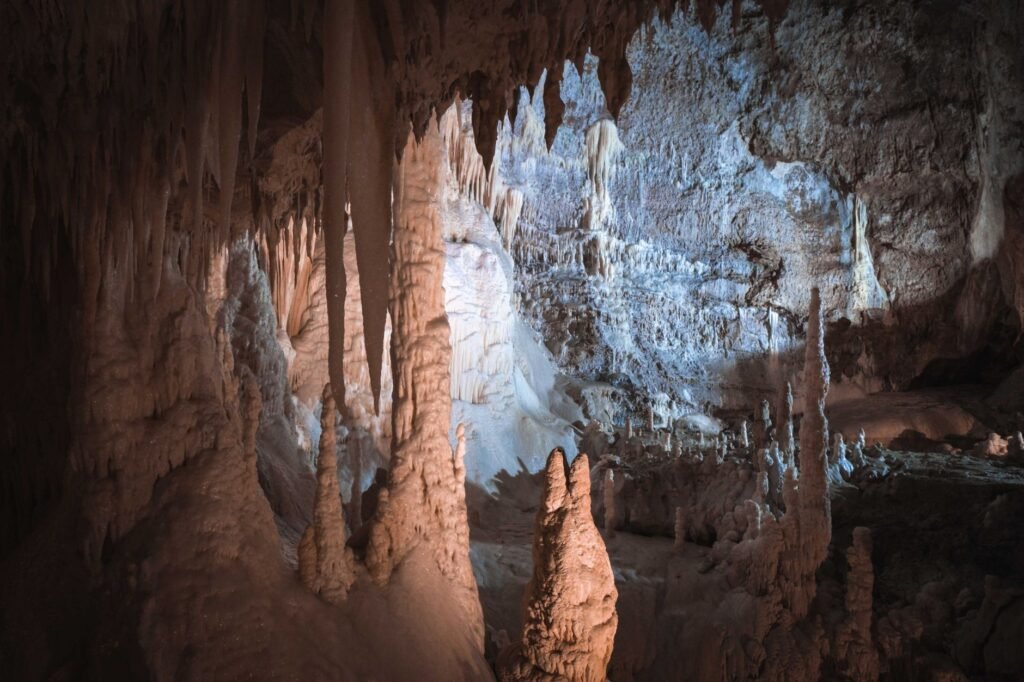
The birth of Zeus in the Cretan cave is one of the most famous episodes in Greek mythology. It tells how Zeus, who later became king of the gods, was secretly hidden on the island of Crete to protect him from his father, the Titan Cronus. According to the best-known tradition, Zeus was born in a cave or mountain sanctuary and raised away from danger until he was strong enough to challenge Cronus and reshape the divine order.
This myth matters for several reasons. It explains Zeus’s rise to sovereignty, reflects ancient ideas about divine succession and kingship, and became deeply connected with Cretan religious identity. In later Greek and Roman literature, the cave of Zeus remained a powerful symbol of hidden divine power, sacred landscapes, and miraculous survival.
Origin and Meaning
The name Zeus comes from the ancient Greek Ζεύς (Zeús), related to the Indo-European root dyeu- meaning “sky,” “daylight,” or “shining heaven.” He is therefore fundamentally a sky god, long associated with weather, thunder, and supreme authority.
The phrase birth of Zeus in the Cretan cave is not a single ancient title but a modern descriptive expression for a cluster of myths and cult traditions. Ancient sources do not always agree on the exact location. Some place Zeus’s birth on Mount Dicte in eastern Crete, others on Mount Ida in central Crete. In Greek tradition, both mountains contained sacred caves linked to his infancy.
Historical origin of the myth
The myth likely developed from a combination of:
- older Indo-European sky-god traditions,
- local Cretan cults centered on caves and mountains,
- and later Panhellenic myths about the struggle between generations of gods.
The cave setting may have reflected the prehistoric and Bronze Age use of caves as sacred places in Crete. Over time, these local sacred landscapes became attached to the story of Zeus’s birth.
Historical Context
The myth belongs to the broader Greek narrative of divine succession: Uranus is overthrown by Cronus, and Cronus in turn is overthrown by Zeus. This sequence expresses a transition from primordial chaos or older rule to a more ordered cosmic kingship.
In Cretan religious culture, caves, peaks, and hidden sanctuaries were especially important. Archaeological evidence from Crete shows that caves were used for ritual activity from the Minoan period onward. Although the archaeological record cannot prove the myth itself, it demonstrates that the island had long-standing sacred landscapes that later Greek tradition could absorb.
Cultural significance in Crete
Crete claimed a particularly important role in Zeus’s early life. The island’s association with the god helped enhance its prestige in the Greek world. Ancient authors sometimes describe Cretans as preserving special rituals, songs, and local claims about his upbringing.
The myth also has a political and religious dimension. By linking Zeus to Crete, communities on the island could connect themselves to the most powerful god in Greek religion. In turn, Greek writers often portrayed Crete as both ancient and mysterious, a land of hidden gods and arcane rituals.
Main Characteristics
The birth of Zeus in the Cretan cave is usually characterized by several core elements:
- Secret birth: Zeus must be hidden from Cronus, who devours his children.
- Cave sanctuary: the infant is raised in a cave, often on Mount Dicte or Mount Ida.
- Divine protection: his survival depends on the aid of other gods or semi-divine beings.
- Nurturing care: he is fed, guarded, and concealed by attendants such as the nymphs or the Curetes.
- Future kingship: the episode anticipates Zeus’s later victory over Cronus and assumption of supreme power.
The cave is not merely a birthplace in a biological sense. It functions as a sacred and symbolic space: hidden, protected, and liminal. The setting marks Zeus as both vulnerable infant and predestined ruler.
Family and Genealogy
Parents
Zeus is the son of:
- Cronus (Cronos), a Titan ruler
- Rhea, a Titaness and his mother
In the standard myth, Cronus had received a prophecy that one of his children would overthrow him. To prevent this, he swallowed each newborn child. Rhea, determined to save Zeus, concealed him at birth and gave Cronus a stone wrapped in swaddling clothes instead.
Siblings
Zeus’s siblings are usually listed as:
- Hestia
- Demeter
- Hera
- Hades
- Poseidon
In most traditions, all except Zeus were swallowed by Cronus and later released.
Children
Zeus later fathers many divine and mortal children. These are not directly part of the infancy myth, but they are important for understanding his role as king of gods and father of numerous lineages. His children include, in different traditions:
- Athena
- Apollo and Artemis in some later traditions through different parentage systems, though standard mythology gives them Leto as mother
- Ares
- Hermes
- Dionysus
- Persephone is not his child but a major later relation through myths
- many heroic descendants, such as Heracles, Perseus, Minos, and others
Spouses and relationships
Zeus’s principal wife is Hera, though he has many relationships in myth. Hera’s later role as his consort contrasts strongly with the danger that threatened him at birth.
Symbols
The birth myth is associated with several important symbols:
| Symbol | Meaning |
|---|---|
| Cave | Hidden sacred space, protection, mystery, liminality |
| Stone wrapped in cloth | Deception, substitution, survival, the tricking of Cronus |
| Thunderbolt | Zeus’s future authority and power |
| Goat Amalthea | Nourishment, nurture, divine abundance |
| Curetes’ clashing weapons | Concealment through noise; ritual protection |
| Beehive or honey | In some local traditions, nourishment and sacred abundance |
| Mountain peak | Connection between earth and sky; divine elevation |
The cave itself became a central symbol in later religious imagination. It represents hidden origins and the idea that greatness may emerge from obscurity.
Sacred Animals
Several animals are linked to Zeus’s Cretan infancy.
The goat Amalthea
The most famous sacred animal is Amalthea, usually described as a goat who nursed the infant Zeus. Some traditions treat Amalthea as a goat, while others describe her as a nymph associated with a goat. The cornucopia, or horn of plenty, is later connected to her broken horn in some myths, though details vary.
Bees
In some Cretan traditions, bees are connected with Zeus’s nurture in the cave. Honey is often presented as divine food, and bees symbolize sustenance, purity, and sacred order.
Eagles
The eagle is not specifically tied to Zeus’s birth in the cave, but it is one of his principal sacred animals later in myth. It represents kingship, vision, and divine dominion.
Sacred Plants
Ancient sources do not provide a single universally agreed plant tied uniquely to Zeus’s cave birth. However, several plant associations appear in broader Cretan and Greek religious traditions.
Ash and mountain vegetation
The cave and mountain landscape would have been surrounded by local vegetation typical of Crete. Sacred mountain settings were often linked to wild growth, suggesting a setting outside ordinary cultivated life.
Honey-bearing plants and herbs
Because bees and honey are sometimes associated with Zeus’s upbringing, plants that sustain bee populations become indirectly meaningful. In mythic language, such natural abundance reinforces the image of divine nurture.
Oak
The oak is one of Zeus’s major sacred trees in broader Greek religion, especially at Dodona. It is not central to the Cretan birth myth itself, but it is relevant to Zeus’s wider cult and symbolism.
Sacred Places
Crete
Crete is the core geographical setting of the myth. Ancient writers often insist that Zeus was born there, though not always in the same exact location.
Mount Dicte
Mount Dicte in eastern Crete is one of the most common places identified as Zeus’s birthplace. The Dictean Cave became strongly associated with the god.
Mount Ida
Mount Ida in central Crete is another major candidate. The Idean Cave or Idaean Cave was a powerful cult site in antiquity and later tradition. Some sources prefer this location over Dicte, and both mountains remain linked to the story.
Cretan caves
Caves in general mattered greatly in Minoan and later Greek religion. Their enclosed, hidden nature made them suitable for ritual and mythic concealment. The cave of Zeus was a sacred site of memory as much as of worship.
Later sanctuaries
In later times, sanctuaries dedicated to Zeus or related figures were established in Crete, reinforcing the island’s mythic importance. However, the exact development of cult sites varied across periods and locations.
Powers and Attributes
The infancy myth does not describe Zeus’s mature powers directly, but it foreshadows them.
Main domains later associated with Zeus
- sovereignty over gods and humans
- control of thunder and lightning
- protection of oaths and justice
- kingship and cosmic order
- hospitality and the regulation of social bonds
- weather, storms, and atmospheric power
Symbolic significance of the cave birth
His cave birth suggests that authority can arise from concealment and protection. Zeus is not merely born; he is preserved for destiny. The episode emphasizes:
- survival against cosmic threat,
- the legitimacy of his eventual rule,
- and the idea that his reign has divine sanction.
Main Myths
The swallowing of the children
The central background myth tells that Cronus swallowed his offspring to avoid being overthrown. This is one of the best-known stories in Greek mythology and forms the immediate cause of Zeus’s hidden birth.
Rhea’s deception
Rhea, distressed by the fate of her children, seeks help and gives birth to Zeus in secret. She presents Cronus with a stone wrapped in swaddling cloth, which he swallows, believing it to be the infant.
The cave upbringing
Zeus is taken to a cave in Crete. There he is raised in secrecy. Different sources describe his caregivers differently, but the essential point is that he is hidden from Cronus.
The Curetes
In many versions, the Curetes are armed dancers or divine attendants who beat shields and clash weapons to drown out the cries of the infant Zeus. This noise prevents Cronus from hearing him.
Amalthea and nourishment
Zeus is fed by Amalthea, the goat, or by the milk and honey supplied by attendants and nymphs. This part of the myth reinforces the theme of miraculous survival.
The future overthrow of Cronus
The cave birth is only the beginning. Zeus later forces Cronus to disgorge his swallowed children, gathers allies, and defeats the Titans in the Titanomachy. The infancy myth thus functions as the prelude to his ascent to power.
Relationship with Other Mythological Figures
Cronus
Cronus is Zeus’s most important early adversary. Their conflict defines the mythic transition from Titan rule to Olympian rule.
Rhea
Rhea is the protective mother who enables Zeus’s survival. She is a figure of maternal intelligence and resistance.
The Curetes
The Curetes are protectors, ritual performers, or armed attendants associated with the infant Zeus. Their exact nature varies by source: sometimes they are described as divine beings, sometimes as a local Cretan group.
The nymphs
Nymphs appear in some traditions as caretakers of Zeus in the cave. They embody nurturing nature and sacred femininity.
Amalthea
Amalthea is one of the most distinctive figures connected with the myth. Her role as nurse or foster-mother gives the story a pastoral and benevolent dimension.
Other Titans and Olympians
Zeus’s hidden infancy is part of a wider divine family conflict that includes all the Olympian siblings and the defeated Titans.
Worship and Cult
The birth of Zeus in Crete was not only a story but also a basis for cultic practices.
Cave worship
Caves associated with Zeus were used for ritual activity. Offerings may have included:
- votive objects,
- figurines,
- food and drink offerings,
- and possibly animal sacrifice in some later contexts.
Local rituals
Ancient authors mention Cretan customs connected with Zeus, though the surviving evidence is uneven. Some rituals may have involved:
- dances,
- music,
- armed performances,
- and seasonal ceremonies.
Festival traditions
The precise festival calendar varied by city and sanctuary. Because Cretan religious practice differed from place to place, it is safest to say that Zeus was honored in local cults linked to his cave birth, rather than to assign one universal festival.
Archaeological evidence
Excavations in Cretan caves such as the Idaean Cave have yielded offerings that indicate long-term cult use. While archaeology cannot prove the myth, it confirms that these places were sacred in antiquity.
Ancient Sources
Different ancient authors preserve different versions of the myth.
Hesiod
In the Theogony, Hesiod gives the classic account of Zeus’s family struggle and rise to power. He provides the core framework for the myth, though not always detailed cave imagery.
Homer
Homer does not narrate the birth story in full, but Zeus’s supreme position is central to the epics. Later readers often used Homeric authority to reinforce Zeus’s divine kingship.
Apollodorus
The Bibliotheca attributed to Apollodorus gives a compact and useful summary of Zeus’s concealment, the stone deception, and his eventual victory over Cronus.
Callimachus
Callimachus is especially important for the Cretan version. In the Hymn to Zeus, he presents the traditions that place Zeus’s birth on Mount Dicte, and he also mentions the rival claim of Mount Ida. He is valuable because he explicitly acknowledges differing local traditions.
Diodorus Siculus
Diodorus preserves rationalized or historicizing accounts and is useful for understanding how later Greek writers interpreted Cretan myths.
Pausanias
Pausanias frequently records local cult traditions and differing claims about sacred places, though not always with detailed infancy narratives. His work helps show the diversity of Greek religious geography.
Ovid
Ovid does not focus on the Cretan cave birth in the same way as Greek sources, but his mythological poetry helped spread Roman literary adaptations of Greek divine stories.
Roman Equivalent
Zeus’s Roman equivalent is Jupiter. The Roman god shares Zeus’s core functions as sky god, ruler of gods, and guarantor of order.
However, the birth in the Cretan cave is primarily a Greek mythic tradition. Romans inherited the broader Zeus/Jupiter identification but did not always emphasize the Cretan infancy narrative to the same degree. When they did, it appeared as part of the larger Greek mythological corpus rather than a distinctly Roman story.
Influence on Modern Culture
The birth of Zeus in the Cretan cave continues to appear in modern literature, art, education, and popular culture.
Literature and scholarship
The myth remains a standard subject in classical studies, comparative mythology, and retellings of Greek myth. It is often used to illustrate themes of succession, divine legitimacy, and sacred landscape.
Visual art
Artists have depicted the infant Zeus, the cave, Amalthea, and the Curetes in paintings, sculpture, and illustration. The scene is visually attractive because it combines danger, secrecy, and divine infancy.
Cinema and television
Greek myth adaptations sometimes reference Zeus’s hidden birth or the Titanomachy that follows it. While many modern works simplify the story, the cave birth remains a recognizable origin scene.
Games and fantasy media
Video games, fantasy novels, and role-playing settings often draw on the imagery of Zeus’s cave, thunderbolts, and Titan conflicts. The motif of a hidden child destined for greatness is especially influential.
Tourism and heritage
Cretan caves associated with Zeus attract visitors interested in myth and archaeology. The legend contributes to cultural tourism and the island’s identity in global imagination.
Curiosities
- Ancient sources do not fully agree on whether Zeus was born on Mount Dicte or Mount Ida.
- The stone swallowed by Cronus is a classic example of divine deception in Greek myth.
- The Curetes are sometimes interpreted as mythic beings and sometimes as a ritualized, local warrior group.
- The cave of Zeus may reflect a much older sacred use of caves in Crete, predating the written myths.
- The story has parallels with other world myths in which a child destined for greatness is hidden from a threatening parent.
- Some ancient traditions tie Zeus’s infancy to honey and bees, emphasizing sacred nourishment rather than ordinary human feeding.
- The myth helped make Crete a central place in the Greek imagination, even for audiences far from the island.
Frequently Asked Questions
Was Zeus really born in a cave in Crete?
In mythology, yes. Ancient traditions widely place Zeus’s birth in a cave on Crete, though they differ on the exact mountain or cave.
Why was Zeus hidden after his birth?
He was hidden because his father, Cronus, feared being overthrown by one of his children and swallowed them as they were born.
Who raised Zeus in the Cretan cave?
Different sources mention the Curetes, nymphs, and Amalthea as caretakers or protectors.
Is the cave on Mount Ida or Mount Dicte?
Both traditions exist. Some ancient sources favor Mount Dicte, while others favor Mount Ida.
What is the role of Amalthea?
Amalthea is usually the goat or foster figure who nourished the infant Zeus, often with milk. She is one of the best-known figures in the myth.
What does the cave symbolize?
The cave symbolizes concealment, protection, sacred mystery, and the hidden origins of divine kingship.
Which ancient author is most useful for this myth?
Callimachus is especially important for the Cretan local traditions, while Hesiod and Apollodorus are essential for the broader myth of Zeus and Cronus.
Conclusion
The birth of Zeus in the Cretan cave is a foundational myth in Greek religion and literature. It combines themes of hidden birth, maternal protection, divine nurture, and the dramatic overthrow of an older cosmic order. Although ancient sources differ about details such as the exact cave, mountain, and caretakers, they agree on the central importance of Zeus’s concealed infancy.
Its legacy endures because the story is both mythically powerful and culturally rich. It links landscape to divinity, local Cretan tradition to Panhellenic myth, and childhood vulnerability to supreme authority. As a result, the cave birth of Zeus remains one of the most enduring and symbolically resonant episodes in the ancient mythological imagination.

Orin Vale has spent the better part of two decades tracing the threads that connect the world’s oldest stories — from the halls of Asgard to the banks of the Nile, from Olympus to the jungles of the Maya. What began as a childhood fascination with flood myths and trickster gods grew into years of independent study across comparative mythology and ancient religion, always chasing the same question: what did these stories mean to the people who first told them? Orin writes for readers who want more than trivia — the ones looking for the beliefs, fears, and truths that myths were built to carry.