Who Is Hathor in Egyptian Mythology?
Introduction
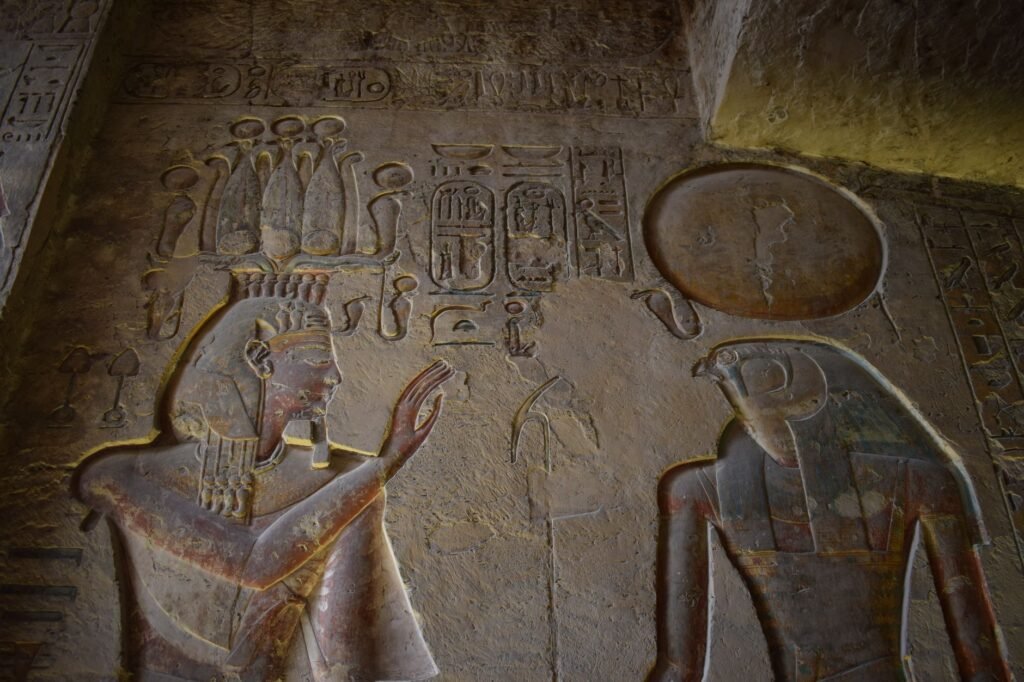
Hathor is one of the most important and enduring goddesses in ancient Egyptian religion. She was worshipped for thousands of years and appeared in many roles: goddess of love, joy, music, beauty, fertility, motherhood, and protection. She was also associated with the sky, the sun, the dead, and the afterlife, which makes her one of the most complex deities in the Egyptian pantheon.
The question “who is Hathor in Egyptian mythology?” does not have a single simple answer, because her identity changed over time and varied by region and religious tradition. In some contexts she was a nurturing mother goddess; in others she was a powerful celestial cow; and in still others she was a fierce protector or a guide for the dead. Her long history reflects the richness and adaptability of ancient Egyptian religion.
Origin and Meaning
The name Hathor is the Greek form of the Egyptian name ḥwt-ḥrw (commonly transliterated as Hut-Hor or House of Horus), meaning “House of Horus”. This title points to one of the goddess’s most important relationships: she was closely connected with the sky god Horus, and in some traditions she was imagined as the divine dwelling or motherly space associated with him.
The origin of Hathor as a deity is very ancient. She is attested from the early dynastic period and may have roots in pre-dynastic beliefs about cows, fertility, and the life-giving powers of the sky. Over time, she became one of the major goddesses of the Egyptian state religion.
Her name also reflects an important feature of Egyptian theology: deities were often understood through their functions rather than as separate “characters” in a fixed mythological system. Hathor could therefore be identified with other goddesses and merged with them depending on local tradition and religious need.
Historical Context
Hathor was worshipped throughout much of ancient Egyptian history, from the Early Dynastic Period through the Ptolemaic era and into Roman Egypt. Her cult was widespread, and she appears in temples, inscriptions, tombs, papyri, amulets, and ritual scenes.
Religious and cultural setting
Ancient Egyptian religion did not separate the sacred from everyday life in the way modern societies often do. Deities such as Hathor were involved in:
- royal legitimacy
- fertility and childbirth
- music, dance, and celebration
- protection of women and children
- the transition from life to death
- cosmic order and the movement of the sun
Hathor was especially important in both royal and non-royal settings. Pharaohs associated themselves with her to emphasize divine birth, legitimacy, and protection. Ordinary people invoked her in domestic religion, especially for fertility, health, and joy.
Regional importance
Although Hathor was known across Egypt, certain centers became especially linked with her worship, including:
- Dendera, one of her most famous cult centers
- Serabit el-Khadim in the Sinai, where she was honored by miners
- Thebes, where she was connected with royal and funerary traditions
- Memphis and other major cultic regions where her image and titles were adapted to local theology
Her broad appeal helped her remain relevant across changing political periods and religious systems.
Main Characteristics
Hathor is a multifaceted goddess. Her most common characteristics include femininity, beauty, music, joy, and maternal care, but she also has a more dangerous side.
Typical forms and depictions
Hathor is usually shown as:
- a woman wearing a headdress of cow horns and a sun disk
- a cow
- a woman with cow ears
- occasionally as a lioness-like or serpent-associated form in her more destructive manifestations
The cow form is especially significant because cows symbolized nourishment, motherhood, and the sky in ancient Egyptian thought. The sun disk between the horns represents her celestial and solar dimensions.
Key traits
Hathor is commonly associated with:
- love and sexuality
- fertility and childbirth
- music, dance, and celebration
- beauty and adornment
- motherhood and nurturing
- protection of the king
- the afterlife and funerary care
- the “Eye of Ra” tradition, in which she can appear as a powerful solar goddess
Her personality is not fixed in a single moral category. She can be gentle and beneficent, but also dangerous when provoked or when she takes on the fierce role of a divine avenger.
Family and Genealogy
Hathor’s genealogy varies across ancient traditions, which is typical in Egyptian mythology.
Common associations
She is often described as:
- the wife or consort of Horus, especially in her title “House of Horus”
- the mother of Horus in some local or symbolic traditions
- the daughter of Ra in solar mythologies
- sometimes connected with Atum, Ptah, or other creator deities through syncretic theology
Relationships with other deities
Because Egyptian gods often merged or shared roles, Hathor’s family ties are not always consistent. In some myths she is closely linked to Isis, and in certain contexts the two goddesses overlap in function as mothers, protectors, and mourners. She is also related to goddesses such as Sekhmet, Bastet, Mut, and Tefnut through shared roles or transformations in myth.
Descendants and offspring
Different traditions sometimes identify her as mother of Horus or as a maternal figure to the king. She is especially important in royal ideology as a divine mother who legitimizes kingship.
Symbols
Hathor’s symbols are among the most recognizable in Egyptian art and religion.
| Symbol | Meaning |
|---|---|
| Cow horns with sun disk | Divine motherhood, celestial power, connection to the sun |
| Cow | Nourishment, fertility, maternal care, heaven |
| Sistrum | Music, ritual joy, divine presence |
| Menat necklace | Fertility, protection, and ceremonial power |
| Mirror | Beauty, femininity, adornment, and self-presentation |
| Papyrus column / shrine forms | Links to sacred space and cult architecture |
| Turquoise and gold | Preciousness, beauty, and divine radiance |
The sistrum and menat
Two of Hathor’s most important cult objects are the sistrum, a rattle used in ritual music, and the menat, a broad collar necklace associated with fertility, joy, and Hathor’s protective power. These objects appear frequently in temple scenes and are closely tied to her worship.
Colors and materials
Hathor is often linked with gold, turquoise, red, and blue-green tones, especially because these colors suggest brightness, preciousness, life, and the desert-turquoise mines that were sacred to her in some regions.
Sacred Animals
The primary sacred animal of Hathor is the cow.
The cow
Cows were highly symbolic in ancient Egypt because they represented:
- nourishment through milk
- motherhood
- gentleness
- fertility
- the sky, which could be imagined as an enormous protective cow arching over the earth
Hathor’s cow imagery made her a natural goddess of maternal care and abundance.
Other animal associations
Depending on context, Hathor may also be connected with:
- falcons, through her link to Horus and the sky
- lions, when she takes on a fierce protective aspect
- serpents, in her dangerous solar form as the Eye of Ra
These associations do not replace the cow symbolism; rather, they show how flexible Egyptian divine imagery could be.
Sacred Plants
Unlike some deities, Hathor is not strongly defined by a single sacred plant, but several plants and botanical symbols are associated with her in different contexts.
Common plant associations
- Sycamore fig: often linked with divine protection and nourishment, especially in funerary imagery
- Papyrus: symbol of vitality, marshland abundance, and sacred space
- Vine and wine-producing plants: associated with festivity, intoxication, and celebration
Ritual and symbolic importance
Plants connected with Hathor often relate to her roles in nourishment, fertility, and pleasure. In funerary contexts, the sycamore in particular could symbolize the goddess providing refreshment and life to the deceased.
Sacred Places
Hathor had many sacred sites, but several stood out in particular.
Dendera
Dendera in Upper Egypt is the most famous center of Hathor worship. The Temple of Hathor at Dendera, especially in its later Ptolemaic and Roman form, is one of the best-preserved temples in Egypt. It contains rich iconography, astronomical imagery, and numerous references to Hathor’s roles as goddess of joy, beauty, and cosmic order.
Serabit el-Khadim
In the Sinai Peninsula, Hathor was venerated by miners who extracted turquoise and other valuable materials. There she was sometimes called the “Lady of Turquoise.” This title reflects her connection with precious stones, mining expeditions, and protection in dangerous environments.
Theban connections
At Thebes, Hathor was integrated into funerary religion and royal ideology. She appears in tomb scenes as a divine protector and as a welcoming goddess for the dead.
Other sacred locations
Hathor was also honored at:
- Memphis
- Abydos
- Cusae
- various local shrines throughout Egypt and Nubia
Her cult’s spread shows that she was not confined to one city or one theological tradition.
Powers and Attributes
Hathor’s powers are broad and sometimes overlapping.
Major domains
- Love and sexuality: she presides over attraction, pleasure, and emotional fulfillment
- Fertility and childbirth: she supports conception, pregnancy, and maternal care
- Music and dance: she is the patroness of celebration, rhythm, and joyous ritual
- Beauty and adornment: she is associated with cosmetics, jewelry, and refined appearance
- Protection: she guards women, children, the king, and the dead
- Solar and celestial power: she appears as a sky goddess and as a manifestation of the sun’s eye
- Afterlife guidance: she receives and nourishes the deceased
The dual nature of Hathor
A key feature of Hathor is her duality. She is benevolent, but she can also become violent, especially in myths involving the Eye of Ra. This dual nature reflects a common Egyptian religious idea: divine power could be life-giving and destructive at the same time.
Main Myths
Hathor appears in many myths, though not always in a single standardized narrative.
The Eye of Ra
One of the most important mythic roles associated with Hathor is that of the Eye of Ra. In this tradition, the sun god’s eye is a powerful feminine force that can act independently, bringing destruction to enemies and restoring order.
In some versions, this fierce goddess is identified with Hathor, while in others she is linked to Sekhmet, Tefnut, or another goddess. The exact identity varies by text and era.
A common theme is the goddess’s transformation:
- She begins as a dangerous force.
- Her violence threatens humanity.
- She is pacified or restored through divine intervention.
- She returns to a balanced, life-giving role.
This myth highlights Hathor’s power as both destroyer and nurturer.
The myth of intoxication
A well-known tradition tells of the goddess being pacified by beer or wine, sometimes in connection with the destruction of humankind. In this type of story, intoxication changes the goddess’s mood and halts her violence. Scholars often connect this with festivals, ritual drinking, and Hathor’s association with celebration.
The heavenly cow
Hathor is sometimes identified with the celestial cow who supports the sky. In this role, she is linked to cosmic stability and the creation of the ordered world.
The dead and the west
Hathor also appears in funerary contexts as a goddess who welcomes the deceased into the western realm of the dead. She may appear from a sycamore tree or as a protective cow, offering food, water, and comfort.
Relationship with Other Mythological Figures
Hathor’s relationships with other deities are central to her identity.
Horus
Her strongest association is with Horus, reflected in her name “House of Horus.” Depending on tradition, she may be his mother, consort, or divine sphere of protection. The relationship is theological as much as familial.
Ra
Hathor is closely tied to Ra, the sun god. As the Eye of Ra, she embodies solar power, divine retribution, and the restoration of order. This connection also helps explain her celestial and radiant imagery.
Isis
Hathor and Isis overlap significantly in some traditions. Both are goddesses of motherhood, protection, royal support, and funerary aid. In later periods, their roles often become intertwined, though they remain distinct deities in many texts.
Sekhmet
Hathor’s relationship with Sekhmet is especially important in the mythic cycle of the Eye of Ra. In some versions, Hathor and Sekhmet are separate goddesses; in others, they are different aspects or names for a transforming divine power. Sekhmet tends to emphasize the fierce, lioness-like aspect, while Hathor emphasizes the joyful and nurturing one.
Bastet, Mut, and Tefnut
Like many Egyptian goddesses, Hathor can be compared with Bastet, Mut, and Tefnut through shared qualities such as protection, femininity, and solar symbolism. Such comparisons do not mean the goddesses are identical, but they often reflect theological blending in different periods.
Worship and Cult
Hathor was one of the most beloved deities in ancient Egypt, and her worship was widespread.
Forms of worship
Her cult included:
- temple offerings
- music and dance rituals
- libations and incense
- processions
- votive objects such as mirrors, jewelry, and sistrums
- prayers for fertility, health, and protection
Festivals
Festivals dedicated to Hathor often emphasized joy, music, alcohol, and communal celebration. In some settings, ritual intoxication was part of the religious experience, symbolizing the calming or renewal of divine force.
Temple life
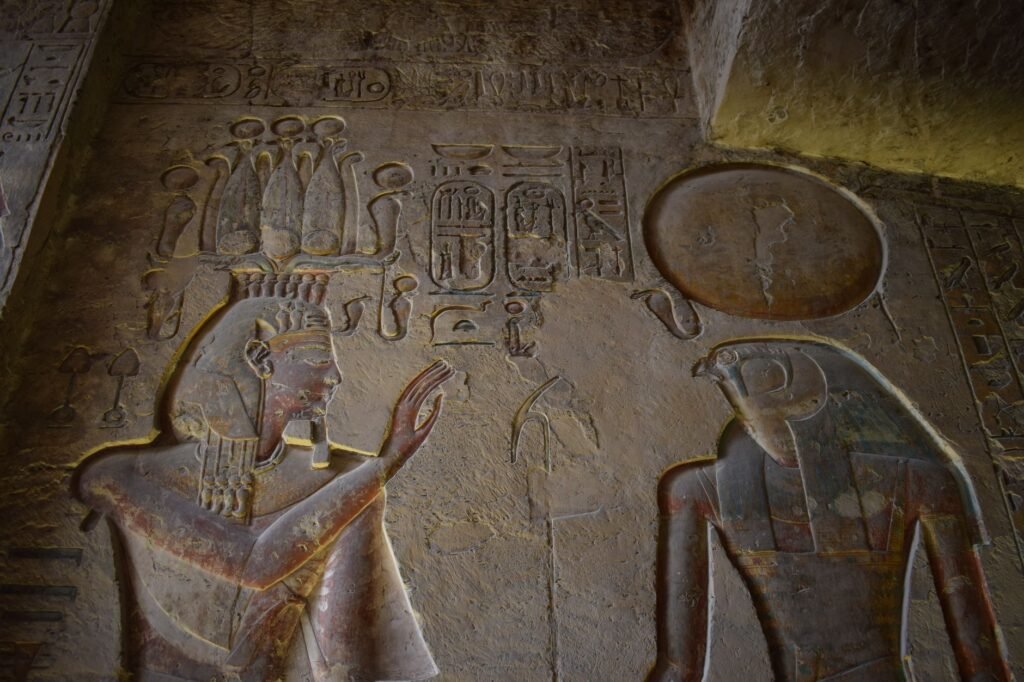
In temple contexts, Hathor was honored by priests and priestesses. Her sanctuaries were decorated with images of cows, sun disks, and ritual instruments. Temple walls often show her receiving offerings or participating in cosmic and royal scenes.
Everyday devotion
Hathor was also important in private religion. Women may have prayed to her for safe childbirth, family well-being, and beauty. Amulets, mirrors, and decorative objects linked with Hathor were common forms of personal devotion.
Ancient Sources
Hathor is known primarily through Egyptian sources rather than Greek literary narratives. However, later Greek and Roman writers, along with classical and archaeological evidence, help us understand her reception.
Egyptian primary sources
Important Egyptian evidence includes:
- Temple inscriptions and reliefs, especially at Dendera
- Pyramid Texts and Coffin Texts, where Hathor appears in funerary and cosmic roles
- Book of the Dead spells and images
- Papyrus texts and hymns
- Royal inscriptions that invoke Hathor’s protection
- Tomb scenes showing offerings, music, and the goddess of the west
Classical and later authors
Classical authors do not provide a single full account of Hathor comparable to Greek mythographers, but they sometimes refer to Egyptian deities through interpretatio graeca, identifying them with familiar figures.
Relevant ancient writers and traditions include:
- Herodotus, who describes aspects of Egyptian religion and ritual customs
- Plutarch, who discusses Egyptian theology in On Isis and Osiris, though his focus is not specifically Hathor
- Diodorus Siculus, who preserves some Hellenistic-era observations on Egypt
Because these authors wrote from Greek or Roman perspectives, their accounts must be used carefully. The best evidence for Hathor comes from Egyptian religious texts and archaeological remains.
Roman Equivalent
Hathor does not have a perfect Roman equivalent. She was sometimes compared with several Roman goddesses depending on which aspect was emphasized.
Possible Roman parallels
- Venus: for beauty, love, and sexuality
- Bona Dea: for feminine sacred power and fertility
- Juno: for protective, maternal, and royal associations
- Ceres in some fertility-related comparisons, though this is less direct
These are approximations rather than true one-to-one equivalents. In Roman Egypt, Hathor continued to be recognized in her own right, though her imagery could be interpreted through Greco-Roman religious ideas.
Influence on Modern Culture
Hathor remains a recognizable figure in modern culture, especially in works inspired by ancient Egypt.
Literature and art
Modern authors and artists often portray Hathor as:
- a goddess of beauty and sensuality
- a maternal protector
- a mystical sky cow or solar deity
- a symbol of ancient feminine power
Her imagery appears in books, illustrations, jewelry design, and decorative art inspired by Egyptian motifs.
Film and television
Hathor sometimes appears in documentaries, fantasy films, and television programs dealing with ancient Egypt, archaeology, or mythological themes. In popular storytelling, she may be simplified into a goddess of love or pleasure, though historical accounts are more complex.
Games and fantasy media
Video games and tabletop role-playing settings often use Hathor as:
- a divine patron of music or magic
- a desert or celestial goddess
- a healer or protector
- a powerful ancient deity with animal features
Popular symbolism
Her sistrum, cow horns, and sun disk are widely used in Egyptian-inspired design. Hathor also appears in modern spiritual movements that reinterpret ancient deities, though such uses are distinct from historical Egyptian religion.
Curiosities
Here are some lesser-known facts about Hathor:
- She is one of the few major Egyptian goddesses who could be depicted as both a gentle cow and a terrifying solar force.
- Her name, “House of Horus,” reflects a theological idea rather than a literal building.
- She was especially important to women, but also deeply connected to kingship and state ritual.
- Some ancient Egyptians called her “Lady of Turquoise” because of her Sinai cult.
- The temple at Dendera contains a famous zodiac ceiling associated with later Egyptian astronomical thought.
- Hathor could be linked with the dead without losing her identity as a goddess of joy and beauty.
- In Egyptian religion, a goddess could be many things at once; Hathor is one of the clearest examples of this flexibility.
Frequently Asked Questions
1. Who is Hathor in Egyptian mythology?
Hathor is an ancient Egyptian goddess associated with love, music, beauty, fertility, motherhood, protection, and the sky. She also has important roles in royal ideology and the afterlife.
2. Why is Hathor called the House of Horus?
Her Egyptian name means “House of Horus.” This title reflects her close connection to the god Horus, though the exact meaning varies by tradition and theological context.
3. What animal represents Hathor?
Hathor is most commonly represented as a cow or as a woman with cow horns and a sun disk. The cow symbolizes nourishment, motherhood, and the sky.
4. Is Hathor the same as Isis?
No. Hathor and Isis are separate goddesses, but they overlap in some roles, especially as maternal protectors and royal goddesses. In later periods, their imagery and functions sometimes became closely linked.
5. What is Hathor the goddess of?
Hathor is associated with love, joy, music, fertility, beauty, childbirth, protection, the sun, and aspects of the afterlife.
6. Where was Hathor worshipped?
She was worshipped throughout Egypt, especially at Dendera and Serabit el-Khadim in the Sinai. She also had cult connections in Thebes and other major centers.
7. What symbols are linked to Hathor?
Her major symbols include the cow horns and sun disk, the sistrum, the menat necklace, the mirror, and the cow itself.
8. Does Hathor have a dark or dangerous side?
Yes. In some myths she appears as a fierce and destructive solar goddess, especially in the traditions of the Eye of Ra. This duality is an important part of her character.
Conclusion
Hathor is one of the most significant goddesses in Egyptian mythology because she embodies both delight and power, gentleness and danger, motherhood and cosmic force. Her long history, broad cult, and rich symbolism made her central to ancient Egyptian religion at every level of society.
To ask who is Hathor in Egyptian mythology is to encounter a deity who cannot be reduced to a single function. She is a goddess of music and celebration, but also of kingship and the dead; a cow goddess of nourishment, but also a solar force capable of fierce protection. Her enduring importance lies in this versatility. Hathor reflects the Egyptian understanding that divine power could nurture life, preserve order, and transform the world in many interconnected ways.

Orin Vale has spent the better part of two decades tracing the threads that connect the world’s oldest stories — from the halls of Asgard to the banks of the Nile, from Olympus to the jungles of the Maya. What began as a childhood fascination with flood myths and trickster gods grew into years of independent study across comparative mythology and ancient religion, always chasing the same question: what did these stories mean to the people who first told them? Orin writes for readers who want more than trivia — the ones looking for the beliefs, fears, and truths that myths were built to carry.