Who Is Ammit in Egyptian Mythology?
In the rich world of ancient Egyptian belief, the afterlife was not simply a mysterious place where the dead continued their journey. It was a realm of judgment, truth, and moral reckoning. Among the many divine and supernatural beings associated with this process, Ammit stands out as one of the most fearsome.
So, who is Ammit in Egyptian mythology? Ammit was a terrifying creature connected to the judgment of the dead. She was not usually worshipped like major gods such as Osiris, Isis, or Ra. Instead, she served a specific and frightening role: she devoured the hearts of those judged unworthy in the afterlife.
Ammit’s Name and Meaning
The name Ammit is often translated as “Devourer” or “Eater of the Dead.” She is also sometimes called “Devourer of Hearts” or “Great of Death.” These names reflect her function in Egyptian mythology rather than a personality or independent mythology of her own.
Ammit was not considered a goddess in the same way as many other Egyptian deities. She did not have temples dedicated to her, and people did not typically pray to her for blessings. Instead, she represented a final and terrifying consequence for those who failed the moral test after death.
What Did Ammit Look Like?
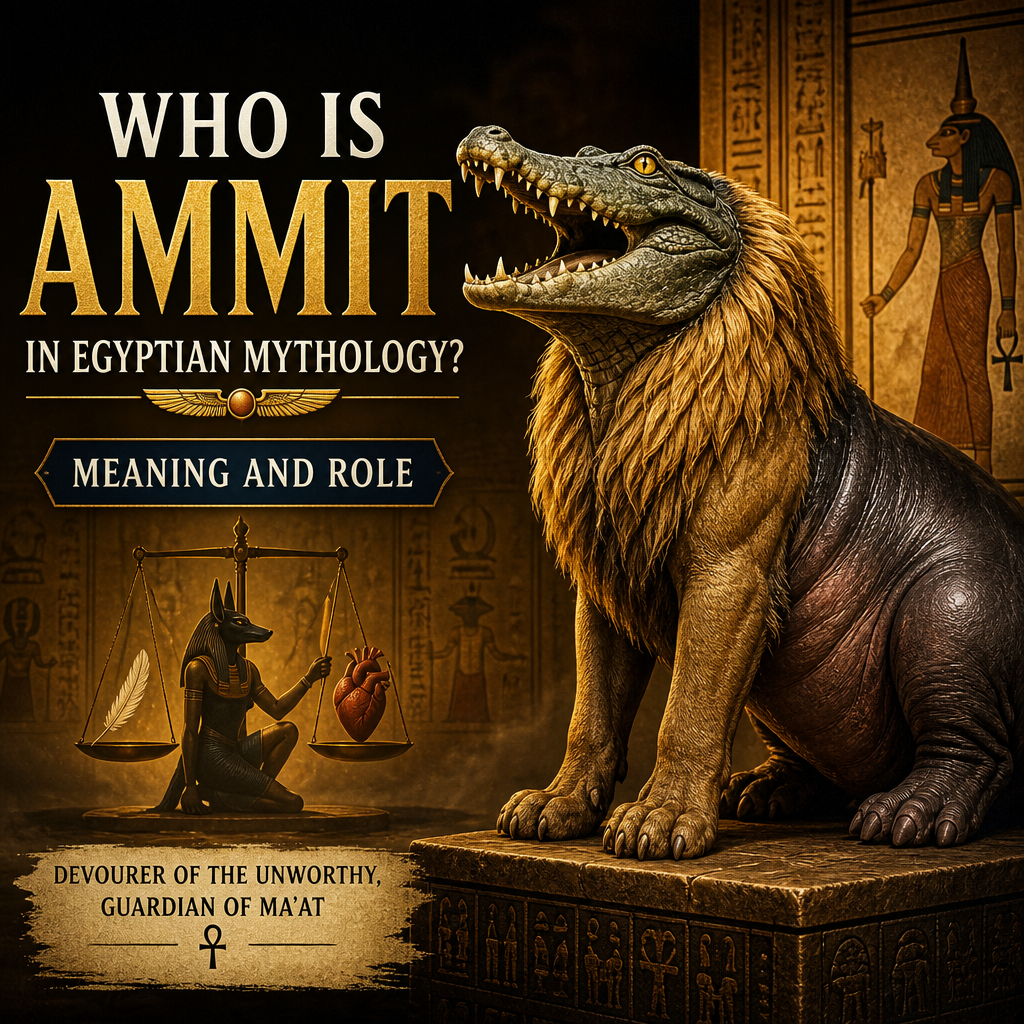
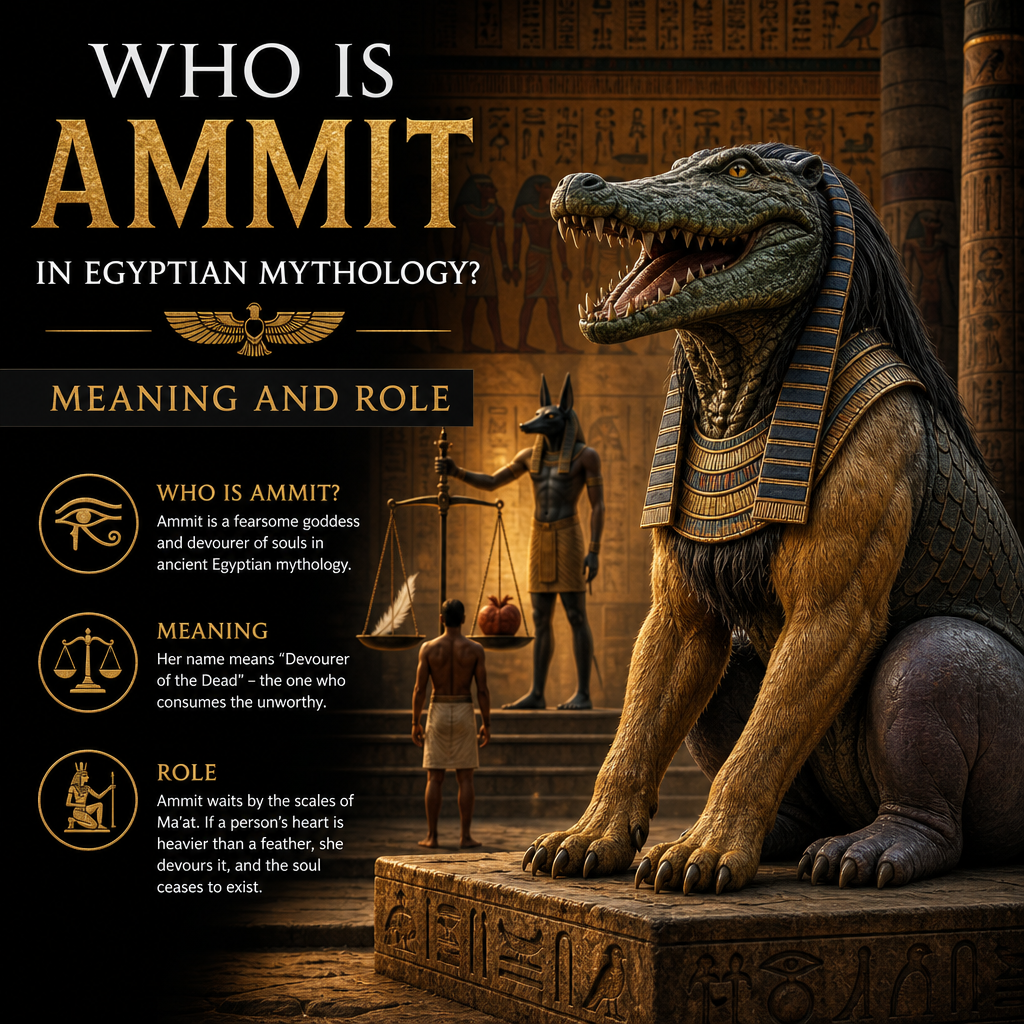
Ammit’s appearance was deliberately frightening. She was a composite creature made from parts of three dangerous animals known to the ancient Egyptians:
- The head of a crocodile
- The front body of a lion or leopard
- The hindquarters of a hippopotamus
Each of these animals was associated with danger and destructive power. Crocodiles were feared predators in the Nile. Lions symbolized ferocity and strength. Hippopotamuses, though sometimes associated with protective female deities like Taweret, could also be violent and deadly.
By combining these three animals, the Egyptians created an image of a monster that embodied fear, chaos, and punishment.
Ammit and the Weighing of the Heart
Ammit’s most important role appears in the famous scene known as the Weighing of the Heart. This ritual was described in funerary texts such as the Book of the Dead, a collection of spells and instructions meant to help the deceased navigate the afterlife.
In this judgment scene, the dead person’s heart was placed on a scale and weighed against the feather of Ma’at.
What Was Ma’at?
Ma’at was the Egyptian concept of truth, justice, balance, and cosmic order. She was also personified as a goddess, often shown with an ostrich feather on her head. To live according to Ma’at meant to live honestly, fairly, and in harmony with the world.
The heart was believed to contain a person’s thoughts, emotions, and moral character. If the heart was light and balanced with the feather, the person was judged righteous and allowed to enter the blessed afterlife.
If the heart was heavier than the feather, it meant the person had lived a life burdened by wrongdoing.
That is where Ammit appeared.
The Devourer of Unworthy Hearts
Ammit waited beside the scales during the judgment of the dead. If a person failed the test, she devoured their heart. This was not simply a physical punishment. In Egyptian belief, it meant the person was denied eternal life.
For the ancient Egyptians, the afterlife was a continuation of existence. To be destroyed by Ammit was one of the worst possible fates. It meant a kind of spiritual annihilation, sometimes described as a “second death.”
This made Ammit deeply feared. She was not evil in the way a villain might be evil in a modern story. Rather, she was part of the divine system of justice. Her role was to ensure that those who violated Ma’at could not enter the eternal paradise promised to the righteous.
Was Ammit a Goddess or a Monster?
One of the most interesting questions about Ammit in Egyptian mythology is whether she should be called a goddess or a monster. The answer depends on how the term is used.
Ammit had a supernatural role and appeared in religious texts and art. In that sense, she belonged to the divine world. However, she was not worshipped like a traditional deity. She had no major cult, no priesthood, and no known temples dedicated specifically to her.
Because of this, many scholars describe her as a demoness, monster, or divine creature rather than a full goddess. Still, she was closely connected with major gods of the afterlife, especially Osiris, Anubis, and Thoth.
Ammit’s Place Among the Afterlife Gods
In the judgment scene, Ammit was not alone. Several important figures appeared alongside her:
- Osiris, ruler of the underworld, presided over the judgment.
- Anubis, god of mummification and the dead, guided the deceased and often adjusted the scales.
- Thoth, god of wisdom and writing, recorded the result.
- Ma’at represented truth and cosmic balance through her feather.
Ammit’s role came at the end of this process. She did not decide guilt or innocence. Instead, she carried out the consequence if the judgment went badly.
Why Was Ammit Important?
Ammit’s importance lies in what she reveals about Egyptian ideas of morality. Ancient Egyptian religion was not only concerned with rituals and offerings. It also placed great value on ethical behavior.
The fear of Ammit reinforced the belief that actions in life mattered after death. A person could not simply rely on wealth, status, or burial rituals. They also needed to live in accordance with Ma’at.
In this way, Ammit symbolized accountability. Her presence reminded people that the afterlife was not guaranteed automatically. It had to be earned through a balanced and truthful life.
Ammit in Modern Culture
Today, Ammit continues to appear in books, games, films, and television inspired by ancient Egypt. Modern portrayals often exaggerate her into a villain, demon, or dark goddess. While these versions can be entertaining, they are not always accurate to ancient Egyptian belief.
In traditional mythology, Ammit was not a ruler of evil forces. She was a terrifying but necessary part of the afterlife judgment system. Her purpose was to maintain cosmic justice by destroying those who were unworthy of eternal life.
Conclusion
So, who is Ammit in Egyptian mythology? Ammit is the fearsome “Devourer of the Dead,” a supernatural creature who waited beside the scales during the judgment of the soul. With the head of a crocodile, the body of a lion, and the hindquarters of a hippopotamus, she embodied danger and divine punishment.
Her role in the Weighing of the Heart made her one of the most terrifying figures in the Egyptian afterlife. Yet Ammit was not simply a monster of chaos. She represented the serious moral order at the heart of Egyptian religion: those who lived against truth and balance could not pass into eternity.

Orin Vale has spent the better part of two decades tracing the threads that connect the world’s oldest stories — from the halls of Asgard to the banks of the Nile, from Olympus to the jungles of the Maya. What began as a childhood fascination with flood myths and trickster gods grew into years of independent study across comparative mythology and ancient religion, always chasing the same question: what did these stories mean to the people who first told them? Orin writes for readers who want more than trivia — the ones looking for the beliefs, fears, and truths that myths were built to carry.