Celtic mythology’s sacred symbols range from the legendary treasures of the Tuatha Dé Danann to sacred trees and animals woven throughout Irish, Welsh, and continental tradition. This guide brings together the essential symbols of the Celtic world — and separates genuine ancient tradition from later folk and revival symbols often mistaken for it.
The Four Treasures of the Tuatha Dé Danann
Cauldron of the Dagda
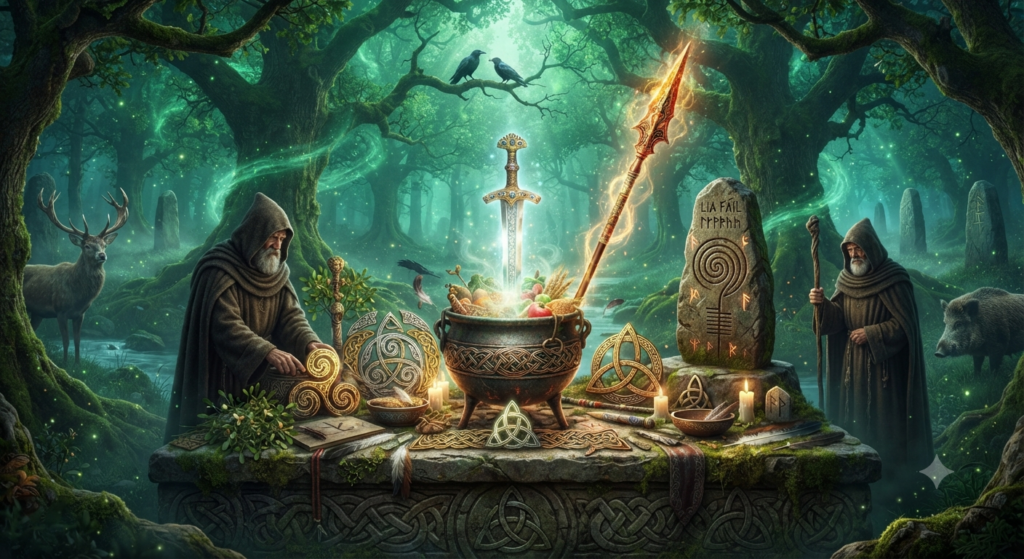
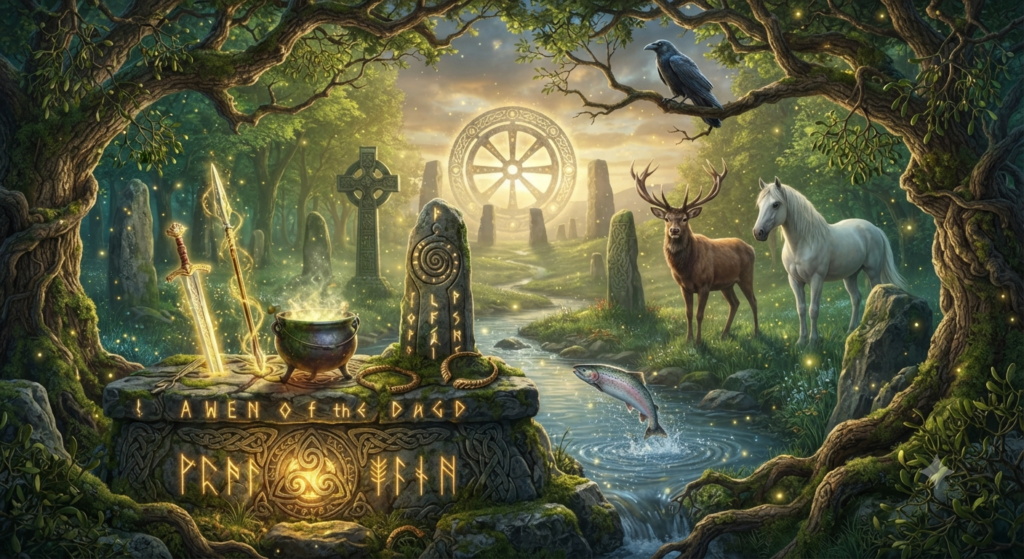
One of the legendary Four Treasures brought by the Tuatha Dé Danann, the Dagda’s cauldron never emptied and could satisfy any number of guests, symbolizing endless abundance and generous hospitality.
Sword of Nuada (Sword of Light)
The Sword of Nuada, one of the Four Treasures of the Tuatha Dé Danann, was said to be so unstoppable that no enemy could escape it once drawn from its sheath.
Spear of Lugh
The Spear of Lugh, another of the Four Treasures, guaranteed victory to whoever wielded it in battle, and was said to strain so eagerly for combat that it had to be kept soaked in a cauldron of water to restrain it.
Stone of Fal (Lia Fáil)
The Stone of Fal, the last of the Four Treasures, was said to cry out loudly when touched by the rightful king of Ireland, serving as a divine test of legitimate sovereignty at the Hill of Tara.
Sacred Symbols and the Written Word
Triskele (Triskelion)
The triskele, a three-armed spiral found carved at ancient sites like Newgrange, is believed to have symbolized concepts of movement, progress, or the threefold nature found throughout Celtic thought.
Triquetra
The triquetra, a three-lobed knot, is a widely recognized Celtic design associated with threefold concepts, later widely adopted in Christian art to represent the Holy Trinity.
Celtic Cross
The Celtic cross, combining a traditional cross with an encircling ring, emerged during Ireland’s early Christian period, blending Christian symbolism with earlier Celtic artistic traditions.
Celtic Knotwork
Celtic knotwork, with its unbroken interwoven lines, appears throughout medieval Celtic art and manuscripts, often interpreted as representing the interconnectedness and continuity of life.
Awen
The Awen, a symbol of three converging rays representing poetic inspiration, is closely associated with Welsh bardic tradition, though its familiar visual form was popularized in the eighteenth century rather than surviving directly from antiquity.
Ogham Alphabet
The Ogham alphabet, Ireland’s earliest known writing system, was traditionally credited to the god Ogma and consisted of simple notched lines carved along the edges of standing stones.
Status, Protection, and Folk Symbols
Torc
The torc, a rigid twisted metal neck ring, symbolized nobility, warrior status, and divine favor throughout the Celtic world, worn by chieftains and depicted on deities in Celtic art.
Claddagh
The Claddagh symbol, showing hands clasping a crowned heart, represents love, loyalty, and friendship, though it originated as a seventeenth-century Irish folk tradition rather than an artifact of ancient Celtic mythology.
Green Man
The Green Man, a face formed from or surrounded by leaves, appears widely in medieval European architecture and is often associated with Celtic nature worship, though its precise origins and connection to specific ancient Celtic deities remain uncertain among scholars.
Sheela na Gig
Sheela na Gigs are figurative stone carvings found on many medieval churches and castles across Ireland and Britain, generally interpreted as protective or apotropaic figures, though their exact original meaning remains debated among scholars.
Wheel of Taranis
The wheel associated with the continental Celtic god Taranis symbolized the sun and thunder, frequently appearing on Gaulish coins, altars, and votive offerings across ancient continental Europe.
Sacred Trees and Plants
Mistletoe
According to the Roman writer Pliny the Elder, druids considered mistletoe found growing on oak trees especially sacred, ceremonially harvesting it with a golden sickle as part of important ritual practice.
Sacred Oak Tree
The oak tree held special sacred status in Celtic tradition, closely associated with druidic ritual, strength, and endurance, with sacred groves of oak trees serving as important religious sites.
Sacred Yew Tree
The yew tree, remarkably long-lived and evergreen, was closely associated with death, eternity, and the boundary between worlds in Celtic tradition, often planted near sacred and burial sites.
Sacred Hazel Tree
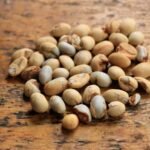
In Irish mythology, sacred hazel trees grew beside the mystical Well of Segais, dropping nuts of wisdom into the water below that were later consumed by the legendary Salmon of Knowledge.
Sacred Animals
Sacred Boar
The boar symbolized strength, ferocity, and warrior status throughout Celtic culture, prominently featured in feasting traditions and in tragic myths such as the death of the hero Diarmuid.
Sacred Stag
The stag, with its impressive antlers, symbolized the untamed wilderness and was closely associated with horned deities such as the continental Celtic god Cernunnos.
Sacred Horse
The horse held deep symbolic importance across Celtic culture, closely linked to sovereignty, fertility, and goddesses such as the continental Epona and the Welsh Rhiannon.
Sacred Raven
The raven symbolized war, death, and prophecy in Celtic tradition, closely associated with the goddess Morrigan and believed to foretell the outcome of battles through its presence and cries.
Salmon of Knowledge
The Salmon of Knowledge gained all the world’s wisdom by eating hazelnuts that fell from the sacred trees around the Well of Segais, later passing that wisdom to the hero Fionn mac Cumhaill through a single accidental taste.
Clarifications and Distinctions
Difference Between the Celtic Cross and the Christian Cross
The Celtic cross’s distinctive ring, absent from the standard Christian cross, is generally understood as a blend of earlier Celtic circular symbolism with the imported Christian cross following Ireland’s conversion.
Is the Awen an Authentic Ancient Celtic Symbol?
While the concept of Awen as poetic inspiration is genuinely rooted in medieval Welsh bardic tradition, its familiar three-ray visual symbol was created by the eighteenth-century Welsh scholar Iolo Morganwg rather than surviving from ancient Celtic sources.
Triskele vs. Triquetra
Though both are three-part Celtic symbols, the triskele consists of three spiraling arms radiating from a center, while the triquetra is formed from a single continuous interlocking line — two visually distinct designs often confused with one another.
Is the Claddagh Ring Part of Celtic Mythology?
The Claddagh ring is a genuine and cherished piece of Irish folk tradition dating to the seventeenth century, but it is not connected to ancient Celtic mythology or the pre-Christian Celtic pantheon.
Is the Green Man a Celtic Symbol?
Though widely associated with Celtic nature worship in popular imagination, the Green Man motif is documented primarily in medieval Christian church architecture across Europe, and its direct connection to specific ancient Celtic deities remains unproven.
Frequently Asked Questions
What is the most important symbol in Celtic mythology?
The Four Treasures of the Tuatha Dé Danann are often considered the most mythologically significant symbols, representing sovereignty, abundance, and invincible power.
Are most popular “Celtic” symbols actually ancient?
Not always — several widely recognized symbols today, including the Awen and the Claddagh, actually originate from later medieval or early modern periods rather than surviving directly from pre-Christian Celtic antiquity.
Why are trees so important in Celtic symbolism?
Trees like the oak, yew, and hazel held deep spiritual significance in Celtic tradition, connected to druidic ritual, sacred groves, wisdom, and the boundary between the mortal and Otherworldly realms.
What animals were most sacred to the Celts?
The horse, stag, raven, and boar held particularly strong symbolic and religious significance, each associated with specific deities, seasonal cycles, or aspects of warrior culture.
Did every Celtic region use the same symbols?
No — symbolism varied significantly between Irish, Welsh, and continental Gaulish traditions, though certain themes like sacred trees, animals, and threefold designs appear widely across the Celtic world.
What is the significance of the number three in Celtic symbolism?
Threefold patterns, seen in symbols like the triskele and triquetra and in triple goddesses like the Morrigan, reflect a recurring emphasis on triads throughout Celtic religious and artistic thought.
How did Christianity influence Celtic symbols?
Following Ireland’s conversion, many Celtic symbols and artistic traditions were adapted into Christian art, most visibly in the Celtic cross and the interlace patterns found in illuminated manuscripts.
Do Celtic symbols still appear in modern culture?
Yes — symbols like the triskele, triquetra, and Celtic knotwork remain widely popular today in jewelry, tattoos, and design, valued both for their aesthetic beauty and their connection to Celtic heritage.

Orin Vale has spent the better part of two decades tracing the threads that connect the world’s oldest stories — from the halls of Asgard to the banks of the Nile, from Olympus to the jungles of the Maya. What began as a childhood fascination with flood myths and trickster gods grew into years of independent study across comparative mythology and ancient religion, always chasing the same question: what did these stories mean to the people who first told them? Orin writes for readers who want more than trivia — the ones looking for the beliefs, fears, and truths that myths were built to carry.