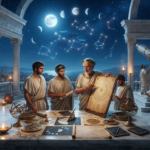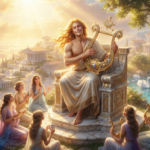
The question of who is Astraea, the Greek goddess of justice? leads us to a luminous figure who bridges the celestial and the ethical, embodying the ancient Greek ideal of a world governed by righteousness. Astraea (Ἀστραία), whose name means “starry one” or “star-maiden,” was the virgin goddess of justice, innocence, purity, and precision . She is most famous for her poignant departure from Earth, representing the loss of divine justice from a corrupt humanity, before being immortalized in the stars as the constellation Virgo . Closely associated with another justice goddess, Dike, Astraea’s story is a powerful allegory of the decline of human virtue from a utopian Golden Age to the harsh realities of the Iron Age . This article will serve as a definitive guide to Astraea, exploring her origins, her role in the Ages of Man, her family, her symbols, and her enduring legacy.
Origins and Family of Astraea
Astraea’s genealogy is notable for its dual tradition, with ancient writers presenting two distinct parentages. This duality often reflects the Greek practice of connecting a goddess’s function to the most appropriate divine parents.
The Celestial Parentage
According to one prominent tradition, Astraea is the daughter of the Titan Astraeus, the god of dusk and the stars, and Eos, the goddess of the dawn . This lineage is most famously recorded by the astronomer-poet Aratus and the mythographer Hyginus . This parentage is particularly fitting, as it directly links Astraea to the very fabric of the heavens. Her name shares an etymology with her father’s, both deriving from the Greek word astēr, meaning “star” . In some accounts, she is also said to be the sister of the Anemoi (the Winds) and the stars, making her a truly celestial being .
The Olympian Parentage
Alternatively, Astraea is identified with Dike, the goddess of justice, and is made the daughter of Zeus, the king of the gods, and Themis, the Titan goddess of divine law and order . This genealogy, preserved by writers like Hyginus, aligns her with the established Olympian order and the concept of justice as a fundamental law of the cosmos . When considered as the daughter of Zeus and Themis, she becomes a sister to other Horae (goddesses of the seasons and order), including Eunomia (Good Order) and Eirene (Peace) . This parentage emphasizes her role as a divine arbiter of justice within the cosmic and social spheres.
Astraea and the Ages of Man
The central myth of Astraea is her sojourn among humans and her subsequent departure, a narrative that explains her presence in the sky as the constellation Virgo.
The Golden Age
According to this myth, during the idyllic Golden Age, Astraea lived among mortals on Earth . This was a time of perfect peace and prosperity, where there was no strife, war, or hatred, and humanity lived in a state of virtue and honor . The goddess, an immortal among mortals, urged people to be kind to one another, and they enjoyed a life free from the hardships that would later plague humanity. In this pre-seafaring era, the earth provided its bounty without the need for toil or conflict . Astraea, also known as Dike in this context, was the divine force that maintained this utopian order.
The Departure from Earth
As the ages of man progressed into the Silver Age, humanity began to lose its virtue . Astraea, dissatisfied, withdrew to the hills and mountains, speaking to people with less gentle words and threatening them with divine retribution for their wrongdoings . By the time the Bronze Age arrived, humanity had degenerated further, succumbing to war, hatred, corruption, and greed . The advent of the Iron Age brought even greater suffering, as people abandoned honor and love, and they began to dig up the earth in search of gold and iron . Finally, the goddess could no longer bear to witness humanity’s wickedness. She abandoned the earth and flew to the heavens, taking her place among the stars as the constellation Virgo (the Maiden) . The bright star Spica, which sits in the constellation, represents the ear of corn she holds, a symbol of her former role in the Golden Age .
This story, while rooted in the works of the 8th-century BCE poet Hesiod, was greatly expanded upon by later poets such as Aratus and Ovid, solidifying the narrative of Astraea as the last of the immortals to leave a wicked Earth . She serves as a powerful symbol of the loss of divine justice and innocence from the world.
Astraea, Dike, and Nemesis
Astraea was deeply connected with other figures of justice, to the point of being conflated with them. She is most frequently identified with Dike, the goddess of justice and the spirit of moral order . Indeed, many ancient authors alternated between referring to her as Astraea or Dike . In this capacity, as Dike, she is also called Iustitia, the name of the Roman goddess of justice .
Furthermore, Astraea is also linked to Nemesis, the goddess of divine retribution and righteous indignation. While Nemesis represented the punishing aspect of justice, Astraea personified the ideal state of justice itself . The three goddesses—Astraea, Dike, and Nemesis—formed a triad that represented the full spectrum of justice: the ideal of innocence and fairness, the enforcement of moral order, and the punishment of those who transgressed it. The poet Hesiod prophesied that Nemesis and Aidos (the goddess of humility) would also abandon the earth at the end of the Iron Age .
Symbols and Iconography
Astraea’s attributes in art reflect her dual nature as a goddess of justice and a starry celestial being.
- The Scales of Justice: A symbol of justice and impartiality, which she shares with her counterpart Dike and the Roman Justitia .
- The Crown of Stars: A symbol of her celestial nature and her name as the “star-maiden,” often depicted in art and described in literature .
- The Ear of Corn: A symbol of her association with the abundance of the Golden Age, and most famously represented in the sky as the star Spica in the constellation Virgo .
- A Flaming Torch and Wings: Sometimes depicted with these attributes, particularly when she is shown as the goddess Astrape (“Lightning”) who stands beside the throne of Zeus as an implement of divine justice .
Astraea’s Legacy: The Return of the Golden Age
Astraea’s myth became a powerful political and cultural symbol, particularly in the Roman era. The poet Virgil, in his 1st-century BCE work the Eclogues, used the legend of Astraea’s return to announce the coming of a new Golden Age under the rule of Augustus . He wrote that “Justice returns, returns old Saturn’s reign,” heralding a time of peace and prosperity . This idea of Astraea’s return served as a potent image of hope, representing the restoration of a righteous and harmonious world.
The goddess’s legacy continues to be felt today. Her name is borne by the main-belt asteroid 5 Astraea, discovered in 1845 . In modern literature, art, and popular culture, she remains a symbol of justice, purity, and the eternal hope for a better world. She is frequently invoked as a figure of hope and righteousness, representing the potential for good in humanity .
Frequently Asked Questions About Who is Astraea, the Greek goddess of justice?
Who were the parents of Astraea?
Astraea has two differing genealogies. In one, she is the daughter of the Titan Astraeus and Eos. In the other, she is the daughter of Zeus and Themis .
What is the meaning of the name Astraea?
Her name, derived from the Greek word astēr meaning “star,” translates to “starry one” or “star-maiden” .
Why did Astraea leave Earth?
Astraea left Earth because of the growing wickedness and corruption of humanity, particularly during the Bronze and Iron Ages. She abandoned the mortal realm to live among the stars as the constellation Virgo .
What is the connection between Astraea and the constellation Virgo?
In myth, when Astraea fled the earth due to humanity’s corruption, she was placed among the stars as the constellation Virgo, which is also known as the Maiden . The star Spica represents the ear of corn she holds .
Is Astraea the same as Dike?
Astraea was often conflated and treated as interchangeable with Dike, the goddess of justice . Dike is one of the several goddesses identified with the Virgo constellation, and in this role, she is often called Astraea .
What are the symbols of Astraea?
Her symbols include the scales of justice, a crown of stars, and an ear of corn . She is sometimes also depicted with a flaming torch and wings .
What is Astraea’s legacy?
Astraea is a symbol of hope, justice, and purity. Her myth of the departing Golden Age was later used as a symbol of a hoped-for return to a virtuous era, most notably by Virgil . Her legacy continues in astronomy (asteroid 5 Astraea) and in modern art and literature .
Conclusion
Astraea, the Greek goddess of justice, is a figure of profound beauty and melancholic significance. The question of who is Astraea, the Greek goddess of justice? reveals a celestial maiden whose story is a powerful allegory for the ancient Greek understanding of virtue, decline, and hope. As the virgin goddess who lived among mortals during a utopian Golden Age, she embodied the ideal of a just and innocent world . Her departure from a wicked humanity marks the end of divine harmony on Earth, yet her placement among the stars as the constellation Virgo ensures that her memory, and the dream of justice, endures . Conflated with Dike and Nemesis, she represents the full spectrum of moral order . Her legacy, from Virgil’s prophecies of her return to the modern naming of an asteroid, continues to inspire hope for a world where innocence and justice prevail . Astraea is not just a myth; she is a symbol of the eternal human aspiration for a better world.

Orin Vale has spent the better part of two decades tracing the threads that connect the world’s oldest stories — from the halls of Asgard to the banks of the Nile, from Olympus to the jungles of the Maya. What began as a childhood fascination with flood myths and trickster gods grew into years of independent study across comparative mythology and ancient religion, always chasing the same question: what did these stories mean to the people who first told them? Orin writes for readers who want more than trivia — the ones looking for the beliefs, fears, and truths that myths were built to carry.