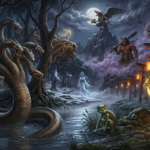
Culhwch and Olwen
Introduction

Culhwch and Olwen is one of the best-known early Welsh prose tales associated with the Mabinogion. It survives in medieval manuscripts and is widely valued as one of the oldest Arthurian narratives in any language. The story combines heroism, impossible tasks, supernatural helpers, and a distinctly Welsh vision of Arthur’s court. It is especially important because it preserves early material about King Arthur, Welsh mythology, and the literary culture of medieval Wales.
Unlike later Arthurian romances, Culhwch and Olwen is not mainly a courtly love story. It is a vast adventure tale in which a young hero, Culhwch, is forced to perform a series of extraordinary quests in order to win the beautiful Olwen. The tale is famous for its immense cast of characters, its humorous tone, and its preservation of archaic mythological features.
Origin and Meaning
The title refers to the two central figures:
- Culhwch: the hero
- Olwen: the maiden he seeks to marry
The name Culhwch is usually connected with Welsh linguistic elements, though its precise etymology is not completely certain. Olwen is generally interpreted as meaning “white footprint” or “white track,” from Welsh ol (“track, footprint”) and gwyn/gwyn in a mutated form traditionally associated with whiteness. In the tale, this meaning is reflected in her description: wherever she walks, white flowers appear beneath her feet.
The story probably took shape in medieval Wales, though it likely preserves older oral material. It is usually dated to the 11th or 12th century in the form in which it survives, though some of its contents may be older. The text is found in manuscripts that also preserve other Welsh tales and Arthurian material.
Historical Context
Culhwch and Olwen belongs to the world of medieval Welsh literature, a culture in which heroic legend, genealogy, oral tradition, and learned storytelling were deeply interconnected. The tale was transmitted in written form by medieval scribes, but it likely reflects older oral narrative traditions.
Several historical and cultural contexts shaped the story:
Welsh literary culture
Medieval Welsh storytellers preserved tales of heroes, kings, and supernatural beings. These narratives often mixed:
- heroic adventure
- mythological figures
- kinship and genealogy
- marvels and transformations
- courtly and social ideals
The Arthurian tradition
The tale is one of the earliest surviving Arthurian stories. In it, Arthur is not yet the fully developed medieval king of later French and English romances. Instead, he appears as a powerful leader surrounded by warriors, retainers, and supernatural helpers.
Myth and folklore
The tale retains many features that seem older than medieval romance, including:
- giant adversaries
- magical boars
- enchanted objects
- impossible hunting tasks
- the assistance of named specialists and warriors
These elements suggest a narrative shaped by older Celtic storytelling patterns.
Main Characteristics
Culhwch and Olwen is distinctive for several reasons:
1. Enormous cast of characters
The tale includes a remarkable number of named figures, many of them members of Arthur’s court or linked to Welsh tradition. This makes it one of the richest early sources for Arthurian and Welsh heroic names.
2. Quest structure
The plot is driven by a quest: Culhwch must complete difficult and often absurdly dangerous tasks in order to win Olwen. These tasks are so numerous that the tale reads almost like a catalogue of impossible labours.
3. Humor and exaggeration
The story often uses comic excess. The tasks are exaggerated, the lists are long, and the action can be playful even when violent.
4. Mythological depth
Many characters and episodes seem rooted in older myth, especially the conflict involving Ysbaddaden Bencawr, the giant father of Olwen.
5. Early Arthurian form
Arthur is a central figure, but the tale presents him as part of a wider heroic world rather than as the idealized king of later literature.
Family and Genealogy
The tale is unusually attentive to kinship and ancestry, though different versions and traditions may vary in emphasis.
Culhwch
Culhwch is the son of Cilydd and Goleuddydd. After his mother’s death, his father remarries, and Culhwch’s stepmother tries to manipulate dynastic succession in favor of her own son. When Culhwch refuses to marry the woman chosen for him, she places a curse on him, leading him to seek Olwen.
Olwen
Olwen is the daughter of Ysbaddaden Bencawr, a giant or monstrous father figure. Her mother is not a major figure in the surviving tale.
Ysbaddaden Bencawr
Ysbaddaden is Olwen’s father and the chief obstacle to the marriage. He is a giant whose death is foretold if Olwen marries. This makes him a classic “blocking father” in folktale terms, but he is also a mythic and monstrous antagonist.
Arthur’s wider kin and companions
Arthur’s court includes numerous figures who are sometimes presented as companions, allies, or retainers. The exact relationships among these figures vary in other Welsh and Arthurian traditions.
Symbols
The tale is not organized around a single symbolic system, but several recurring symbols are important.
White footprints and flowers
Olwen’s name and appearance are strongly symbolic. As she walks, white flowers grow beneath her feet, marking her as a figure of beauty, purity, and otherworldly distinction.
The giant’s weapons and possessions
Ysbaddaden’s comb, razor, and shears are mentioned in connection with his grooming before his death. These objects appear in the tale as both practical and symbolic, marking his status as a powerful but doomed being.
The boar and the hunt
The boar is a major symbolic creature in Celtic and medieval literature. In this tale, the hunting of the monstrous boar Twrch Trwyth becomes one of the most famous impossible tasks. The boar represents danger, chaos, and the test of heroic endurance.
The cauldron and magical objects
Like many early Celtic narratives, the tale includes enchanted or marvellous objects, reinforcing the idea that the world of the story is one in which the supernatural is ordinary.
Sacred Animals
The tale features several animals of mythic or symbolic importance.
The boar
The most important animal is Twrch Trwyth, a magically transformed boar that must be hunted across Britain and beyond. Boars in Celtic tradition often symbolize:
- ferocity
- royal power
- hunting prestige
- otherworldly danger
Dogs and hunting animals
Dogs appear in the context of the hunt and heroic tracking. In medieval and Celtic literature, hunting dogs often symbolize loyalty, skill, and aristocratic pursuit.
Birds and other creatures
While not the central focus of the tale, birds and other animals appear in passing in the broader Welsh mythological world, where animals often serve as messengers, signs, or symbols of the otherworld.
Sacred Plants
Culhwch and Olwen is not structured around a formal sacred plant tradition, but plants play an important descriptive role.
White flowers
The best-known plant image is the white flowers that bloom where Olwen steps. This image is central to her identity and is one of the most memorable motifs in the tale.
Vegetation and landscape
The story frequently presents the natural world as responsive to supernatural beings and heroic action. While specific sacred plants are not systematically emphasized, the tale participates in a wider Celtic literary sensitivity to landscape, growth, and transformation.
Sacred Places
The tale names many places, some of which are precise locations in Wales or Britain, while others are legendary.
Arthur’s court
Arthur’s court functions as a central gathering place of heroes and specialists. It is not described in the same fixed way as later literary courts, but it serves as the political and narrative center of the tale.
Ysbaddaden’s stronghold
Ysbaddaden’s dwelling is the destination of Culhwch’s quest and the place where the final confrontation occurs. It is a hostile, liminal space associated with the giant’s power.
Britain as a heroic landscape
The story moves through a wide heroic geography that includes hunting grounds, rivers, and legendary sites. In many episodes, the landscape itself is part of the challenge.
Specific places and uncertain identifications
Some locations mentioned in the tale can be linked loosely to real or traditional places in Wales and Britain, but exact identifications are often uncertain and should not be overstated.
Powers and Attributes
Culhwch and Olwen are not deities, so they are not associated with divine powers in the strict sense. However, the tale gives them and other figures notable attributes.
Culhwch
Culhwch is characterized by:
- determination
- loyalty in love
- heroic persistence
- willingness to seek aid
He is not presented as a flawless warrior, but as a questing hero whose success depends on support from Arthur’s court.
Olwen
Olwen’s chief attributes are:
- extraordinary beauty
- symbolic whiteness
- a connection to flowers and renewal
- the status of a prize in the narrative
She is less active than Culhwch in the plot, but she remains central to the tale’s meaning.
Ysbaddaden
Ysbaddaden embodies:
- monstrous fatherhood
- hostile guardianship
- prophetic inevitability
- violent resistance to marriage
He is powerful, but his power is limited by fate.
Arthur and his men
Arthur’s court is characterized by:
- martial ability
- resourcefulness
- collective cooperation
- the capacity to aid in impossible tasks
Main Myths
The tale contains several interwoven mythic episodes.
The cursed marriage quest
Culhwch falls under a curse that directs him toward Olwen. The marriage is blocked by Ysbaddaden, who sets a series of impossible conditions. This is a familiar folktale pattern: a hero must complete great deeds to win a bride.
The gathering at Arthur’s court
Culhwch goes to Arthur, who accepts him and sends messengers to gather aid. This episode establishes Arthur as a leader able to summon the heroic community.
The impossible tasks
Ysbaddaden requires Culhwch to complete numerous tasks, including obtaining tools, hunting beasts, and performing feats requiring help from specialists. The list is one of the tale’s most famous features.
The hunt of Twrch Trwyth
The hunt for the boar Twrch Trwyth is a major mythic episode. It spans large distances and requires the cooperation of many figures. The boar’s pursuit is one of the oldest and most important legendary hunts in Welsh tradition.
The final confrontation
After the tasks are completed, Culhwch and his allies confront Ysbaddaden. The giant is overcome, and Olwen is won. The ending completes the heroic pattern of impossible labour and triumphant union.
Relationship with Other Mythological Figures
The tale is densely connected to the wider Welsh mythological and Arthurian world.
Arthur
Arthur is the most important external figure in the tale. He is not merely a background king; he is an active organizer and supporter of Culhwch’s quest.
Kai and Bedwyr
Kai (Cei) and Bedwyr are among Arthur’s best-known companions in Welsh tradition. They appear as prominent members of the court and are associated with martial skill and service.
Gwrhyr Gwalstawd Ieithoedd
This figure, whose name suggests mastery of languages, reflects the tale’s interest in specialist knowledge and unusual talents.
Mabon ap Modron
Mabon is one of the most famous mythic figures in the tale. He is a mysteriously lost child or youth who must be found to help with the quest. His rescue is one of the tale’s most ancient-feeling mythic episodes.
Twrch Trwyth
The boar is itself almost a mythic personage. In some traditions, it may preserve the memory of a transformed or enchanted being.
Worship and Cult
There is no evidence that Culhwch and Olwen itself was an object of worship, nor that its characters were worshipped in a historical religious cult. It is a literary narrative, not a sacred text in the sense of a liturgy or mythology tied to formal ritual.
However, the tale may preserve echoes of older beliefs and practices:
- hunting prestige in aristocratic culture
- the importance of kinship and marriage alliances
- reverence for heroic ancestry
- mythic memory of otherworldly beings and transformations
Any claim that specific rituals were historically performed for Culhwch, Olwen, or Arthur would go beyond the evidence.
Ancient Sources
The tale survives in medieval Welsh manuscript tradition rather than in classical Greek or Roman authors. The most important primary sources are:
| Source | Significance |
|---|---|
| The White Book of Rhydderch | One of the principal manuscripts preserving early Welsh prose tales |
| The Red Book of Hergest | Major manuscript witness for the Mabinogion material |
| Later Welsh versions and parallels | Help show how the tale circulated and developed |
Although the prompt refers to classical authors such as Homer or Ovid, they are not sources for this tale. Culhwch and Olwen belongs to Welsh medieval literature, not the classical Mediterranean canon. That said, scholars sometimes compare its structure to heroic quests and impossible tasks in other ancient traditions.
Roman Equivalent
There is no direct Roman equivalent to Culhwch, Olwen, or the tale itself. The story is specifically Welsh and Celtic in origin and transmission.
If a broader comparison is useful, it may be noted that Roman literature contains tales of:
- heroic quests
- love trials
- divine or monstrous opposition
- transformation and pursuit
But these are analogies, not true equivalents. The tale’s closest literary relatives are other Welsh stories and later Arthurian romances, rather than Roman adaptations.
Influence on Modern Culture
Culhwch and Olwen has had a significant influence on the study and imagination of Arthurian literature and Welsh mythology.
Literature and scholarship
The tale is foundational for scholars interested in:
- early Arthurian legend
- medieval Welsh prose
- Celtic mythological survivals
- comparative folklore
- narrative structure in heroic literature
It is frequently discussed in academic studies of the Mabinogion and Arthurian origins.
Modern retellings and adaptations
The story has inspired retellings in:
- modern fantasy literature
- Welsh-language literary revival
- children’s books and abridged myth collections
- academic and popular introductions to Celtic myth
Art and illustration
Illustrators and artists have been drawn to the tale’s vivid images:
- Olwen’s white footprints
- the giant Ysbaddaden
- the hunt of Twrch Trwyth
- Arthur’s bustling court
Popular culture
While not as globally famous as later Arthurian works, the tale contributes indirectly to the modern image of Arthurian Britain found in:
- fantasy novels
- role-playing games
- comics
- television adaptations drawing on Celtic myth
- museum and heritage presentations about Wales
Its importance is often strongest in contexts that emphasize the older, more mythic Arthur rather than the later chivalric king.
Curiosities
A tale of lists
One of the most unusual features of Culhwch and Olwen is its long sequence of named helpers, tasks, and objects. It can feel almost encyclopedic, as though preserving a world of traditional knowledge.
Arthur is secondary to the quest
Although Arthur is central, the story is not simply “about Arthur.” Instead, Arthur’s role is to support the hero’s mission. This makes the tale different from many later Arthurian romances.
A giant with a prophetic fate
Ysbaddaden knows that his death is tied to Olwen’s marriage. This makes him both powerful and tragically doomed, an antagonist who cannot escape destiny.
One of the earliest Arthurian texts
The tale is often cited as one of the earliest substantial Arthurian narratives, making it crucial for understanding how the legend developed before the French romances.
A blend of comedy and seriousness
The story can be violent and grand, but it also contains comic exaggeration. This combination is one reason it remains so striking to modern readers.
Frequently Asked Questions
1. What is Culhwch and Olwen about?
It is a Welsh medieval tale in which Culhwch seeks to marry Olwen, the daughter of a giant, and must complete a series of impossible tasks with Arthur’s help.
2. Is Culhwch and Olwen part of the Mabinogion?
Yes. It is commonly included among the tales known as the Mabinogion, though that label is a modern convention for a group of medieval Welsh prose narratives.
3. Is Arthur a major character in the story?
Yes. Arthur plays an important supporting role and helps organize the quest, though Culhwch is the main hero.
4. What makes the tale important?
It is one of the oldest surviving Arthurian stories and a major source for medieval Welsh mythology, heroic tradition, and early prose literature.
5. Who is Olwen?
Olwen is the heroine sought by Culhwch. Her name is associated with whiteness, and white flowers are said to bloom where she walks.
6. Who is Ysbaddaden?
Ysbaddaden Bencawr is Olwen’s giant father and the main obstacle to her marriage. He sets the tasks Culhwch must complete and is ultimately defeated.
7. What is Twrch Trwyth?
Twrch Trwyth is a monstrous boar hunted as part of Culhwch’s quest. The boar hunt is one of the tale’s most memorable episodes.
8. Does the tale come from pagan religion?
It is a medieval literary text, not a direct religious scripture. However, it likely preserves older mythic and folkloric material that may reflect pre-Christian traditions.
Conclusion
Culhwch and Olwen is a foundational text of medieval Welsh literature and one of the earliest and richest Arthurian tales. Its combination of heroic adventure, mythic fantasy, comic excess, and cultural memory gives it lasting significance. The story offers valuable insight into the imaginative world of early Wales, where Arthur appears not as a later courtly monarch but as the leader of a vigorous heroic community.
Its vivid characters, especially Culhwch, Olwen, Ysbaddaden, and the boar Twrch Trwyth, continue to shape modern understanding of Celtic myth and Arthurian legend. As a literary and historical document, Culhwch and Olwen remains essential for anyone interested in the development of British myth, medieval storytelling, and the early history of one of Europe’s most enduring legendary traditions.

Orin Vale has spent the better part of two decades tracing the threads that connect the world’s oldest stories — from the halls of Asgard to the banks of the Nile, from Olympus to the jungles of the Maya. What began as a childhood fascination with flood myths and trickster gods grew into years of independent study across comparative mythology and ancient religion, always chasing the same question: what did these stories mean to the people who first told them? Orin writes for readers who want more than trivia — the ones looking for the beliefs, fears, and truths that myths were built to carry.