The question of who is the Greek goddess of the harvest (Demeter)? leads us to one of the most ancient and revered figures in the Greek pantheon, a deity whose power over the earth’s fertility determined the fate of mortals and whose grief could plunge the world into famine. Demeter (Δημήτηρ) was the Olympian goddess of agriculture, grain, and the fertility of the earth, a fundamental figure who presided over the crops that sustained human life . She was also a goddess of sacred law, the cycle of life and death, and the central figure of the Eleusinian Mysteries, a secret religious tradition that offered initiates the promise of a blessed afterlife . This article will serve as a definitive guide to Demeter, exploring her origins, her central myth involving her daughter Persephone, her family, her symbols, her worship, and her enduring legacy.
Origins and Genealogy
Demeter was one of the oldest and most venerated gods in the ancient Greek pantheon, with her roots likely extending back to the Bronze Age, where she was probably a reincarnation of local mother Earth goddesses worshipped in rural communities .
Parentage and Siblings
Demeter was the daughter of the Titans Cronus and Rhea, making her a second-generation Titan and a sister to some of the most powerful figures in the cosmos . Her siblings included:
- Hestia: Goddess of the hearth
- Hera: Goddess of marriage and queen of the gods
- Hades: God of the underworld
- Poseidon: God of the sea
- Zeus: God of the sky and king of the gods
Like her other siblings except Zeus, Demeter was swallowed by her father Cronus at birth. She was later freed when Zeus, who had escaped, forced Cronus to regurgitate his children .
Consorts and Children
Demeter had several notable consorts and offspring:
- With Zeus: She bore Persephone (also known as Kore), her most famous child, who became a fertility goddess and resurrection deity . In some traditions, she also bore Dionysus with Zeus .
- With Poseidon: She gave birth to Despoina and the winged horse Arion .
- With Iasion (a mortal hero): On a thrice-ploughed field in Crete, she bore Plutus, the god of wealth, representing the bounty of the harvest .
The Central Myth: Demeter and Persephone
The most important myth surrounding Demeter is the story of the abduction of her daughter Persephone by Hades, the god of the underworld. This myth, preserved in the Homeric Hymn to Demeter, explains the origin of the seasons and the cycle of life and death .
The Abduction
According to the myth, Zeus had promised Persephone to Hades without Demeter’s knowledge. While Persephone was gathering flowers in a field, the earth opened, and Hades emerged to carry her away to the underworld to be his bride . Her cries were heard only by Hecate and Helios .
The Search and the Famine
Distraught, Demeter searched the earth for her lost daughter for nine days, refusing to eat or bathe . Finally, Hecate told her she had heard Persephone’s cries, and both went to Helios, who revealed that Hades had taken her with Zeus’s consent .
In her anger at Zeus, Demeter withdrew from Olympus and wandered the earth in disguise. She caused a great famine by refusing to let anything grow, threatening to destroy humanity and deprive the gods of their sacrifices .
The Compromise
Zeus, concerned about the extinction of mortals, sent gods to appease Demeter, but she refused to return to Olympus or restore fertility until she saw her daughter again . Zeus then sent Hermes to the underworld to retrieve Persephone. Hades agreed to release her but tricked her into eating a pomegranate seed, which compelled her to return to him for a portion of each year .
A compromise was reached: Persephone would spend part of the year (the winter months) in the underworld with Hades and the rest of the year with her mother. While Persephone is in the underworld, Demeter mourns, and the earth is barren—this is winter. When Persephone returns in spring, Demeter rejoices, and the earth blossoms with life, explaining the seasonal cycle .
Role and Domains
Demeter was the goddess of agriculture and grain, presiding over crops, grains, food, and the fertility of the earth . Her function extended to vegetation and all fruits, and she was sometimes identified with the earth goddess Gaia .
Beyond the Harvest
Although primarily a grain goddess, Demeter also appeared as a goddess of health, birth, and marriage, and she had connections to the underworld . As agriculture was the basis of society, she was also considered a friend of peace and a law-giving goddess .
She was also the patron of secret rites, and she and Persephone were the central figures of the Eleusinian Mysteries, which promised initiates a happy afterlife .
Symbols and Attributes
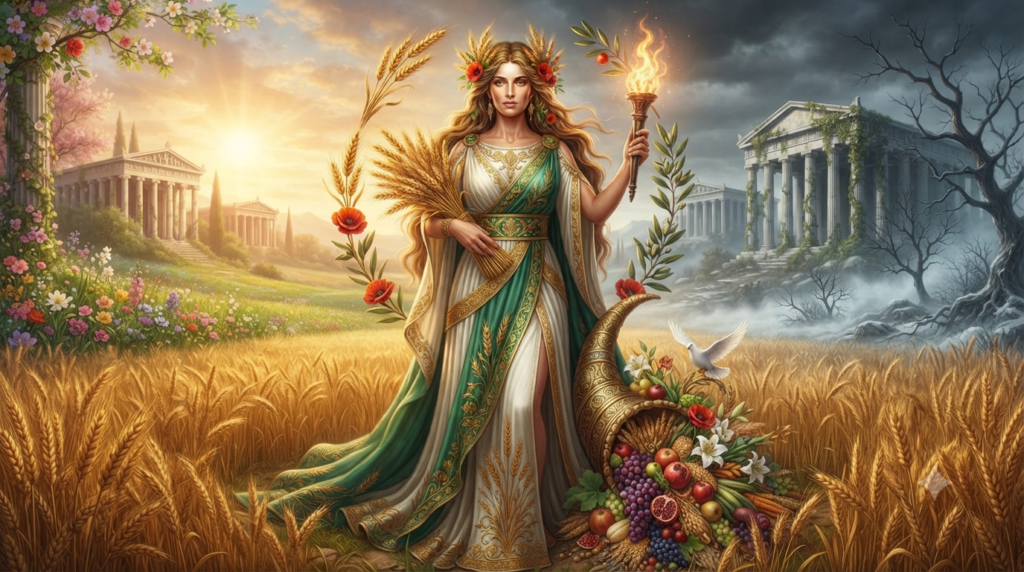
Demeter was depicted with several symbols that reflected her connection to the harvest and the earth:
- Wheat-ears: The most common symbol, representing her domain over grain .
- Cornucopia (Horn of Plenty): Symbol of abundance and the bounty of the harvest .
- Torch: Represented her search for Persephone and her role in the mysteries .
- Poppy: The opium poppy was sacred to her, possibly representing the sleep of death or the cycle of renewal .
- Radiate Crown: She was often depicted wearing a crown .
Sacred Animals and Plants
Demeter had several sacred animals and plants :
- Sacred Animals: Pig (the symbol of fertility), serpent, spotted lizard, and turtle-dove.
- Sacred Plants: Wheat, barley, mint, and the poppy.
Worship and Festivals
Demeter was widely worshipped throughout the Greek world, with significant cult centers in Attica, Sicily, Crete, Delos, Argolis, and the western coast of Asia Minor . Her temples were known as Megara .
The Eleusinian Mysteries
The most famous and significant of Demeter’s festivals were the Eleusinian Mysteries, celebrated in the sanctuary at Eleusis, near Athens . This secret religious tradition was based on ancient agrarian cults and predated the Olympian pantheon, probably having its roots in the Mycenaean period c. 1400–1200 BC .
The mysteries, which were celebrated annually in September–October, promised initiates a blessed afterlife . The rites were kept secret, but they involved purification rituals, fasting, and a dramatic reenactment of the Demeter-Persephone myth. Initiates descended into a dark area (symbolizing the underworld) and emerged into bright light, where they were shown sacred objects symbolizing fertility . The Eleusinian Mysteries were so important that a two-month truce was declared for travel to the celebration .
The Thesmophoria
The Thesmophoria was another major festival in honor of Demeter, celebrated exclusively by women . It was a fertility festival held in October–November, which involved sacrifice, fasting, and rituals of purification. The name Thesmophoros means “giver of customs” or “legislator,” reflecting Demeter’s role as a goddess of sacred law .
Other Festivals
Other festivals included the Haloa (a winter fertility festival), the Chloēa (a spring festival celebrating the first shoots), and the Megalartia . Sacrifices offered to her included pigs (the symbol of fertility), bulls, cows, and honey-cakes .
Roman Equivalent
The Romans identified Demeter with their own goddess of agriculture, Ceres, from whom the English word “cereal” is derived .
Legacy
Demeter’s legacy is profound. As the goddess of agriculture, she was central to the survival of the ancient Greek world, and her myth with Persephone provided a powerful explanation for the seasons and the cycle of life, death, and rebirth. The Eleusinian Mysteries, which offered hope for a blessed afterlife, had a significant influence on religious thought in the Greek world and beyond . Her story continues to resonate as a timeless allegory of maternal love, loss, and renewal.
Frequently Asked Questions About Who is the Greek goddess of the harvest (Demeter)?
Who were the parents of Demeter?
Demeter was the daughter of the Titans Cronus and Rhea. She was the sister of Hestia, Hera, Hades, Poseidon, and Zeus .
What is the story of Demeter and Persephone?
Demeter’s daughter Persephone was abducted by Hades, the god of the underworld. Demeter searched for her and caused a famine. A compromise was reached: Persephone would spend part of the year in the underworld and the rest with her mother, explaining the seasons .
What is the Roman equivalent of Demeter?
The Roman equivalent of Demeter is Ceres, from whom the English word “cereal” is derived .
What were the Eleusinian Mysteries?
The Eleusinian Mysteries were secret religious rites celebrated in honor of Demeter and Persephone at Eleusis, near Athens. They promised initiates a blessed afterlife and were among the most important religious festivals in Greece .
What symbols are associated with Demeter?
Her symbols include wheat-ears, the cornucopia (horn of plenty), torches, poppies, and a radiate crown .
Conclusion
Demeter, the Greek goddess of the harvest, is a figure of profound importance. The answer to the question of who is the Greek goddess of the harvest (Demeter)? reveals a deity who was not only responsible for the fertility of the earth and the crops that sustained humanity but who also embodied the cycle of life and death itself. Her story of maternal grief and the abduction of her daughter Persephone explained the seasons, the death of the earth in winter, and its rebirth in spring. Her cult, particularly the Eleusinian Mysteries, offered the hope of a blessed afterlife to thousands of initiates. As the Roman Ceres, her legacy continues in the word “cereal.” Demeter remains an enduring symbol of nature’s bounty, the strength of a mother’s love, and the cyclical nature of life.

Orin Vale has spent the better part of two decades tracing the threads that connect the world’s oldest stories — from the halls of Asgard to the banks of the Nile, from Olympus to the jungles of the Maya. What began as a childhood fascination with flood myths and trickster gods grew into years of independent study across comparative mythology and ancient religion, always chasing the same question: what did these stories mean to the people who first told them? Orin writes for readers who want more than trivia — the ones looking for the beliefs, fears, and truths that myths were built to carry.