The question of who is Helios, the Greek god of the sun? leads us to one of the most ancient and awe-inspiring figures in the Greek pantheon, a deity whose daily journey across the sky was the very rhythm of life itself. Helios (Ἥλιος), the personification of the sun, was a Titan god who drove his golden chariot from east to west each day, bringing light, warmth, and the gift of sight to gods and mortals alike . As the son of the Titans Hyperion and Theia, and brother of Selene (the Moon) and Eos (the Dawn), he was part of a celestial family that governed the cycles of day and night . While often overshadowed by the more prominent Olympian Apollo, Helios was a figure of immense power and significance, an all-seeing witness who was invoked in sacred oaths and whose wrath could bring devastation. This article will serve as a definitive guide to Helios, exploring his origins, his daily journey, his family, his myths, his worship, and his enduring legacy in art and culture.
Origins and Genealogy
Helios was a second-generation Titan, born to the Titans Hyperion and Theia . In the Homeric Hymn to Helios, his mother is named Euryphaessa, while other sources give his parents as Hyperion and Aethra . His sisters were Selene, the goddess of the moon, and Eos, the goddess of the dawn . Together, these three siblings personified the celestial cycles that governed the ancient Greek understanding of time.
In some traditions, Helios was sometimes simply called “Hyperion” or “Titan,” using his father’s name as an epithet . His name itself is the ancient Greek word for “sun,” which is derived from the Proto-Indo-European root *seh₂u-el, making him a deity of impeccable Indo-European lineage .
Consorts and Offspring
Helios had numerous consorts and a vast progeny . Some of his most notable children include:
- With Perse (or Perseis), an Oceanid: He fathered Circe, the famous enchantress; Aeëtes, the king of Colchis and keeper of the Golden Fleece; and Pasiphaë, the queen of Crete who gave birth to the Minotaur .
- With Clymene, another Oceanid: He fathered Phaethon, whose tragic attempt to drive his father’s chariot is one of the most famous myths in Greek mythology .
- With Rhode, a nymph: He fathered the Heliadae, the seven sons who became the first kings of the island of Rhodes .
- With Neaera: He fathered Lampetia and Phaethusa, the nymphs who tended his sacred flocks of cattle .
- With Aegle: He was sometimes said to have fathered the Charites (the Graces), goddesses of charm and beauty .
The Daily Journey of the Sun
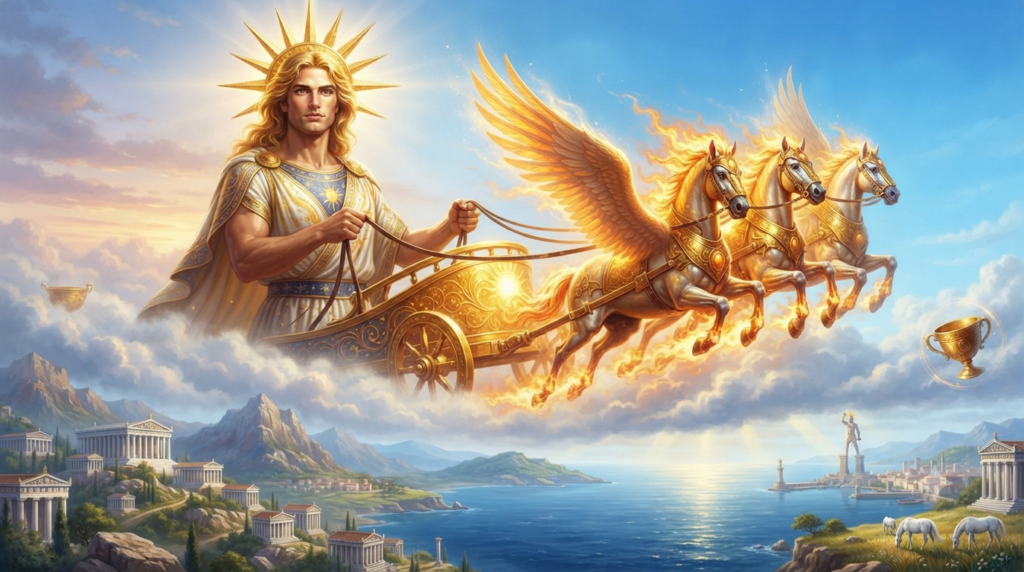
Helios’s most defining function was his daily journey across the heavens . Each morning, he emerged from a golden palace located in the east, at the edge of the River Oceanus, the great world-encircling stream . He was crowned with a radiant aureole, wearing purple robes, and drove a golden chariot drawn by four winged horses: Pyrois (“The Fiery One”), Aeos (“He of the Dawn”), Aethon (“Blazing”), and Phlegon (“Burning”) .
He would drive his chariot across the sky, bringing light to the world, until he reached the west, where the land of the Hesperides lay . There, he would descend into a golden cup or bowl, also known as a kylix or drepane, which would carry him through the northern streams of Oceanus back to his palace in the east, where he would rest during the night . In some accounts, he made this nightly voyage while slumbering in a golden bed . The extreme northern and southern points of his journey were known as the tropai hêlioio, the “turning points of the sun” .
The Myths of Helios
Helios was a figure who appeared in several of the most famous myths of Greek literature and art.
The Fall of Phaethon
The most famous myth involving Helios is the story of his son Phaethon . When Phaethon discovered his divine parentage, he traveled to his father’s palace in the east and asked for a gift. Helios, bound by his oath to grant his son any wish, reluctantly agreed when Phaethon asked to drive the sun-chariot for a day . Despite his father’s warnings, Phaethon was unable to control the fiery horses. He lost control of the chariot, driving it too close to the earth, scorching the land and creating the deserts of Africa. To prevent the destruction of the world, Zeus struck Phaethon down with a thunderbolt .
The Sacred Cattle of Thrinacia
In Homer’s Odyssey, Helios’s most prominent role is as the guardian of sacred cattle on the island of Thrinacia . These flocks, consisting of 350 cattle and 350 sheep, were tended by his daughters, Lampetia and Phaethusa . Odysseus and his crew landed on the island, and despite Odysseus’s warnings, his starving men killed and ate some of the cattle when he was asleep . When Helios discovered this act of sacrilege, he begged Zeus to punish the offenders. Zeus responded by striking their ship with a thunderbolt, killing all the men except for Odysseus, who was the only one who had not partaken of the sacred cattle .
Helios Panoptes: The All-Seeing God
Due to his position in the sky, Helios was able to observe everything that happened on the earth below . He was known as Panoptes, “the all-seeing,” and was invoked as a witness to sacred oaths and treaties . Several myths illustrate his role as a divine observer:
- The Punishment of Aphrodite and Ares: In the Odyssey, Helios famously spied on the adulterous affair between Aphrodite and Ares and reported their secret tryst to Aphrodite’s husband, Hephaestus, who then trapped them in a net .
- The Abduction of Persephone: Helios was the only god to witness Hades abducting Persephone, and he revealed the truth to Demeter .
- The Wrath of Heracles: When Heracles was crossing the Libyan desert, he became so frustrated with the sun’s heat that he drew his bow and shot an arrow at the god. Rather than punishing Heracles for his audacity, Helios was amused and rewarded the hero’s boldness by gifting him a golden cup (or bowl) that he used to cross the sea .
The Founding of Rhodes
Helios was the patron god of the island of Rhodes, a role that was central to its mythology and identity . According to Pindar’s Seventh Olympian Ode, when the gods were dividing the earth among themselves, Helios was absent, and he was not given a portion of land. He complained to Zeus, who promised him that the land that would rise from the sea would be his. Rhodes then emerged from the waters, and Helios became its lord . He was said to have married the nymph Rhodos, and their seven sons, the Heliadae, became the founders of the island’s principal cities .
Worship and Cult
Despite his role as the personification of the sun, Helios was a relatively minor figure in classical Greek religion compared to the Olympian gods . His worship was not widespread, and he lacked a pan-Hellenic cult . However, he was honored in several specific locations.
Rhodes: The Cult Center
Rhodes was the most important center of Helios’s worship . He was considered the chief god of the island . Panhellenic games, the Halieia, were held in his honor every five years . The island was also home to the Colossus of Rhodes, a gigantic statue of the god that was considered one of the Seven Wonders of the Ancient World . Built between 304 and 280 BCE, the statue stood approximately 33 meters high at the entrance to the harbor . It was toppled by an earthquake in 228 or 226 BCE .
Other Cult Sites
Helios was also worshipped in several other places in Greece, including:
- Corinth and the Corinthia: He had a significant cult in this region .
- Elis: A temple was dedicated to him there .
- Argos, Troezen, Hermione, and Megalopolis: He was worshipped in these cities of the Peloponnese .
- Apollonia: He had a temple there .
Practices and Sacrifices
The sacrifices offered to Helios typically consisted of white animals, particularly white horses, white rams, boars, bulls, and goats . Honey was also a common offering . The cock was considered sacred to him . In Rhodes, the annual sacrifice of a chariot and four horses (a quadriga) was thrown into the sea as an offering to the god .
Helios and Apollo: The Problem of Syncretism
One of the most persistent questions in the study of Greek mythology is the relationship between Helios and Apollo . In Homer’s epics, they are clearly distinct figures: Helios is the sun god, while Apollo is an archer god of prophecy and plague . However, from the 5th century BCE onwards, the two began to be increasingly identified with one another . This syncretism was largely driven by Greek philosophers, who interpreted Apollo as a solar deity .
By the Hellenistic period, Apollo was often referred to as “Phoebus Apollo,” with “Phoebus” meaning “shining” . However, despite this identification, the Greeks never made Apollo the driver of the sun-chariot . That role always remained Helios’s domain. The identification became more complete in Roman literature, where the Latin poets would often use “Phoebus” to refer to the sun-god .
Depictions in Art
Helios was a popular subject in ancient Greek and Roman art, and his iconography was remarkably consistent.
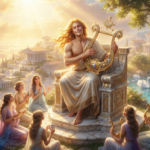
- General Appearance: He was usually depicted as a handsome, beardless youth with wavy hair . He often wore a chiton (a tunic) and his head was crowned with the shining aureole of the sun, which traditionally had twelve rays to symbolize the months of the year .
- The Chariot: He was most frequently shown driving his quadriga (a four-horse chariot) across the sky . The horses were often winged . In some scenes, dragons pulled the chariot instead of horses .
- Famous Artistic Works: Helios appeared in several significant works of art:
- The East Pediment of the Parthenon: He was depicted rising from the ocean in his chariot at the extreme left of the composition .
- Vase Painting: He often appears in the background of scenes on Greek pottery, particularly those involving the myth of Heracles . One notable example is a red-figure kalyx-krater (c. 420 BCE) in the British Museum, which shows him descending into the ocean .
- The Colossus of Rhodes: This was, by far, his most famous representation, though no images of it survive .
The Roman Equivalent: Sol
The Romans identified Helios with their own sun god, Sol . Sol was originally a Sabine god, but his cult was incorporated into Roman religion . The worship of Sol (and Luna, the Moon) was established in Rome with a temple in the Circus Maximus as early as the 3rd century BCE .
The cult of Sol, and particularly Sol Invictus (“the Unconquered Sun”), grew increasingly important in the later Roman Empire. Emperor Elagabalus and Aurelian promoted the worship of Sol, with Aurelian making the sun god one of the most important deities in the Roman state . The Emperor Julian, who attempted to revive traditional Roman religion, made Helios the central divinity of his pagan revival in the 4th century AD .
Frequently Asked Questions About Who is Helios, the Greek god of the sun?
Who were the parents of Helios?
Helios was the son of the Titans Hyperion and Theia. In some sources, his mother is named Euryphaessa .
Who were the siblings of Helios?
His sisters were Selene, the goddess of the moon, and Eos, the goddess of the dawn .
What did Helios look like?
Helios was depicted as a handsome, beardless youth with wavy hair, crowned with the shining aureole of the sun, which had twelve rays. He wore a purple chiton and drove a golden chariot .
What is the difference between Helios and Apollo?
Helios and Apollo were originally distinct gods. Helios was the Titan personification of the sun, while Apollo was an Olympian god of archery, prophecy, and music . However, from the 5th century BCE onwards, the two were increasingly identified, with Apollo becoming associated with the sun . Despite this, Apollo was never depicted driving the sun-chariot .
What is the story of Phaethon?
Phaethon was the mortal son of Helios and Clymene. He asked his father to allow him to drive the sun-chariot for a day, which Helios reluctantly agreed to do. However, Phaethon lost control of the horses, nearly setting the earth on fire. Zeus was forced to strike him down with a thunderbolt to prevent the destruction of the world .
Why was Helios important in the Odyssey?
In Homer’s Odyssey, Odysseus’s men landed on Thrinacia, an island sacred to Helios, and despite warnings, they killed and ate some of his sacred cattle. Helios demanded vengeance, and Zeus destroyed their ship, drowning all the crew except Odysseus .
What was the Colossus of Rhodes?
The Colossus of Rhodes was a gigantic statue of Helios that stood at the entrance to the harbor of the city of Rhodes. Built between 304 and 280 BCE, it was one of the Seven Wonders of the Ancient World. It was destroyed by an earthquake in the 3rd century BCE .
What is the Roman equivalent of Helios?
The Roman equivalent of Helios is Sol. He was also identified with the solar cult of Sol Invictus [“The Unconquered Sun”] .
Conclusion
Helios, the Greek god of the sun, was a figure of immense power and profound importance, whose daily journey across the sky was the foundation of life itself. He was the son of Hyperion and Theia, the brother of Selene and Eos, and the father of a vast divine and mortal progeny . The question of who is Helios, the Greek god of the sun? reveals a deity who was both a majestic and impersonal cosmic force and a personal figure involved in the tragedies and triumphs of gods and heroes. From the tragic fall of his son Phaethon to the wrath he unleashed upon the foolish crew of Odysseus, Helios’s presence was felt throughout Greek myth . He was an all-seeing witness, a guardian of oaths, and the patron god of Rhodes, honored with the magnificent Colossus . Though his worship was not as widespread as that of the Olympians, his role as the sun itself ensured his place at the heart of ancient Greek belief, a legacy that continues to shine in the art, literature, and language of the modern world.

Orin Vale has spent the better part of two decades tracing the threads that connect the world’s oldest stories — from the halls of Asgard to the banks of the Nile, from Olympus to the jungles of the Maya. What began as a childhood fascination with flood myths and trickster gods grew into years of independent study across comparative mythology and ancient religion, always chasing the same question: what did these stories mean to the people who first told them? Orin writes for readers who want more than trivia — the ones looking for the beliefs, fears, and truths that myths were built to carry.