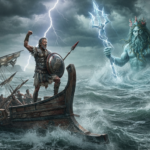
Anyone searching for how many men did Poseidon kill in the Odyssey is likely expecting a specific number, but Homer’s poem never provides a body count attributed directly to the sea god. The Odyssey does not track deaths by which deity caused them, and Poseidon’s role throughout the epic is defined far more by prolonged pursuit and suffering than by a tally of kills. Understanding this distinction is essential before looking at what the text actually says.
What the Odyssey does provide is a single, explicit and unambiguous killing carried out by Poseidon within the poem itself, recounted not as part of Odysseus’s own journey, but as a story told by King Menelaus during a separate episode in Book Four. This one confirmed death stands apart from the many losses Odysseus’s crew suffers throughout the epic, most of which trace back to entirely different causes unrelated to Poseidon’s wrath.
Separating this one documented killing from the broader pattern of hardship Poseidon inflicts on Odysseus reveals a more accurate picture of the god’s actual role in the story. Rather than functioning as a direct killer of Odysseus’s men, Poseidon operates as a persistent, obstructive force, delaying and endangering the hero without directly causing the deaths that occur along the way.
What follows examines the one man Poseidon explicitly kills in the Odyssey, the broader context of the Greek fleet’s disastrous return from Troy, and the real causes behind the deaths of Odysseus’s own crew, building a complete and accurate answer to how many men did Poseidon kill in the Odyssey according to Homer’s actual text.
There Is No Official Body Count in the Text
Homer’s Odyssey does not organize its narrative around tracking which god causes which death, making any search for a specific number tied to Poseidon fundamentally at odds with how the poem actually functions. Deaths throughout the epic result from a wide range of causes, including monsters, hostile mortals, divine punishment from multiple gods, and the consequences of Odysseus’s crew disobeying direct warnings.
This structural reality means that how many men did Poseidon kill in the Odyssey cannot be answered with a running total, since the text simply was not composed with that kind of accounting in mind. Ancient epic poetry generally favored individual, narratively significant deaths over comprehensive casualty counts, focusing audience attention on specific, memorable episodes rather than aggregate statistics.
Most losses among Odysseus’s crew occur in episodes where Poseidon plays no direct role whatsoever, further complicating any attempt to attribute a specific death count to him personally. The confusion behind this search likely stems from Poseidon’s well-established reputation as Odysseus’s primary divine antagonist, leading some readers to assume he must be responsible for crew deaths that the text actually attributes to entirely different sources.
Recognizing this absence of a formal count reframes the entire question productively, shifting the search for how many men did Poseidon kill in the Odyssey away from an impossible statistic and toward the one specific, textually confirmed killing the god does carry out within the poem.
Ajax the Lesser: Poseidon’s One Explicit Killing in the Odyssey
The only death in the Odyssey explicitly and directly attributed to Poseidon involves Ajax the Lesser, a Greek warrior from the Trojan War whose fate is recounted by Menelaus during his conversation with Telemachus in Book Four. According to this account, Ajax survives a shipwreck during the fleet’s chaotic return from Troy, clinging to a rock after being saved, remarkably, through divine intervention despite the god’s general hostility toward the fleet at that time.
Rather than expressing gratitude for this survival, Ajax boasts arrogantly that he escaped the sea despite the will of the gods, a claim that directly insults Poseidon’s authority over the very element that had nearly killed him. This act of hubris proves fatal, since such open defiance of divine power rarely goes unpunished within the moral framework of Greek epic poetry.
In response to this boast, Poseidon strikes the rock Ajax is clinging to with his trident, splitting it apart and casting the warrior into the sea, where he drowns as a direct result of the god’s deliberate action. This episode represents the clearest, most unambiguous example within the entire Odyssey of Poseidon personally and intentionally killing a specific individual.
This single, well-documented episode provides the actual answer to how many men did Poseidon kill in the Odyssey among named individuals: one, Ajax the Lesser, killed not as part of a broader pattern of violence against Odysseus’s crew, but as direct punishment for arrogance displayed toward the god himself.
The Storm That Scattered the Greek Fleet
The death of Ajax occurs within a much larger episode involving the disastrous return of the Greek fleet from Troy, an event Homer references without providing extensive detail, since the Odyssey focuses primarily on Odysseus’s own journey rather than the broader Nostoi, or homecoming stories, of other Greek heroes. Poseidon’s role in scattering this fleet with violent storms places him at the center of widespread chaos and loss during this period.
Menelaus’s account makes clear that the returning Greek ships faced severe difficulty at sea, with Poseidon’s control over ocean conditions creating dangerous circumstances for the entire fleet rather than targeting any single ship or individual specifically. This broader context suggests that additional, unnamed losses likely occurred during this chaotic return, even though Homer does not enumerate them individually.
Because the poem never assigns specific numbers to these broader losses, any comprehensive answer to how many men did Poseidon kill in the Odyssey during this fleet-wide storm remains necessarily incomplete regarding unnamed casualties, even as Ajax’s death stands out as the one figure receiving explicit, individual attention within this larger disaster.
This distinction between named and unnamed casualties reinforces why the question resists a precise numerical answer, since Homer’s narrative choices prioritize the moral lesson embedded in Ajax’s specific death over any broader accounting of every life lost during Poseidon’s storm.
Did Poseidon Kill Any of Odysseus’s Own Crew?
A particularly important clarification when addressing how many men did Poseidon kill in the Odyssey involves Odysseus’s own crew specifically, since no textual evidence supports Poseidon directly killing any of the men who sailed under Odysseus throughout his ten-year journey home. The crew’s actual deaths trace back to entirely different sources scattered across various episodes of the epic.
The Ciconians kill several of Odysseus’s men during an ill-advised raid early in the journey, while the Laestrygonians, a tribe of giant cannibals, destroy most of his remaining ships and crew in a devastating attack shortly afterward. Later, the monster Scylla claims six more men as Odysseus sails past her cave, and the surviving crew ultimately perishes entirely after defying Odysseus’s explicit warning not to eat the Cattle of the Sun, resulting in Zeus himself destroying their final ship with a thunderbolt.
By the time Poseidon’s most dangerous direct assault on Odysseus occurs, the storm depicted in Book Five, Odysseus has already lost his entire crew and travels completely alone, having departed from Calypso’s island on a solitary raft. This timing makes it structurally impossible for Poseidon to have killed any of Odysseus’s crew members during this particular episode, since none remained alive to be endangered.
This examination confirms clearly that when considering how many men did Poseidon kill in the Odyssey specifically among Odysseus’s own crew, the answer is none, with every crew death attributable instead to other monsters, hostile mortals, or divine punishment from Zeus rather than direct action by Poseidon himself.
Why Poseidon’s Wrath Focuses on Suffering, Not a Kill Count
Poseidon’s overall role throughout the Odyssey reveals a consistent pattern that explains why his mythology centers on prolonged suffering rather than an accumulation of kills. Bound by fate’s guarantee that Odysseus will eventually reach Ithaca, Poseidon cannot simply kill his target outright, redirecting his fury instead toward delay, hardship, and the destruction of resources like ships and, indirectly, crew members through the dangerous circumstances his anger creates.
This structural limitation on Poseidon’s power shapes the entire nature of his conflict with Odysseus, distinguishing his approach from a more straightforward pattern of direct violence. Rather than killing Odysseus’s men himself, Poseidon’s storms and general hostility create conditions that expose the crew to other, more immediate dangers throughout their journey, even without the god directly causing their deaths.
This pattern connects directly to Poseidon’s broader characterization elsewhere in his mythology, where his power consistently operates within boundaries set by fate, prolonging suffering rather than achieving outright destruction whenever a target’s ultimate survival has already been determined by higher forces within the Greek cosmological order.
Understanding this pattern completes the answer to how many men did Poseidon kill in the Odyssey, confirming that his true significance within the poem lies not in a body count, but in his role as a persistent obstacle whose fury shapes the entire structure of Odysseus’s difficult and prolonged journey home.
Frequently Asked Questions
Did Poseidon kill Odysseus’s men?
No, there is no textual evidence of Poseidon directly killing any of Odysseus’s crew; their deaths result from the Ciconians, the Laestrygonians, Scylla, and Zeus’s punishment after they ate the Cattle of the Sun.
Who did Poseidon kill in the Odyssey?
Poseidon explicitly kills Ajax the Lesser, a Greek warrior whose death is recounted by Menelaus in Book Four after Ajax boasted of surviving the sea against the gods’ will.
Why couldn’t Poseidon kill Odysseus?
Fate guaranteed that Odysseus would eventually return to Ithaca, a boundary even Poseidon could not override, limiting him to prolonging Odysseus’s suffering instead.
Conclusion
The real answer to how many men did Poseidon kill in the Odyssey is not a number but a specific, deliberate act: the drowning of Ajax the Lesser in punishment for his arrogance, recounted in Book Four rather than within Odysseus’s own journey. Every death among Odysseus’s own crew traces back to other sources entirely, confirming that Poseidon’s true role in the epic is defined by relentless obstruction and prolonged suffering rather than any direct pattern of killing.

Orin Vale has spent the better part of two decades tracing the threads that connect the world’s oldest stories — from the halls of Asgard to the banks of the Nile, from Olympus to the jungles of the Maya. What began as a childhood fascination with flood myths and trickster gods grew into years of independent study across comparative mythology and ancient religion, always chasing the same question: what did these stories mean to the people who first told them? Orin writes for readers who want more than trivia — the ones looking for the beliefs, fears, and truths that myths were built to carry.