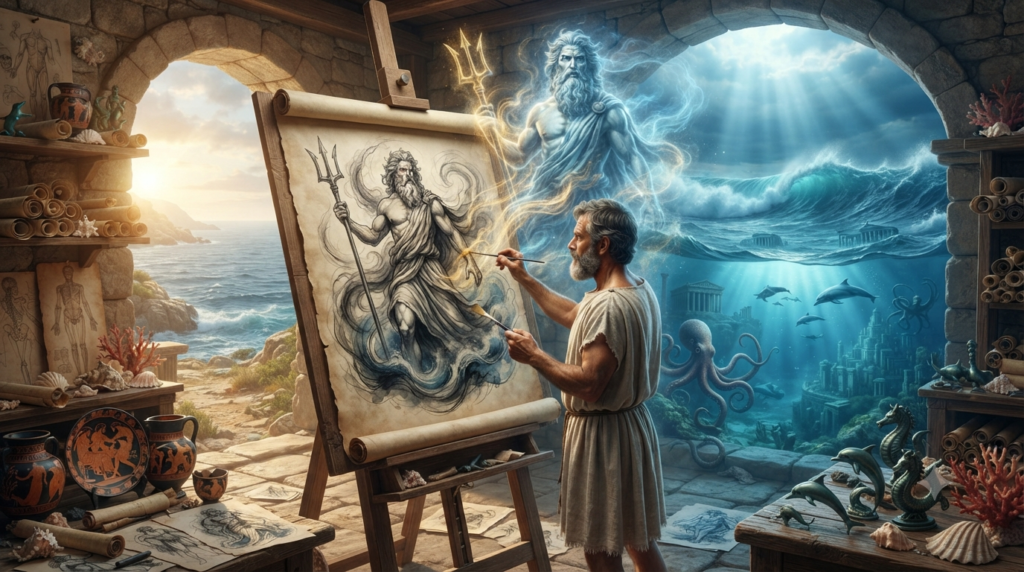
Anyone searching how to draw Poseidon benefits far more from understanding the specific attributes and iconography that define him than from generic drawing technique alone, since accurately capturing this particular god depends heavily on his distinctive symbols and visual conventions. This guide approaches how to draw Poseidon as a reference resource, focused on the consistent visual attributes established throughout ancient Greek art and mythology. Understanding how to draw Poseidon in a way that feels authentic starts with recognizing the specific objects, creatures, and stylistic conventions that consistently distinguish him from other major Greek gods.
Poseidon’s Core Attributes — What Makes Him Recognizable
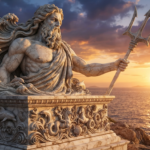
Poseidon’s trident stands as his single most defining attribute, immediately distinguishing him from his brothers through weapon design specifically, providing the essential starting point for anyone exploring how to draw Poseidon with genuine mythological accuracy and recognizability.
Poseidon’s mythological connection to horses, having been credited in various accounts with their creation, adds another significant attribute relevant to how to draw Poseidon, frequently reflected through his association with the hippocamp, a hybrid creature combining the front of a horse with the tail of a fish.
Dolphins serve as an additional sacred animal connected to Poseidon, offering another meaningful visual element relevant to how to draw Poseidon that reinforces his authority over the sea and its creatures throughout ancient Greek artistic and mythological tradition.
These three elements, the trident, the hippocamp, and dolphins, together establish the essential visual vocabulary for how to draw Poseidon recognizably, ensuring any artistic representation remains clearly connected to his specific identity within the broader Greek pantheon.
Physical Presentation in Classical Art
Poseidon is typically depicted as a mature, bearded figure, consistent with the broader artistic convention applied to older, established Greek gods, providing an important baseline consideration for anyone exploring how to draw Poseidon within historically accurate stylistic parameters.
Water-based elements play a particularly significant role relevant to how to draw Poseidon, with sea foam, waves, and blue-green color tones frequently incorporated into his depictions, visually reinforcing his connection to the ocean rather than the sky or underworld realms governed by his brothers.
Poseidon is frequently depicted either standing while wielding his trident or riding within a sea chariot pulled by hippocamps, providing two distinct compositional approaches relevant to how to draw Poseidon depending on whether the artist wishes to emphasize his authority or his active presence within a maritime scene.
Understanding these stylistic conventions, mature bearded appearance, aquatic color palette, and these two primary compositional postures, provides essential grounding for how to draw Poseidon in a manner consistent with established Greek artistic tradition surrounding this particular god.
Common Compositions Featuring Poseidon
Depicting Poseidon emerging dramatically from the sea represents one of the most common compositional approaches relevant to how to draw Poseidon, emphasizing his fundamental connection to the ocean and his sudden, commanding presence within maritime settings.
Poseidon riding within a sea chariot, typically pulled by hippocamps, offers another significant compositional option relevant to how to draw Poseidon, providing dynamic movement and reinforcing his authority as ruler of the sea through this distinctive mode of transportation.
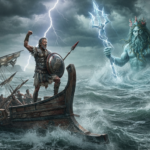
Depicting Poseidon amid storm and fury, reflecting his epithet as the “Earth-Shaker” connected to earthquakes, offers a particularly dramatic compositional option relevant to how to draw Poseidon that emphasizes his more volatile, temperamental characteristics documented throughout Greek mythology.
These three compositional approaches, emerging from the sea, riding his chariot, or embodying storm and fury, provide meaningful starting points for anyone exploring how to draw Poseidon within different narrative or symbolic contexts relevant to his broader mythology.
Where to Find Authentic Historical References
Ancient Greek pottery and sculpture provide extensive historical reference material showing exactly how ancient Greek artists themselves depicted Poseidon, offering invaluable primary source material for anyone seriously exploring how to draw Poseidon with historical accuracy in mind.
These historical sources demonstrate the consistent use of his key attributes, including the trident and his connection to horses and sea creatures, providing concrete visual precedent for anyone exploring how to draw Poseidon who wants their work to connect meaningfully with authentic ancient Greek artistic tradition.
Studying these genuine historical references allows artists to understand precisely how the culture that originated Poseidon’s mythology visually represented him, providing essential grounding for anyone exploring how to draw Poseidon who wants their work to reflect genuine, historically informed artistic choices.
This engagement with authentic historical source material ultimately provides far richer creative grounding than relying solely on modern reinterpretations, ensuring that anyone exploring how to draw Poseidon builds their work upon an accurate foundation rooted in genuine ancient Greek iconographic tradition.
FAQ — Quick Answers About Drawing Poseidon
What is Poseidon’s main symbol?
Poseidon’s trident serves as his primary symbol of authority, immediately distinguishing him from Zeus’s thunderbolt and Hades’s bident.
What creature is associated with Poseidon?
The hippocamp, a hybrid creature with a horse’s front and a fish’s tail, is closely associated with Poseidon, along with dolphins.
Why is Poseidon connected to horses?
According to Greek mythology, Poseidon was credited with creating horses, making them a significant symbol connected to his broader mythology.
What color palette suits Poseidon best?
Blue-green tones, along with sea foam and wave imagery, help visually reinforce Poseidon’s connection to the ocean.
Where can I find authentic references for Poseidon?
Ancient Greek pottery and sculpture provide authentic historical visual references for Poseidon’s established iconography.
Conclusion
Anyone exploring how to draw Poseidon benefits significantly from understanding his established iconography rather than relying on generic drawing technique alone. Knowing that his trident, connection to horses and hippocamps, and association with dolphins define his visual identity provides the essential foundation for creating recognizable, mythologically accurate artwork.
Understanding the stylistic conventions surrounding his depiction, from his mature bearded appearance to his aquatic color palette, further ensures that any artistic exploration remains grounded in authentic ancient Greek characterization.
Ultimately, mastering how to draw Poseidon means building genuine familiarity with his specific attributes and historical visual tradition first, ensuring that whatever personal artistic style an artist brings to their work remains clearly and meaningfully connected to his authentic mythological identity.

Orin Vale has spent the better part of two decades tracing the threads that connect the world’s oldest stories — from the halls of Asgard to the banks of the Nile, from Olympus to the jungles of the Maya. What began as a childhood fascination with flood myths and trickster gods grew into years of independent study across comparative mythology and ancient religion, always chasing the same question: what did these stories mean to the people who first told them? Orin writes for readers who want more than trivia — the ones looking for the beliefs, fears, and truths that myths were built to carry.