Anyone asking is Chinese mythology a religion encounters a question without a simple yes or no answer, largely because Chinese mythology does not exist as a single, unified religious system in the way many other mythological traditions do. Instead, Chinese mythology developed across centuries through a complex interweaving of folk religion, Taoism, Confucianism, and Buddhism, each contributing distinct mythological figures and narratives while maintaining its own philosophical or religious identity. Understanding is Chinese mythology a religion requires examining how these different traditions relate to one another and recognizing that Chinese mythology functions less as a single belief system and more as a shared cultural and narrative framework spanning multiple, sometimes overlapping religious and philosophical traditions.
What Makes Chinese Mythology Different From Greek or Norse Mythology
Chinese mythology differs significantly from more unified mythological systems such as Greek or Norse mythology, which each developed within a relatively defined religious framework centered on a specific pantheon and cosmology. Chinese mythology, by contrast, lacks a single authoritative source comparable to Hesiod’s Theogony or the Norse Eddas, instead emerging as a mosaic of narratives drawn from multiple distinct religious and philosophical traditions accumulated over an extraordinarily long historical period.
This structural difference matters significantly when addressing is Chinese mythology a religion, since the term “Chinese mythology” actually encompasses contributions from Chinese folk religion, Taoism, Confucianism, and Buddhism, each of which maintains its own distinct relationship to religious practice, philosophical inquiry, and cultural tradition within Chinese society.
Rather than representing the belief system of a single religious tradition, Chinese mythology functions more as a broad narrative category incorporating figures and stories that different communities and traditions have engaged with in varying ways throughout Chinese history. Figures such as Pangu, the primordial creator, and Nuwa, the mother goddess associated with human creation, appear within this broader mythological framework without belonging exclusively to any single one of these distinct religious or philosophical systems.
This mosaic structure explains why is Chinese mythology a religion resists a simple answer, requiring instead a more detailed examination of how mythology relates separately to folk religion, Taoism, Confucianism, and Buddhism, each of which engages with mythological material according to its own distinct religious or philosophical framework.
Chinese Folk Religion — Where Myth and Worship Meet
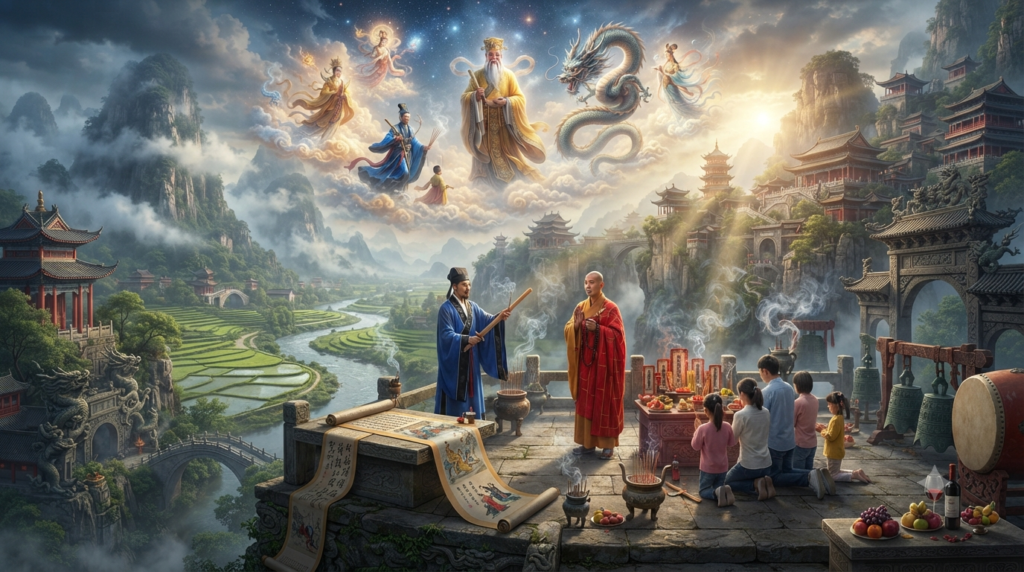
Chinese folk religion represents the tradition most directly connected to active religious worship involving mythological figures, encompassing ancestor veneration, local deity worship, and community temple practices that continue actively today throughout China and Chinese communities worldwide. This folk religious tradition provides the clearest example of genuine religious practice intersecting directly with Chinese mythological narrative.
Ancestor worship forms a central component of Chinese folk religion, reflecting deep cultural values regarding family continuity and respect for previous generations, while numerous local and regional deities receive ongoing worship at temples throughout China, many directly connected to mythological narratives explaining their origin and significance. This active worship distinguishes folk religion from more purely narrative or philosophical engagement with Chinese mythology.
The Jade Emperor stands among the most widely recognized deities within Chinese folk religious practice, understood as ruling over heaven within traditional Chinese religious cosmology and receiving continued veneration at temples dedicated to his worship. This ongoing religious practice involving mythological figures like the Jade Emperor provides some of the strongest evidence supporting a religious dimension when addressing is Chinese mythology a religion.
This folk religious layer represents the aspect of Chinese mythology most directly comparable to religious practice found within other mythological traditions, involving genuine worship, ritual observance, and community religious life organized around specific mythological figures and narratives that remain actively meaningful within contemporary Chinese religious practice.
Taoism — Philosophy, Religion, or Both
Taoism presents a particularly complex case when examining is Chinese mythology a religion, as the tradition exists in two related but distinct forms: philosophical Taoism, associated primarily with foundational texts by Laozi and Zhuangzi, and religious Taoism, a more institutionalized tradition incorporating deities, rituals, and organized religious practice developed over subsequent centuries.
Philosophical Taoism centers primarily on concepts such as balance, natural order, and the concept of the Tao itself, functioning more as a philosophical framework for understanding existence than as an organized religious system involving worship of specific deities. This philosophical dimension complicates any straightforward classification of Taoism as simply religious in the conventional sense.
Religious Taoism, however, developed a more structured religious tradition incorporating specific deities, ritual practice, and institutional religious organization, with numerous Taoist mythological figures becoming integrated into broader Chinese religious practice over time. This religious branch of Taoism illustrates how Chinese mythological figures could transition from philosophical concept toward active religious veneration within organized institutional contexts.
This dual nature of Taoism, spanning both philosophical inquiry and organized religious practice, reinforces why is Chinese mythology a religion cannot receive a simple answer, as Taoism itself demonstrates how the same broader tradition can function as either philosophy or religion depending on which specific branch and historical period is under consideration.
Confucianism — A Moral System With Mythological Roots
Confucianism occupies a distinct position within this broader discussion, generally understood primarily as an ethical and philosophical system focused on moral behavior, social harmony, and proper relationships rather than as a theological tradition centered on divine worship or cosmological belief in the conventional religious sense.
Despite this primarily philosophical orientation, Confucianism incorporates ritual practices and reverential traditions, including forms of ancestor veneration and structured ceremonial observance, that carry a distinctly religious character even within a system generally classified as ethical philosophy rather than organized religion. This ritual dimension complicates any simple classification of Confucianism as purely secular philosophy.
Confucius himself, along with various historical and legendary figures associated with Confucian tradition, occupies a position within Chinese cultural memory that sometimes approaches quasi-religious reverence, particularly through historical temple worship dedicated to Confucius that developed in various periods of Chinese history. This reverential practice further blurs any absolute distinction between philosophy and religion within the Confucian tradition specifically.
This combination of ethical philosophy and ritual reverence illustrates yet another dimension relevant to is Chinese mythology a religion, demonstrating that even traditions primarily classified as philosophical, such as Confucianism, can incorporate religious or quasi-religious elements that complicate any straightforward categorization within Chinese mythological and religious tradition.
Buddhism’s Role in Shaping Chinese Mythological Tradition
Buddhism arrived in China from India and gradually integrated with existing Chinese religious and mythological traditions, contributing significant figures and narratives that became incorporated into the broader landscape of Chinese mythology over subsequent centuries. This integration represents a clear example of religious tradition directly shaping and expanding Chinese mythological narrative.
Buddhist figures such as bodhisattvas became incorporated into popular Chinese religious practice, sometimes merging with or existing alongside pre-existing folk religious deities, creating a syncretic religious landscape in which Buddhist and indigenous Chinese mythological traditions frequently intersected and influenced one another significantly over time.
This process of religious syncretism, in which Buddhism blended with existing Chinese folk religion and philosophical traditions, further illustrates why is Chinese mythology a religion resists simple classification, as Buddhism itself represents an organized world religion that became deeply woven into the broader Chinese mythological and cultural framework rather than remaining entirely separate from it.
This Buddhist integration demonstrates that Chinese mythology, as a broader narrative category, actively incorporated material from a recognized world religion, further reinforcing the complex, multi-layered relationship between mythology and organized religious tradition found throughout Chinese cultural and religious history.
So, Is Chinese Mythology a Religion?
Based on this examination, Chinese mythology itself is not a single, unified religion in the way some other mythological traditions might be more directly classified, but rather a broad narrative framework deeply entangled with multiple distinct religious and philosophical traditions, including folk religion, Taoism, Confucianism, and Buddhism, each maintaining its own relationship to organized worship and belief.
This distinction matters significantly for understanding is Chinese mythology a religion accurately, as studying Chinese mythology academically differs meaningfully from actively practicing any of the specific religious traditions that contribute mythological material to this broader narrative framework, such as folk religious temple worship or institutional religious Taoism.
At the same time, significant portions of Chinese mythology remain directly connected to living religious practice today, particularly through Chinese folk religion and religious Taoism, both of which continue involving active worship of mythological figures within contemporary Chinese communities, distinguishing Chinese mythology from traditions that exist purely as historical or literary material without ongoing religious practice.
This nuanced conclusion reinforces that is Chinese mythology a religion depends significantly on which specific mythological figures, narratives, and traditions are under consideration, reflecting the genuinely complex, multi-layered relationship between myth, philosophy, and religion that has characterized Chinese cultural and religious history across many centuries of development.
FAQ — Quick Answers About Chinese Mythology and Religion
Is Chinese mythology a religion?
Chinese mythology is not a single unified religion, but a broad narrative tradition connected to multiple distinct religious and philosophical systems, including folk religion, Taoism, Confucianism, and Buddhism.
Is Taoism a religion or a philosophy?
Taoism exists in both forms: philosophical Taoism centers on concepts like balance and natural order, while religious Taoism involves organized worship, deities, and institutional religious practice.
Is Confucianism a religion?
Confucianism is generally classified as an ethical and philosophical system rather than a religion, though it incorporates ritual practices and reverential traditions with religious characteristics.
How did Buddhism influence Chinese mythology?
Buddhism introduced figures such as bodhisattvas into Chinese religious practice, blending with existing folk traditions and significantly expanding the broader Chinese mythological landscape.
Is Chinese folk religion still practiced today?
Yes, Chinese folk religion, including ancestor worship and temple veneration of deities like the Jade Emperor, remains actively practiced within many Chinese communities today.
Conclusion
Anyone who sets out to answer is Chinese mythology a religion finds a genuinely complex answer rather than a simple classification, reflecting the interwoven relationship between mythology, folk religion, Taoism, Confucianism, and Buddhism throughout Chinese history. Rather than existing as a single unified belief system, Chinese mythology functions as a broad narrative framework shaped by multiple distinct religious and philosophical traditions.
This complexity distinguishes Chinese mythology from more unified mythological systems, requiring a more nuanced understanding of how folk religion, philosophical and religious Taoism, Confucian ethics, and Buddhist influence each contribute distinct threads to the broader tapestry of Chinese mythological tradition, some deeply religious and others more philosophical in nature.
Ultimately, Chinese mythology remains meaningfully connected to living religious practice through traditions like folk religion and religious Taoism, while simultaneously encompassing philosophical and narrative material that extends beyond any single religious classification, confirming that its relationship to religion is genuinely as layered and multifaceted as Chinese cultural history itself.

Orin Vale has spent the better part of two decades tracing the threads that connect the world’s oldest stories — from the halls of Asgard to the banks of the Nile, from Olympus to the jungles of the Maya. What began as a childhood fascination with flood myths and trickster gods grew into years of independent study across comparative mythology and ancient religion, always chasing the same question: what did these stories mean to the people who first told them? Orin writes for readers who want more than trivia — the ones looking for the beliefs, fears, and truths that myths were built to carry.